Zcash, the privacy-oriented cryptocurrency that uses zero-knowledge proofs to enable optional shielded transactions, was trading between $1,173 on October 17, 2026, as per CoinGecko market data.
The token moved within a daily range of roughly $1,133 to $1,247, with 24-hour trading volume between $749 million and $803 million. Its market capitalization stood near $19.9 billion, ranking ZEC around 10th among cryptocurrencies, with a circulating supply of approximately 16.99 million coins out of a maximum of 21 million.
As of 11:45 AM UTC, data from CoinGecko placed the price at $1,172.84 reflecting a decline of approximately 5.7% over the preceding 24 hours.
The pullback followed a period of elevated volatility earlier in October. ZEC had climbed sharply in September, briefly approaching levels near $1,700 before giving back a substantial portion of those gains.
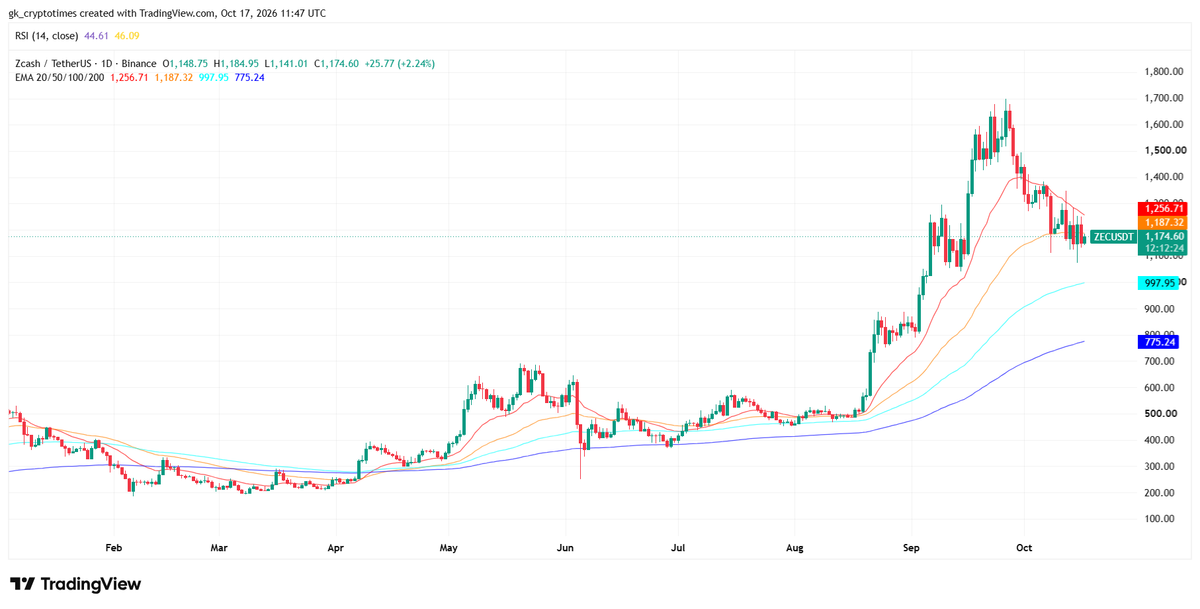
Over the past year, the asset remains up more than 500% according to data tracked by TradingView, underscoring the scale of the earlier advance even after the recent correction. Community sentiment indicators on major tracking platforms showed a modestly positive tilt, though short-term price action has been influenced by broader market conditions, leveraged positioning, and flows related to newly available institutional products.
Price Action and Immediate Market Context
The latest decline of roughly 5% over 24 hours aligns with reports of liquidations in derivatives markets and continued variability in exchange-traded product flows. Spot Zcash ETFs, including the Grayscale product that began trading on NYSE Arca in late August under the ticker ZCSH, have recorded both inflows and outflows in recent weeks.
One day of net inflows earlier in the month interrupted a stretch of redemptions, yet weekly figures have remained mixed. These products provide regulated brokerage-account exposure to ZEC without requiring direct custody of the asset. Their activity has coincided with periods of heightened trading volume, including stretches in which ZEC ranked among the higher-volume assets relative to certain layer-1 tokens on major platforms.
Mining-related developments have also drawn attention. Fortitude Mining Holdings, a Digital Currency Group-affiliated operator focused on Zcash, disclosed the sale of approximately 5,790 ZEC that it had borrowed under a dollar-denominated credit facility. The proceeds, roughly $8.3 million, supported expansion plans that include previously ordered Antminer Z15 Pro units and a non-binding letter of intent for priority access to next-generation equipment potentially totaling up to $100 million.
Because the loans are repayable in U.S. dollars rather than in ZEC, the structure allows the operator to liquidate borrowed coins without creating an obligation to repurchase the same quantity. Such activity can add incremental selling pressure on the spot market even as it funds additional hashrate.
Zcash’s fixed supply schedule, modeled on Bitcoin’s 21-million-coin cap and periodic halvings, continues to shape longer-term narratives. A growing share of the circulating supply has moved into shielded pools that obscure sender, recipient, and amount details while still allowing cryptographic verification of validity.
Network Upgrade Progress and Institutional Developments
Technical work on the next major upgrade, known as NU7, has advanced on the public testnet. The Zcash Foundation released Zebra software supporting the upgrade, which activated on testnet at a scheduled height in early October.
NU7 is designed to reduce target block spacing from 75 seconds to 25 seconds under the proposal documented in ZIP 218 and related specifications, lowering average first-confirmation times while introducing per-pool action limits to constrain validation and synchronization costs.
The upgrade also incorporates a Network Sustainability Mechanism that removes a portion of transaction fees from immediate circulation and recycles them into future block rewards without increasing the overall supply cap. Sprout, the original shielded pool, will become unspendable for remaining funds once the relevant transaction format is invalidated, encouraging migration ahead of activation.
Developers have not yet set a mainnet activation height. Community and foundation materials indicate that a review of testnet performance is expected around October 20, after which a final height—previously discussed in the vicinity of early November—could be assigned.
Node operators must run compatible software such as Zebra, as the older zcashd client will not support the consensus changes. The project’s official upgrade page at z.cash/upgrade/nu7 emphasizes that preparation centers on switching to the Rust-based Zebra implementation developed by the Zcash Foundation.
Institutional product activity has continued in parallel. Beyond the already-trading Grayscale ZCSH, which converted from an earlier trust structure and has undergone a share split, a separate S-1 registration was filed in early October for a proposed Winklevoss Zcash ETF that would hold ZEC with Gemini custody and list under the ticker WINK on Nasdaq, subject to regulatory and exchange approvals. The filing outlines cash creations and redemptions. Earlier in the year, Grayscale’s product gathered substantial assets in its initial weeks of trading, placing it among faster-growing ETFs by first-month inflows according to contemporaneous statements from the sponsor.
These vehicles sit alongside ongoing ecosystem work on post-quantum research and cross-chain liquidity, including a recently activated ZEC pool on THORChain where native trading remains pending while liquidity builds.
Also read: Lose Money to Win Money: Papertrade User Claims $1.73M in Rewards Against $979K in Loss