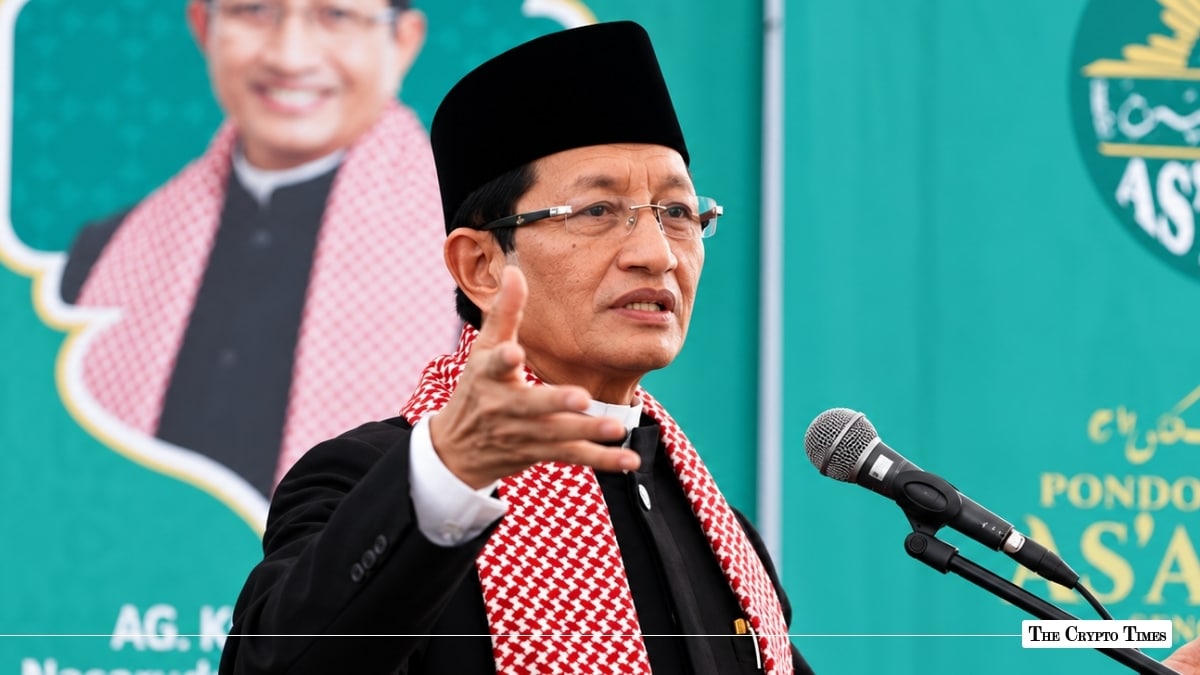
Indonesia’s Religious Affairs Minister Nasaruddin Umar has said the country’s Islamic-law determination that cryptocurrency is prohibited could be reconsidered under different conditions. Speaking to reporters on Thursday, October 15, Umar said the religious status of crypto could change over time. His remarks do not amount to a reversal of the existing ruling.
“Something might be haram today, but tomorrow, once everything is clear and there’s no problem left, it can become halal, and vice versa,” the minister said at the Directorate General of Taxes office in Jakarta during an event on taxation and the digital economy viewed through a sharia lens. Indonesian outlet Warta Ekonomi reported that Umar linked any reconsideration to reducing uncertainty in crypto transactions.
In Islamic terminology, haram means religiously forbidden and halal means permitted.
What the Minister Actually Said
Umar’s central point was about conditionality, not a reversal. The prohibition, he indicated, rests on specific problems that could in principle be resolved — chiefly gharar, the excessive uncertainty or speculation that Islamic jurisprudence treats as a defect in a contract, and dharar, or harm. If uncertainty can be addressed and trading conditions become clearer and more controlled, the religious assessment could be revisited. By the same logic, he noted that an asset considered permissible today could be ruled out later if new risks emerge.
Crucially, the minister was explicit that he was not issuing a ruling himself. “Halal and haram matters are for the ulama council to decide,” he said, referring to the Indonesian Ulema Council (Majelis Ulama Indonesia, or MUI). He described government and clerical oversight as running in parallel and said the two sides “are already working together well.” He also cautioned the public that crypto investment carries high risk.
The distinction is important: Umar was describing circumstances under which the religious assessment might change, not announcing that MUI had revised its ruling.
The 2021 Fatwa This Refers To
The ruling in question dates to November 2021, when MUI’s seventh Ijtima Ulama forum issued its determination on cryptocurrency.
According to MUI’s official announcement, cryptocurrency used as currency was declared haram because of gharar and dharar, among other considerations. The ruling also said cryptocurrency as a digital commodity or asset was not valid for trading if it contained elements of uncertainty, harm, or gambling and failed to meet sharia requirements for sil’ah — broadly, a tradable good with a clear underlying basis and genuine benefit.
However, the ruling left room for cryptocurrency to be traded as a commodity if it meets the applicable sharia requirements, has an underlying basis and provides clear benefits. That distinction between crypto used as money and crypto treated as a qualifying commodity has shaped Indonesia’s debate over digital assets.
The religious determination sits alongside a separate legal framework. Crypto trading is regulated in Indonesia, and the religious ruling is not itself a state prohibition on all crypto trading. MUI’s fatwa provides religious guidance; financial regulation is administered by state authorities.
The regulatory framework changed in January 2025, when responsibility for regulating and supervising digital financial assets, including crypto assets, transferred from the commodity-futures regulator Bappebti to the Financial Services Authority (OJK). The transfer is documented in OJK’s official announcement.
The Crypto Times has also covered Indonesia’s regulated crypto market, including BTSE’s entry into the country’s licensed crypto market this year.
A Push Toward Sharia-Compliant Crypto
Alongside the minister’s comments, a separate initiative is under way to explore crypto products that meet sharia requirements.
On October 15, Cholil Nafis, chairman of MUI’s National Sharia Council (DSN-MUI), said the council was studying Bitcoin and crypto-asset frameworks in collaboration with Indonesia’s Deposit Insurance Corporation (LPS). The study is intended to help develop sharia-compliant crypto instruments and could inform future OJK regulations. “The National Sharia Council is indeed studying bitcoin in collaboration with LPS,” Nafis said. He also said Indonesia does not yet have cryptocurrency products or Bitcoin products that comply with sharia principles.
The initiative is intended to address demand from investors who want to participate in digital-asset markets while following Islamic financial principles. Nafis also linked the work to earlier deliberations within Nahdlatul Ulama, one of Indonesia’s largest Islamic organisations.
Why It Matters
For Indonesia, where crypto trading has attracted millions of investors, the distinction between religious permissibility and state regulation can affect how observant Muslims approach digital assets and whether financial institutions explore sharia-compliant products.
The minister’s comments and the DSN-MUI study are separate developments. Umar has said the religious assessment could change if relevant concerns are addressed, while the council is studying whether crypto products can be structured to meet sharia requirements.
The caveats remain significant. The 2021 MUI ruling has not been shown to have changed, and no revised ruling or officially confirmed sharia-compliant Bitcoin product has been announced in the cited material. The authority to determine the religious position rests with MUI, not the religious affairs minister. Officials have also continued to warn about the risks of crypto investment.
For now, the developments point to further consideration of crypto under Islamic financial principles, rather than a formal change in Indonesia’s religious or regulatory treatment of digital assets.
Also Read: Taiwan Blocks Coinbase and Kalshi Websites Over Suspected Election Betting