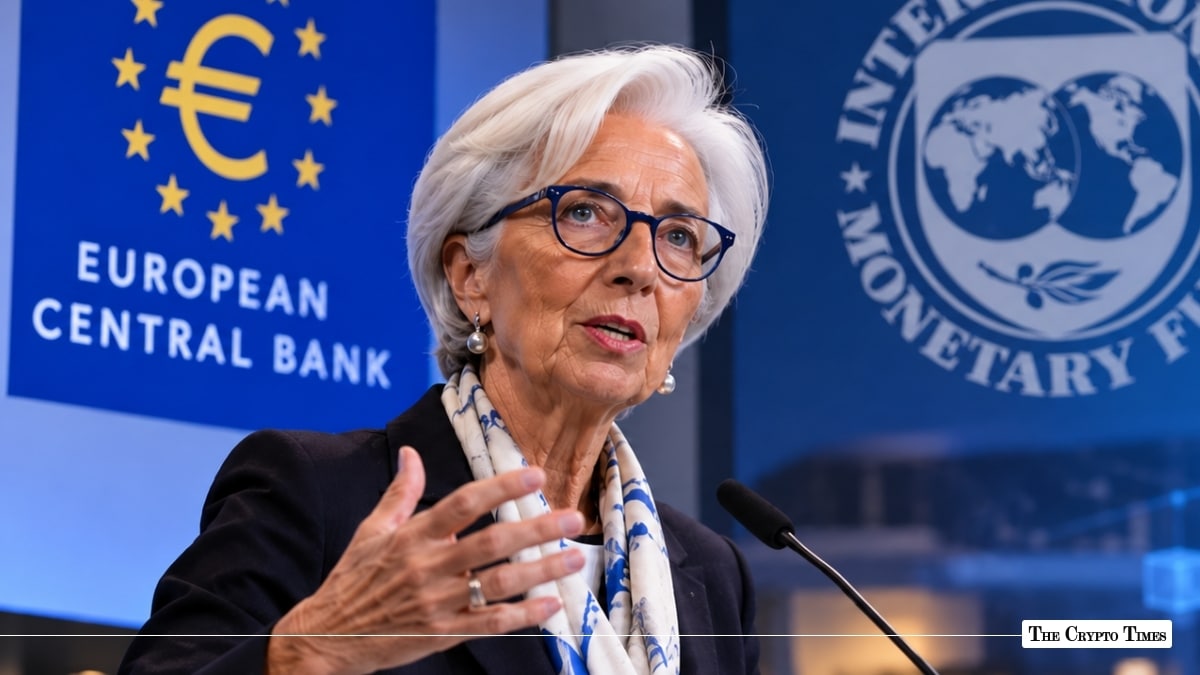
European Central Bank (ECB) President Christine Lagarde used her October 17 statement to the International Monetary and Financial Committee (IMFC) at the IMF’s Annual Meetings to outline two projects at the intersection of central banking and blockchain-based finance: the digital euro and the Eurosystem’s work to settle tokenized assets in central bank money.
The statement did not explicitly mention crypto assets, stablecoins, or Bitcoin. Instead, Lagarde focused on public-sector payment infrastructure, calling for progress on the digital euro’s legislative framework and highlighting Pontes, the Eurosystem’s distributed-ledger technology (DLT) settlement solution.
The Digital Euro, on a Clock
Lagarde reaffirmed that the ECB is “preparing to complement cash with its digital equivalent” — a central bank digital currency (CBDC), or electronic money issued by a central bank. Unlike commercial bank deposits or privately issued stablecoins, a digital euro would represent central bank money.
Her emphasis was on timing. “Adopting the Regulation on the establishment of the digital euro by the end of 2026 is key,” she said, adding that the Eurosystem plans to run a 12-month internal pilot in the second half of 2027. Both milestones appear in the ECB’s official statement.
That legislative deadline is not the ECB’s to set alone. On July 9, 2026, the European Parliament voted 416 to 169, with 22 abstentions, to advance its negotiating position on the digital euro. The vote cleared the way for negotiations with the Council of the European Union and the European Commission. The European Parliament’s announcement records the vote and the next stage of the legislative process.
These negotiations, commonly called trilogue talks, are intended to produce an agreed legal framework. Lagarde’s end-of-2026 target is therefore a call for the institutions to complete the legislative process, not confirmation that the law has already been adopted.
The 2027 pilot would also be an internal test rather than a public launch. The ECB has selected 36 payment service providers for the planned pilot. A decision to issue the digital euro would remain separate from these preparations and dependent on the legislative process.
Tokenization: Central Bank Money on a Blockchain Rail
The second thread is the Eurosystem’s effort to make central bank money available for settling transactions involving tokenized assets. Lagarde said central bank money must evolve with the digital economy and described the Eurosystem as working to bring its “stability and trust” to digital retail payments and tokenized finance.
Tokenization involves representing assets, such as bonds or funds, as digital tokens on a distributed ledger. The technology can support new ways to transfer and settle assets, but the settlement asset matters too. Transactions may ultimately settle using central bank money, tokenized commercial bank deposits, or privately issued stablecoins, depending on the infrastructure and arrangements used.
The ECB’s approach is to make central bank money available for tokenized financial markets, rather than rely exclusively on private settlement assets. In an October 1 speech, ECB Executive Board member Isabel Schnabel made a related case for central bank money on distributed-ledger infrastructure.
Lagarde also highlighted Pontes, the Eurosystem’s DLT solution, which went live on September 21. According to the ECB’s September 21 announcement, Pontes connects DLT-based platforms with the Eurosystem’s existing settlement infrastructure, allowing eligible transactions involving tokenized assets to settle in central bank money.
The ECB has also begun preparatory work to invest a small part of its own funds in tokenized securities. Its initial focus is euro-denominated debt issued by euro-area governments, agencies and supranational institutions, with purchases to be settled in central bank money through Pontes. The initiative is an early step, not evidence that the ECB is moving its entire investment portfolio on-chain.
A longer-term initiative, Appia, is intended to develop a blueprint for a tokenized financial ecosystem in Europe, based on common standards, shared network infrastructure and European governance. Pontes is the settlement infrastructure now in operation; Appia is the broader ecosystem-development initiative. Neither should be confused with the proposed retail digital euro, which is a separate project.
‘Strategic Autonomy’ and the Stablecoin Context
Lagarde tied the payments agenda to “Europe’s strategic autonomy in payments,” arguing that central bank money must evolve for a digital economy while public and private payment solutions continue to coexist. She did not directly link that phrase to stablecoins or foreign payment networks in the October 17 statement.
The wider policy context is relevant, however. In other settings, ECB officials have argued that the growth of privately issued stablecoins could affect bank deposits, payment revenues and Europe’s dependence on non-European payment providers. In July, ECB Executive Board member Piero Cipollone discussed those concerns while making the case for the digital euro.
That context should not be read as a direct response to Lagarde’s latest statement. Her October 17 address focused on the ECB’s payment and settlement plans; the broader debate over stablecoins and European payment sovereignty comes from separate statements and policy discussions.
Stablecoins are also subject to the European Union’s Markets in Crypto-Assets Regulation (MiCA). The framework’s rules for asset-referenced tokens and e-money tokens began applying in June 2024, while the broader MiCA framework for crypto-asset service providers began applying in December 2024. The European Commission’s MiCA overview sets out the regulation’s scope and implementation.
The contrast is therefore between different parts of Europe’s evolving financial infrastructure: a proposed public digital currency for retail payments, a central-bank-money settlement service for wholesale tokenized assets, and a regulated market for privately issued crypto assets. Lagarde’s statement addressed the first two without naming the third.
The Macroeconomic Backdrop
The digital-money discussion formed part of a broader assessment of the euro-area economy. In the October 17 statement, Lagarde described the economy as resilient but exposed to downside growth risks, including uncertainty linked to the conflict in the Middle East and the resulting energy shock.
The ECB’s September staff projections put euro-area economic growth at 0.9% in 2026, 1.4% in 2027, and 1.5% in 2028. The statement also noted that energy prices were expected to keep headline inflation above the ECB’s target into the first half of 2027 before easing.
On monetary policy, Lagarde confirmed that the ECB raised its key interest rates by 25 basis points in June and again in September. She also flagged financial-stability risks associated with geopolitical tensions, private credit markets and the concentration of critical third-party technology providers.
The statement raised concerns about the cybersecurity implications of advanced artificial intelligence models, saying new frontier AI models had increased cyber risks and operational vulnerabilities. These remarks were part of the ECB’s broader financial-stability assessment, rather than a warning directed specifically at crypto markets.
Why It Matters
For digital-asset markets, Lagarde’s statement illustrates how Europe’s central bank is advancing its own approach to digital money and tokenized financial infrastructure. The digital euro remains dependent on legislation, with an internal pilot planned for the second half of 2027. Pontes, meanwhile, is live as a settlement service intended to connect eligible tokenized-asset transactions with central bank money.
The key distinction is between the ECB’s stated plans and the wider implications for private digital assets. The statement supports the conclusion that the Eurosystem is developing public infrastructure for digital payments and tokenized finance. It does not, by itself, establish that the ECB intends to displace stablecoins or that private settlement assets will not play a role in European markets.
The projects also remain at different stages. The digital euro has not been issued, and its enabling legislation is still under negotiation. Pontes has entered operation, but the ECB’s planned tokenized-securities investments are limited in scope, while Appia remains focused on developing a longer-term blueprint.
How public and private settlement options will coexist as tokenized finance develops remains an open question. The ECB’s statement sets out its direction of travel, but does not settle that debate.
Also Read: EBA Names Circle’s USDC EU’s First Significant E-Money Token