Key Highlights
- STRK gained 15.3% in 24 hours to $0.08867 on October 15, with trading volume reaching $401 million.
- Starknet launched a non-binding Snapshot poll asking tokenholders whether to explore becoming an independent Layer 1 focused on post-quantum security.
- A “Yes” outcome would initiate research and more detailed proposals, while a “No” would keep post-quantum development focused on Starknet’s existing Ethereum Layer 2 architecture.
Starknet’s native token STRK rose 15.3% over 24 hours on October 15 to trade at $0.08867, according to CoinGecko data as of 17:15 UTC. The move coincided with the launch of a non-binding Snapshot poll asking tokenholders whether the network should explore becoming an independent Layer 1 focused on post-quantum security.
According to CoinGecko data (on October 15 at 17:15 UTC), STRK traded between $0.07204 and $0.09808 over the preceding 24 hours. Its market capitalization stood at $658.661 million, while its fully diluted valuation was $887.449 million. 24-hour trading volume reached $401.008 million. Total value locked was reported at $385.66 million, and perpetual open interest stood at $480.423 million. Circulating supply was 7.422 billion tokens out of a total and maximum supply of 10 billion.
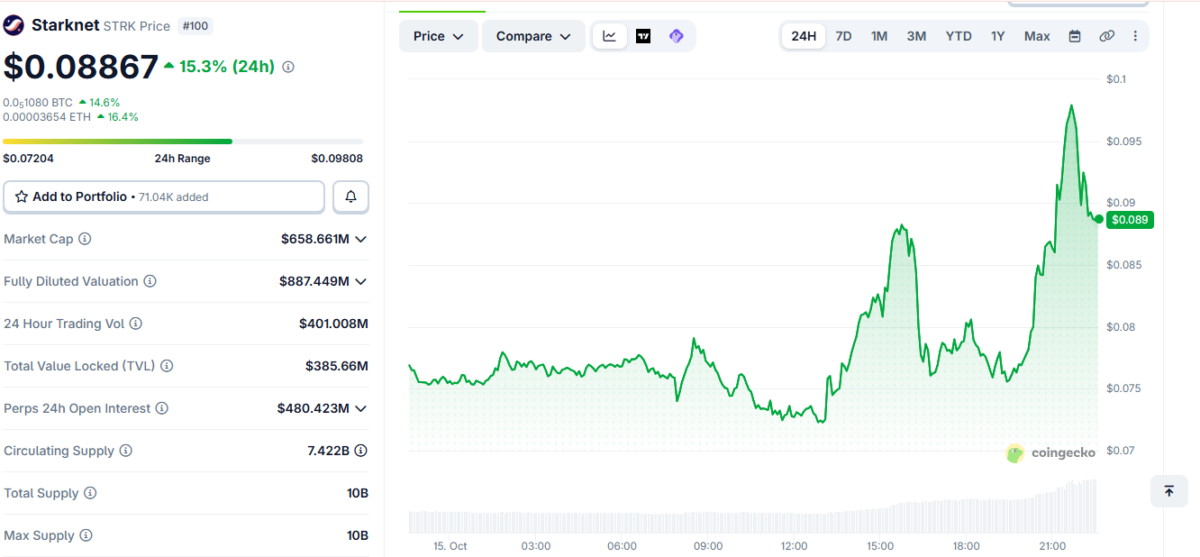
Over seven days, STRK ranged from $0.05485 to $0.1247. Its current price remained 98% below its all-time high of $4.41 and 300.1% above its all-time low of $0.02221. The 24-hour chart showed the token rising through the day, reaching a high near $0.098 before settling around $0.089, according to CoinGecko data (on October 15 at 17:15 UTC).
Starknet polls community on independent layer 1
The poll went live on October 15 and is scheduled to remain open for seven days.
The vote does not authorize a migration. A “Yes” outcome would initiate research and the preparation of more detailed proposals. A “No” result would keep post-quantum work on the existing Ethereum Layer 2 path. A “neutral” outcome would leave the discussion open for further clarification.
The Snapshot vote follows statements published by StarkWare on October 8 indicating that the company was actively considering a transition to an independent Layer 1. StarkWare cited greater control over its own security timeline as a primary reason for examining the option.
StarkWare has previously outlined a post-quantum roadmap for Starknet. The company has argued that the network has a relatively direct migration path among major blockchains because its architecture has not relied on the cryptography most exposed to quantum computing advances.
Starknet’s existing architecture and quantum resistance
Two structural features form the basis of that assessment.
First, Starknet uses STARK proofs. These proofs rely on collision-resistant hash functions rather than elliptic-curve arithmetic. Shor’s algorithm poses a known risk to elliptic-curve cryptography used in many blockchain signature schemes, while hash functions are regarded as more resistant.
Second, Starknet incorporates native account abstraction. This design allows a contract to alter its authentication method without requiring a protocol-level breaking change. As a result, users can deploy quantum-resistant wallets under the current architecture.
Demonstrations of such wallets have already been reported, including a Falcon-512 account built in Cairo by S2morrow and ongoing development of a post-quantum account contract by OpenZeppelin.
These features provide a basis for developing quantum-resistant accounts, but they do not eliminate every potential quantum-related risk across the network.
Poll structure and next steps
The Snapshot poll is limited to gauging community interest. It does not contain binding language or a timeline for implementation. StarkWare has indicated that any affirmative community signal would lead to formal research and subsequent detailed proposals. No migration process has been initiated, and the network continues to operate as an Ethereum Layer 2.
STRK’s price increase coincided with the poll’s launch, while trading volume and perpetual futures open interest reflected activity during the same 24-hour period. These figures do not establish that the governance proposal caused the token’s price movement.
The poll remains open for the stated seven-day period. Its outcome will help determine whether research into an independent Layer 1 proceeds or whether post-quantum development remains focused on the existing Layer 2 framework.
Also Read: Crypto.com Launches Predict Pro for US Prediction Market Traders