Starknet’s STRK token rose sharply on October 9, trading at approximately $0.06825 as of 06:48 UTC, according to CoinGecko’s market data. The token was up around 40.1% over 24 hours, outperforming Bitcoin and Ether over the same period in the supplied snapshot; up about 40.3% against Bitcoin and 43.8% against Ether.
STRK traded between $0.04871 and $0.07013 during the preceding 24 hours. The rally extended a move covered in The Crypto Times’ earlier report.
At the reported snapshot, STRK had a market capitalization of approximately $507.2 million and a fully diluted valuation of about $683.3 million. The network’s total value locked (TVL) stood at roughly $345.2 million, while 24-hour trading volume reached approximately $411.8 million, according to CoinGecko market data.
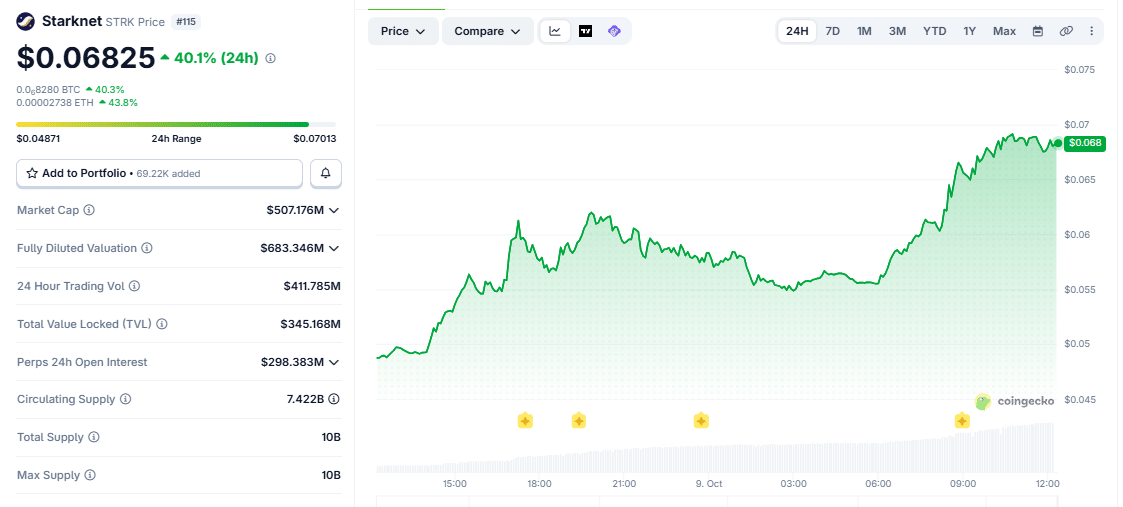
Trading volume equivalent to around 81% of market capitalization indicates substantial turnover relative to the token’s reported market value. It does not mean that 81% of circulating tokens changed hands, because volume can include repeated transactions across exchanges.
Reported perpetual-futures open interest stood near $298.4 million. Open interest measures outstanding derivatives positions, not the amount of money traders have necessarily invested or the direction of their bets. The figure should therefore be read as evidence of significant derivatives activity rather than proof that traders are uniformly positioned for further gains.
What Is Driving the STRK Rally?
The main catalyst is a potential change to Starknet’s network architecture. On October 8, Starknet said it was “actively considering becoming an L1,” adding that the move could enable it to become “the first fully quantum-resistant network,” with 2027 as its target.
Starknet currently operates as an Ethereum Layer 2, using Ethereum as part of its settlement and data-availability architecture. Becoming an independent Layer 1 would change that relationship and give the network greater control over certain protocol-level security upgrades.
The transition is not confirmed. The proposal remains under consideration, and any eventual change would require further technical decisions and governance approval. The announcement has given traders a new development to assess, but the price movement alone cannot establish how much of STRK’s rally was caused by the proposal.
What Starknet’s Quantum-Resistance Plan Involves
The proposal builds on Starknet’s existing work on post-quantum cryptography. In its official quantum-resistance roadmap, Starknet explains that its STARK proof system relies on hash-function-based cryptography rather than the elliptic-curve assumptions underlying many widely used blockchain signatures. This distinction matters because a sufficiently powerful quantum computer running Shor’s algorithm could threaten some widely used public-key cryptographic systems.
However, a post-quantum proof system does not automatically make every component of a blockchain quantum-resistant. Wallet authentication, protocol cryptography, bridges and dependencies inherited from another network may require separate upgrades.
Starknet has also explored account-level changes that allow users to adopt alternative signature schemes without requiring a network-wide protocol fork. Its roadmap discusses Falcon-512, a post-quantum signature scheme, and an experimental account developed with OpenZeppelin.
The project’s quantum-readiness migration register distinguishes demonstrated work from research and remaining dependencies. It notes that the experimental Falcon-512 account is unaudited and that a successful test transaction does not establish production readiness or network-wide quantum security.
Starknet’s 2027 goal is therefore a target, not confirmation that all components will be quantum-resistant by that date. The proposed Layer 1 transition could give the network greater control over some upgrades, but it would not, by itself, guarantee complete protection.
Bitcoin DeFi Adds to the Network’s Narrative
The quantum-resistance proposal comes after Starknet expanded its work on Bitcoin-related decentralised finance. The Crypto Times previously reported on Starknet’s Bitcoin-staking integration and its subsequent efforts to enable Bitcoin staking as part of its BTCfi strategy.
These initiatives aim to bring Bitcoin-related activity into applications built on Starknet. They provide additional context for the network’s development strategy, but do not establish that Bitcoin DeFi activity directly caused the latest STRK price increase.
STRK had also recorded a separate rally earlier in October, when The Crypto Times reported that the token jumped nearly 23% as trading volume increased. The latest move therefore follows earlier price strength, although the available figures do not isolate the contribution of each catalyst.
STRK’s Rally Comes With Market Risks
Despite the sharp rise, STRK remains far below its historical peak. At $0.06825, the token was approximately 98.5% below its all-time high of $4.41, based on the figures in the CoinGecko STRK listing. That comparison provides historical context, but it does not indicate how likely a recovery to that level may be.
CoinGecko’s reported supply figures put circulating STRK at around 7.42 billion tokens against a maximum supply of 10 billion. Token unlocks can increase the amount of supply available to the market, although their effect on price depends on factors such as demand, recipient behavior and prevailing liquidity.
The Crypto Times previously covered the May token-unlock schedule, which included STRK. That report provides historical context; investors should consult the current CoinGecko unlock schedule for the latest release dates and amounts.
The combination of a rapid price rise, high trading volume, and substantial derivatives open interest points to an active market. Such conditions can accompany momentum-driven trading, but they can also leave prices vulnerable to sharp reversals if sentiment changes or leveraged positions are liquidated.
Neither volume nor open interest alone establishes that STRK is overvalued, that traders are predominantly bullish, or that a reversal is imminent.
What to Watch Next
The next developments to monitor are whether Starknet advances a formal Layer 1 proposal, how it addresses Ethereum-dependent components, and whether its quantum-resistance roadmap reaches further implementation milestones.
Market participants can also track changes in STRK trading volume, derivatives open interest, and circulating supply to assess whether activity remains elevated after the initial announcement.
The central distinction is between a proposed network transition and a delivered technical upgrade: Starknet has outlined a potential direction, but its final architecture, implementation timeline, and ability to achieve comprehensive quantum resistance remain unresolved.
Also read: Zcash (ZEC) Price Falls 13% as Open Interest Drops and ETF Outflows Rise