Pearl (PRL), the native coin of the Pearl Network, rallied sharply on Wednesday, September 23, 2026, setting a fresh all-time high before giving back part of the move within hours.
The token, whose network is secured by graphics processing units (GPUs) running the same matrix math used in artificial intelligence (AI), has more than doubled over the past week. A small circulating float and trading concentrated on a few venues are central to reading the move.
PRL Price Today: Record High, Then a Pullback
On September 23, 2026, PRL was at $1.68, up 63.3% over 24 hours. Against bitcoin (BTC), the pair was 0.00001901 BTC, up 60.8%. Market cap was $419.804 million. Fully diluted valuation was $3.457 billion. 24-hour volume was $8.305 million.
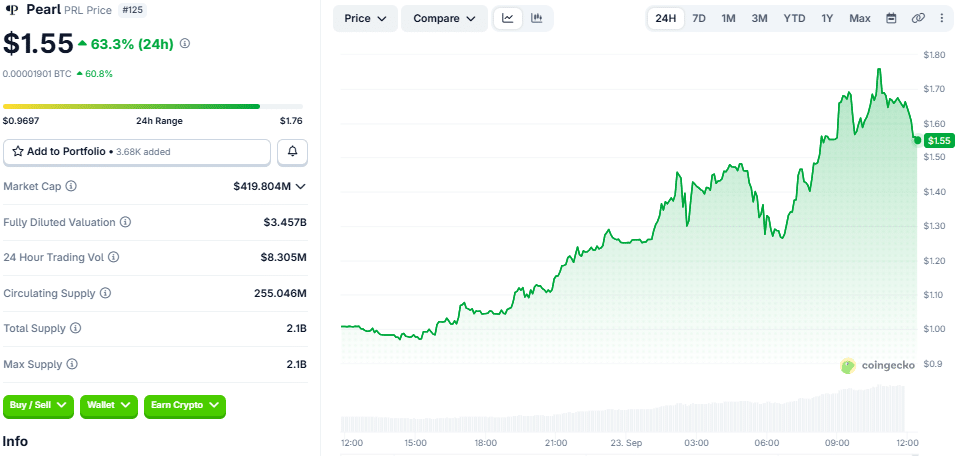
The 24-hour range ran from $0.9697 to $1.76. The $1.76 print is the highest level on record for PRL on CoinGecko. At $1.68, the token sits about 4.5% below that peak. The distance from low to high was about 81.5% in a single day.
CoinGecko also listed a seven-day range of $0.5895 to $1.76 and an all-time low of $0.1399. On a weekly view, PRL’s seven-day low was $0.5895, so $1.68 is about 2.8 times that level.
Supply Is the Key Variable
Market capitalization values only the coins in circulation. Fully diluted valuation (FDV) values the entire maximum supply at the current price. For PRL, the gap between the two is wide.
With 255.046 million PRL circulating against a 2.1 billion cap, about 12.1% of the maximum supply is on the market. The remaining 1.845 billion PRL, or about 87.9%, has yet to be issued. That explains why the FDV of $3.457 billion is about 8.2 times the market capitalization.
Unlike tokens with scheduled team or investor unlocks, PRL enters circulation through mining. Pearl’s whitepaper describes a target block time of about 194 seconds and an emission schedule that follows a polynomial curve rather than Bitcoin-style halvings. In practice, new coins reach miners every block. Miners typically sell part of their rewards to cover power and hardware costs, which creates a steady source of supply regardless of price direction.
Where the Volume Traded
Liquidity is thin relative to valuation. The $8.305 million in 24-hour volume equals roughly 2% of market capitalization, enough to move the price sharply but not evidence of a deep order book.
Earlier in the session, the CoinGecko markets table showed SafeTrade’s PRL/Tether (USDT) pair carrying about $7.33 million in volume, or 88.4% of listed turnover. BigONE’s PRL/USDT pair followed with about $822,625, while CoinEx’s PRL/USDT pair recorded about $26,674. BigONE announced the PRL/USDT listing on September 18, 2026.
When one venue accounts for close to nine-tenths of reported volume, a single order book can set the session high. That does not by itself indicate broad demand across the market.
Data between aggregators also diverge. CoinMarketCap listed a 24-hour volume of $22,210 and a self-reported circulating supply of 225.82 million PRL during the same session, well apart from CoinGecko’s figures. Readers comparing sources should treat the two as separate data sets.
What Pearl Is
Pearl is a Layer-1 (L1) blockchain, meaning a base network with its own native coin, built by Pearl Research Labs. PRL is not a token on Ethereum and has no contract address. Co-founder Omri Weinstein said on X that mainnet blocks had been mined from 09:00 UTC on April 27, 2026.
The network uses what the project calls proof of useful work (PoUW). Instead of hashing random numbers, as Bitcoin miners do, Pearl miners perform matrix multiplication, the core arithmetic behind AI model training and inference. The design draws on a research paper, “Proofs of Useful Work from Arbitrary Matrix Multiplication,” co-authored by Weinstein.
The main named commercial user is Together AI. On May 15, 2026, the AI cloud provider launched a discounted inference endpoint for a model called Gemma-4-31B-it-pearl, priced more than 25% below its standard rate, with the discount offset by PRL mined on the same workload. Together AI said the discount is offset by the future value of those emissions. The line that Pearl “changes the unit economics of AI” is Pearl Research Labs’ phrasing, also quoted on the project’s Together AI case page. Attribute it to Pearl, not as an independent Together AI verdict.
The Usefulness Debate and Mining Economics
The useful-work claim has been challenged. A preprint titled “The Usefulness Gap in Proof-of-Useful-Work,” submitted to arXiv on June 3, 2026, by researcher Abhinaba Basu, argued that Pearl’s protocol verifies that matrix multiplication was performed correctly but does not verify that it came from real AI workloads.
Tom’s Hardware reported on June 14, 2026, that the study estimated the network at about 24 exahashes per second, equivalent to roughly 320,000 RTX 3090-class GPUs drawing around 112 megawatts.
Mining returns have also been volatile. Tom’s Hardware reported on May 31, 2026, that estimated daily revenue for an Nvidia RTX 5090 had halved to $17.19 since April as network difficulty rose. A higher PRL price raises miner revenue per card, which tends to draw more hardware onto the network and push difficulty higher again.
The rally arrived during a broader rise in risk appetite. On September 22, Bitcoin broke above $80,000 resistance as short positions were liquidated, and large memecoins posted double-digit gains the same day. Low-float tokens often move more than the wider market in both directions during such phases.
What to Watch
Three data points will show whether the move holds up. The first is whether spot volume spreads beyond SafeTrade to other venues. The second is how price behaves relative to the $1.76 high and the $0.97 area that marked the session low.
The third is the pace of new supply from mining as higher prices attract more GPUs to the network. Independent data on how much network work is paid for AI inference, rather than mining alone, remains limited.
Also Read: Bitcoin Price Hits $87,000 for First Time Since January: Can the Rally Hold Into Year-End?