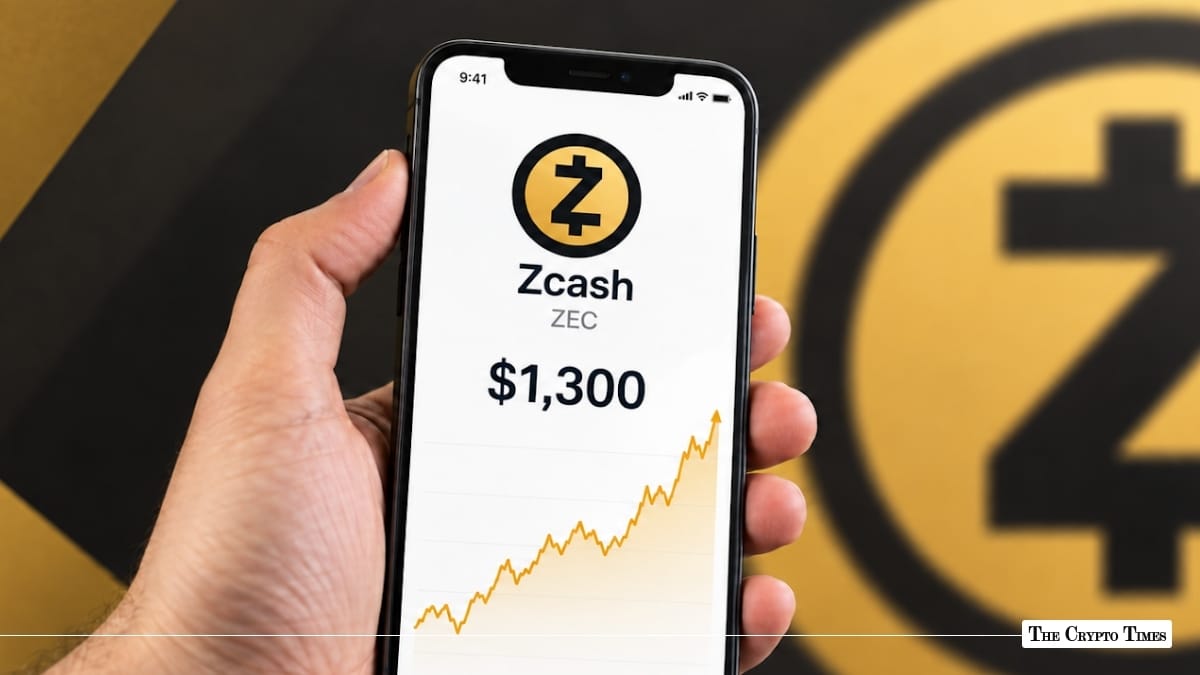
Zcash’s native cryptocurrency, ZEC, has surged by more than 17% in the past 24 hours as the privacy-focused network goes through a series of developments. ZEC was among the strongest large-cap cryptocurrencies in mid-September 2026 after a cluster of protocol, product, and market events landed in a short window.
Coinholders closed a privacy-preserving vote on Network Upgrade 7 (NU7). A hardware-wallet team committed funds to support the newest shielded pool. A U.S.-listed Zcash exchange-traded product continued to scale. Risk assets also firmed after the Federal Reserve raised its policy rate.
Those items do not prove a single cause for the latest move. They do explain why attention returned to a 21-million-supply privacy coin that already spent 2026 rebuilding after an emergency patch and a new shielded pool.
As of 9:50 AM UTC, latest market data from CoinGecko shows ZEC trading near $1,300—up over 170% in the last month.
This article sticks to primary records: the Zcash Community Forum, Zcash Improvement Proposals, issuer filings, official X accounts, and the Federal Reserve.
Coinholders vote to cut block time and keep halvings
The most concrete protocol signal came from the NU7 token holder vote. Valar Group and Project Tachyon set the rules in August: only spendable ZEC in the Ironwood shielded pool at an August 24, 19:00 UTC snapshot could vote; ballots ran through September 14, 19:00 UTC; organizers treated one million ZEC as the minimum turnout for a representative result.
Poll results posted on the same forum after the close show that bar was cleared by a wide margin. Community summaries of the coinholder tally, including a snapshot discussed on that thread, put participation near 2.4 million ZEC out of roughly 3.6 million eligible Ironwood coins. On the questions that matter for users and miners:
- About 99.9% of participating ZEC supported cutting target block spacing from 75 seconds to 25 seconds, paired with per-pool action limits described in ZIP-218.
- About 98.9% favored preserving Zcash’s existing Bitcoin-style halving schedule rather than switching to a smoother issuance curve.
- About 96.6% supported waiting until February 2031 before reissuing coins collected through the Network Sustainability Mechanism.
- Holders also backed shipping NU7 as soon as possible and dropping features not ready by a September 30 readiness date, and disabling legacy Sprout-related v4 transactions at activation.
The ZIP draft is explicit that the shorter interval is meant to lower first-confirmation latency for payments, deposits, and bridges, while reducing the per-block subsidy so calendar issuance does not jump. Developers have not published a locked mainnet height. A NU7-rc0 testnet earlier in the year already ran 25-second blocks; that is a test, not activation.
The vote is a mandate, not a live consensus change. Implementation still requires specification, audits, client releases, and miner and exchange coordination. ZCAP, the advisory panel, split more narrowly on issuance smoothing than coinholders did—an important distinction if readers treat “the community” as one voice.
Ledger integration and the Ironwood custody path
A second primary announcement arrived on September 15 from Zcash Labs. The group said it had a funding agreement with Ledger and would commit $80,000 toward integrating the Ironwood pool into Ledger devices so holders can self-custody ZEC in the latest shielded pool.
The same post pointed to a forum discussion on the path for Ledger support. That is a custody and distribution story, not a change in monetary policy. It matters because Ironwood is the pool that was eligible to vote and the pool created after the 2026 Orchard soundness incident. Crypto Times previously covered Ironwood’s activation when NU6.3 went live at height 3,428,143 and required Orchard funds to migrate through a turnstile.
Hardware support does not, by itself, increase demand. It can reduce friction for users who want shielded balances off exchanges. That is the claim Labs is making. Readers should separate that product work from price action.
ETF plumbing, on-chain labels, and a rate decision
Institutional access is documented in issuer materials, not in social-media price targets. Grayscale converted its long-running Zcash trust into a listed product. An SEC registration filing describes the intent to list shares on NYSE Arca under ticker ZCSH. The issuer later said in a September 8 release that AUM had grown to more than $500 million after the August 25 NYSE Arca debut, including more than $70 million of cumulative inflows in the first two weeks plus a $100 million investment by an affiliate of Digital Currency Group that exchanged 85,705 ZEC through an authorized participant. Grayscale’s own product board listed The Zcash ETF (ZCSH) with about $727 million in AUM as of September 16, 2026—figures that move daily and are reported on a non-GAAP basis by the sponsor.
The Crypto Times reported the listing when ZCSH debuted. An ETF creates a brokerage wrapper. It does not guarantee net creations every day, and DCG’s contribution is an affiliated subscription, which the release itself discloses.
On September 16, on-chain commentator Proxonchain posted that multiple transfers of about 25,000 ZEC, described as worth roughly $30 million each at then-prevailing prices, were moving through Grayscale-labeled wallets. The same post said the flows looked like internal movements rather than confirmed open-market buying, and restated the DCG 85,705 ZEC figure. Labeled-wallet clustering is an inference. It is not a fund filing.
The same week, Paradigm co-founder Matt Huang posted on X that Paradigm is an investor in ZEC and ZODL and discussed long-term developer funding. That is a disclosed holding and an opinion, not an official Paradigm strategy memo.
Macro conditions were not Zcash-specific. On September 16 the Federal Open Market Committee raised the federal funds target range by a quarter point to 3.75%–4.00%, citing still-elevated inflation and a 12–0 vote. Crypto and equity prices often move with that backdrop; they are not explained by it alone.
A longer regulatory note sits in the background. In January the Zcash Foundation said the SEC had closed a 2023 inquiry without recommending enforcement, a development Crypto Times recorded from the Foundation’s own statement. That removed one overhang. It did not approve privacy coins as a class.
What is settled and what is not
Settled in primary sources: coinholders voted for 25-second blocks and retained halvings; Labs is funding Ledger-Ironwood work; ZCSH exists and has published AUM milestones; the Fed hiked. Not settled: a mainnet date for NU7, whether Grayscale-labeled transfers are new spot demand, or how much of the latest percentage move belongs to any one headline.
ZEC remains a volatile asset with a fixed 21 million cap, optional shielding, and a history of both deep drawdowns and sharp squeezes. Readers should treat governance turnout, ETF creations, and custody integrations as separate facts—and check live quotes, fund holdings, and client release notes before treating any of them as a trade.
Also Read: New Bitcoin ATH Prediction: Analyst Puts $232k Price Mark on April 2028 Halving