
Bitcoin analyst Jesse Myers, known as Croesus_BTC, published an assessment on September 9, 2026, examining how the next programmed reduction in miner rewards could shape Bitcoin’s price path.
Myers, whose valuation framework has been cited by Michael Saylor, argued that market participants are now more likely to anticipate the event rather than wait for it. The Bitcoin protocol cuts the block subsidy in half every 210,000 blocks.
The fifth such event is scheduled to occur at block 1,050,000, currently projected for mid-April 2028, when the subsidy falls from 3.125 BTC to 1.5625 BTC—as per official data.
Myers noted that earlier cycles produced large post-halving advances that later moderated. He cited an approximate 100-fold rise after the 2012 event, a 30-fold move after 2016, and an eight-fold increase after 2020. The 2024 cycle broke the prior sequence: Bitcoin reached a new all-time high before the April 2024 cut and then delivered a more modest roughly two-fold gain in the following 18 months.
Myers described this pre-event strength as evidence that the “quadrennial heartbeat” of Bitcoin’s issuance schedule has become sufficiently well-known that investors now attempt to position ahead of it.
Read: Is Bitcoin’s 4-Year Cycle Ending? Willy Woo Points to a 6-8 Year Rhythm
Changing Market Timing Around Halvings
The 2024 experience established a new pattern, Myers wrote. Because the supply reduction is both transparent and inevitable, capital can move earlier. He suggested the same logic is likely to apply again.
Using a recent cycle low near $58,000 as a reference point, Myers illustrated a scenario in which Bitcoin repeats the prior cycle’s four-fold pre-halving advance. That would imply a price near $232,000 by the April 2028 event.
A subsequent two-fold rise over the following 18 months would take the price toward $464,000 in the second half of 2029. This would mark a 504% spike from BTC’s current price, which trades near $76,800 as of 1:40 PM UTC—per CoinGecko data.
To note, these figures are presented as an illustration of repeating the last cycle’s multiples, not as a forecast of guaranteed outcomes. Myers acknowledged that Bitcoin has historically delivered smaller percentage gains as its market capitalization has grown. He also left open the possibility that the long-term trend of diminishing returns could eventually reverse.
The central observation remains behavioral: once a recurring, protocol-level event is widely anticipated, the most intense price discovery may occur in the months leading up to it rather than immediately afterward.
Scarcity Mechanics and Remaining Supply
An accompanying chart released with the analysis shows the stepwise decline in new issuance since 2009 and the approach toward Bitcoin’s 21 million coin limit.
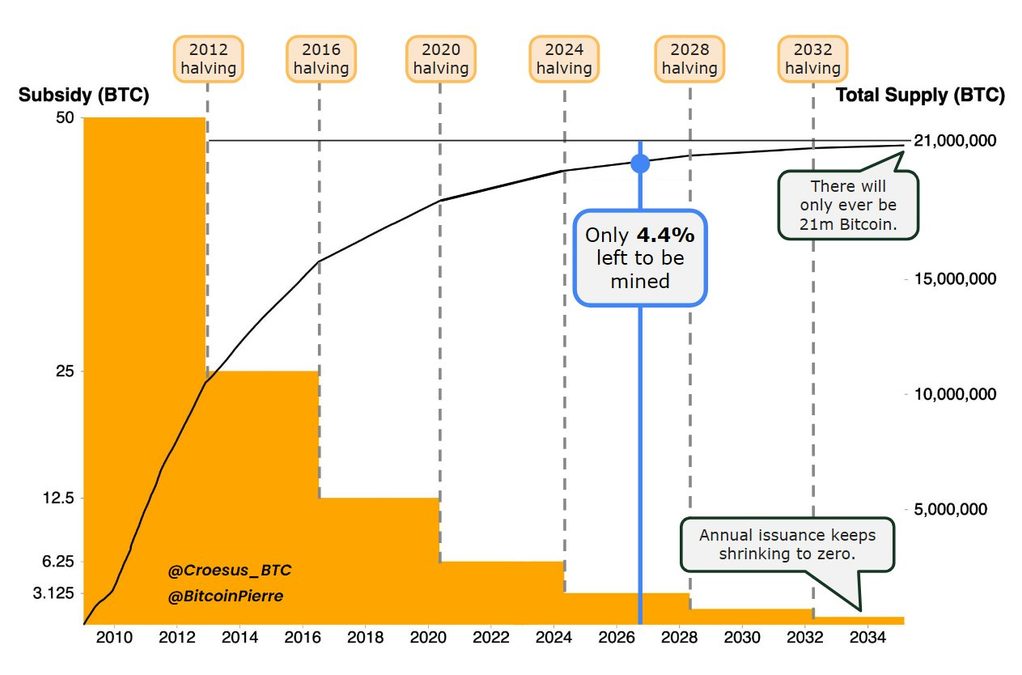
As of September 10, 2026, more than 20 million coins have already been mined—as per CryptoQuant data—leaving roughly 4.4% of the eventual supply still to be created. Annual issuance continues to shrink and will drop by half again in 2028. After that date, daily new supply will fall to approximately 225 BTC, assuming the network’s ten-minute target block interval.
The analysis treats the 2028 halving as the next scheduled tightening of that issuance schedule rather than an unpredictable catalyst. Because the date is determined solely by block height, the remaining interval of about 1.6 years is already visible to every market participant.
Myers concluded that this visibility itself changes incentives. If investors again choose to accumulate in advance of the supply cut, the period between now and April 2028 could become the most active phase of the current cycle.
The projections remain speculative. Bitcoin’s price is influenced by liquidity conditions, regulatory developments, institutional flows, and broader macroeconomic factors that cannot be isolated from the halving calendar.
Past cycle multiples have not repeated with precision, and future returns could be larger or smaller than the illustrations provided. The protocol’s issuance rules, however, are fixed. The subsidy reduction at block 1,050,000 will occur regardless of market sentiment, continuing the long-term decline in new supply that has defined Bitcoin since its launch.
Also read: Coinbase CEO Calls $400,000 Bitcoin Price by 2030 Reasonable