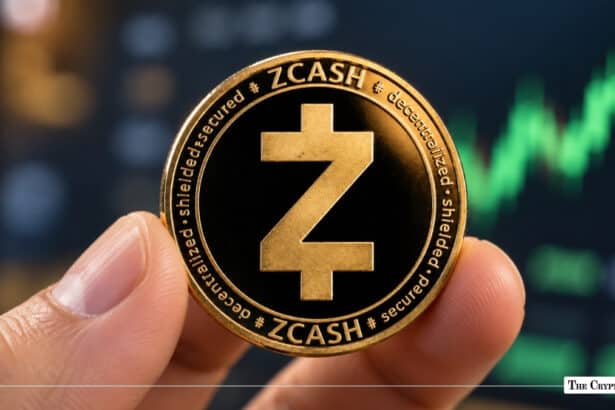
Zcash traded above $1,190 on Monday after a 42% week, and a widely-circulated target for the move sits at $2,200. The largest on-chain short in the token has a liquidation price of $2,292.
Those two numbers are 4% apart, which means the disagreement over September has a specific price attached to it. Garrett Jin is already down more than $24 million on that short, and rather than close it he has added to it.
ZEC traded at $1,190.34 on Coinbase at 10:00 UTC on September 7, down 3.04% on the day but up 42.05% over seven days and 132.17% over thirty, according to TradingView.
Where the Price Is
The Coinbase daily candle at 10:11 UTC opened at $1,227.26, reached a high of $1,230.32, fell to a low of $1,166.70 and last traded at $1,190.22, a decline of 3.05% on the session.
CoinGecko data from 18:40 UTC on September 6 put ZEC at $1,175.04, up 15.3% over 24 hours, with a market capitalization of $19.87 billion and a rank of ninth. The same snapshot showed the privacy coin sector passing $30.48 billion in aggregate, up 9.2%, on $1.39 billion of trading volume. Monero traded at $538.40 with a $10.12 billion capitalization, and Decred at $16.57 with $291.36 million — meaning ZEC alone accounts for roughly two-thirds of the privacy sector’s value.
Longer-horizon figures from TradingView show ZEC up 132.32% year to date, roughly 2,380% over one year and 593.17% over five. The Crypto Times reported the token crossing $1,000 for the first time on September 5, when it traded near $1,018 on a 28% weekly gain.
The Chart Case, and Its Author’s Own Caveat
Crypto Patel identified a cup-and-handle on the weekly timeframe, noting Zcash has broken the neckline and that a full 100% measured move would put the target around $2,200.
He attached an unusually direct caution to his own call. The pattern formed near the highs after a roughly 7,828% run over two years, and he argued such formations carry higher accuracy when they appear near a bottom or after an extended accumulation phase rather than at a top. His concern, he wrote, is where the pattern formed rather than the pattern itself. He listed a fake breakout, profit-taking and a major correction as live possibilities, and closed by saying a chart pattern is a possibility rather than a guarantee.
Brief negative funding appeared in mid-July, late August and again around September 4 — short windows when shorts paid longs, each lasting hours rather than days.
Whether the move reflects sustained demand or leveraged positioning is the question the derivatives data raises without answering. Reaching $2,200 from Monday’s level would require a further 85% gain within September.
The Short That Grew
On-chain tracking of the address 0x92ea19ECeB7a8dE0f50978A1583A5D8b018050e9 shows Garrett Jin holding the largest on-chain ZEC short position.
According to Lookonchain, the position was down more than $24 million when Jin added a further 7,000 ZEC, worth roughly $8.4 million, bringing the total short to 39,760 ZEC or about $47.9 million, with a liquidation price of $2,290.
Adding to a losing short raises the average entry price and pushes the liquidation level further from spot, buying survival room at the cost of a larger position and a larger loss if the trade continues against him. The position is fully visible on Hypurrscan, which is unusual at this size — most traders holding $47 million of directional risk are not doing so where the market can see the liquidation level.
That visibility matters for a reason beyond curiosity. A known liquidation price on a large position becomes a reference point other traders can trade toward, particularly in an asset where a squeeze is already underway.
The Derivatives Picture
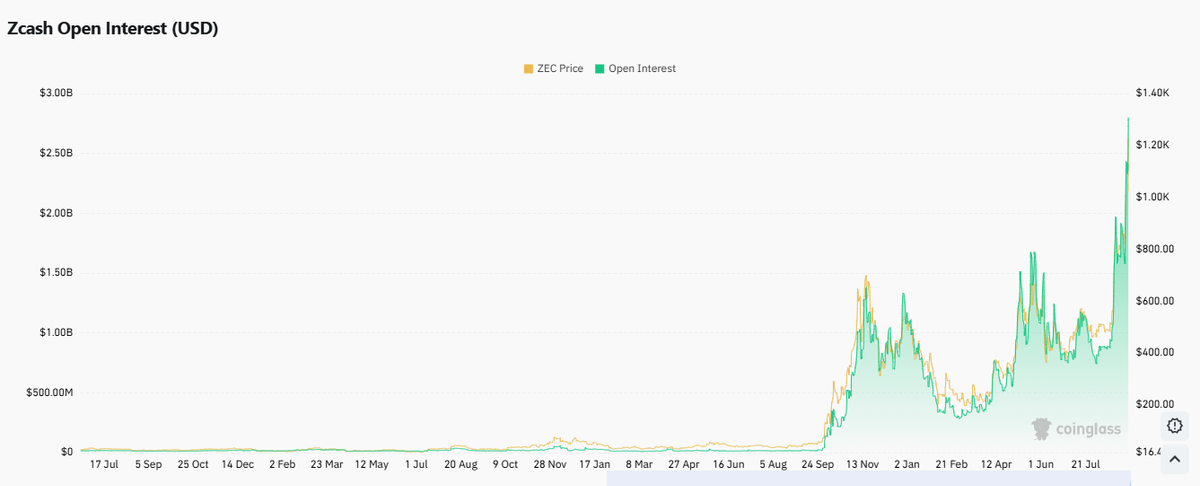
Open interest in ZEC futures has risen to roughly $2.8 billion, according to CoinGlass, a level the market has never previously reached. The prior peaks came in November 2025 near $1.5 billion and again around June 2026 near $1.6 billion, both of which coincided with local price tops. Open interest and price have tracked each other closely throughout the rally, rising and falling together.
The funding rate tells a more specific story. Open-interest-weighted funding has stayed positive for almost the entire period since early July, meaning longs have been paying shorts continuously rather than the reverse. It spiked hardest around August 22, touching roughly 0.065% on the hourly reading — the highest level on the chart — as ZEC broke through $800.
Positive funding at that level means leveraged long positioning is crowded and carries a running cost. It does not indicate direction, but it does mean the rally is being carried in part by positions that must keep paying to stay open, and that a move against them unwinds faster than spot selling alone would.
The Levels on the Chart
Two horizontal levels have defined ZEC’s range over the past year. The $638 zone capped the token at its November 2025 high and again in May 2026. The $231 area marked the floor through the March 2026 trough.
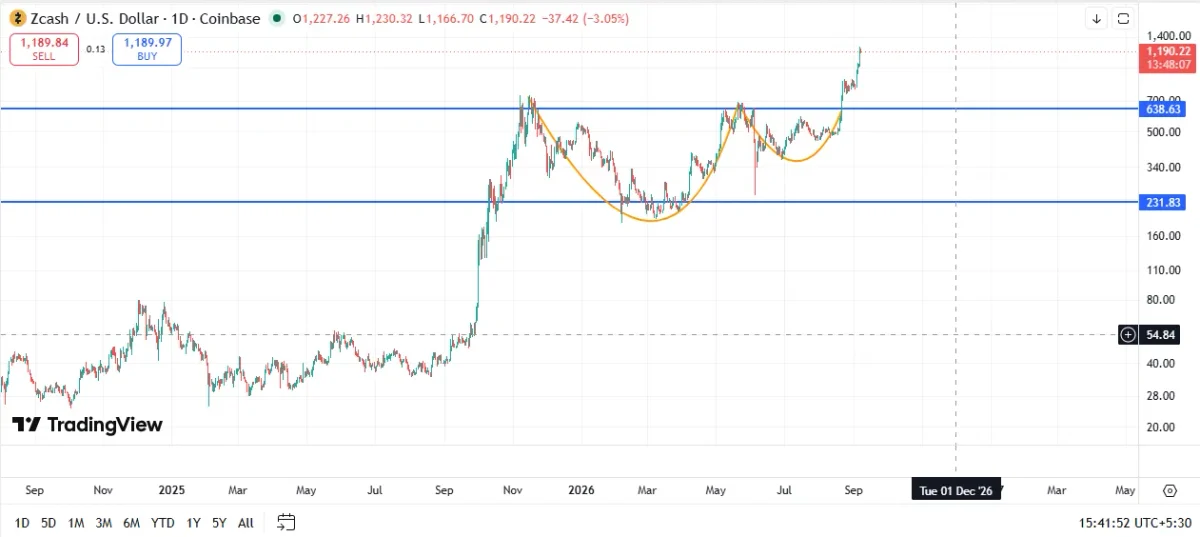
ZEC broke above the upper level in August and has not traded back into it. Between those two points, the daily chart traced a rounded recovery from the November 2025 peak down through the March low and back up — the formation several chartists are now reading as a cup.
What the Bull Case Counts
10x Research put ZEC up 140% in a month and 46.8% over a week, trading above both its 7-day and 30-day moving averages.
The firm listed four catalysts. Grayscale’s spot ZEC product began trading on the NYSE and served as a major catalyst. Grayscale published a note arguing Zcash has features Bitcoin lacks, tying rising demand to growing AI-surveillance-related privacy concerns. A new cryptography stack promising faster private transaction proof generation added technical utility. And deployment updates introduced wrapped ZEC as cbZEC on the Base ecosystem, opening decentralised finance uses.
Founder Markus Thielen described ZEC as the biggest winner of 2026 and said the bull market is back, while noting other coins may be less volatile and similarly promising.
Grayscale’s head of research Zach Pandl has separately outlined a scenario in which ZEC reaches roughly $8,100 if it captured 10% of Bitcoin’s market value by 2030, and around $1,622 at a 2% share. Those are Grayscale’s projections rather than forecasts by The Crypto Times, and the firm has a listed product tied to the asset.
How ZEC Got Here
A year ago ZEC traded near $45. Four developments stacked between then and now.
The second halving in November 2024 tightened the supply curve with roughly 16.67 million of the 21 million maximum already mined, and the token tripled within three months. Grayscale filed to convert its existing Zcash Trust into a spot ETF in late 2025, the first such filing for a privacy-focused cryptocurrency, and updated the filing in May 2026 shortly after the SEC closed its investigation. And ZEC overtook Monero as the largest privacy coin by market capitalization during 2026.
The run has not been uninterrupted. A disclosed soundness vulnerability in the older Orchard shielded pool triggered a 40% single-day fall in June, with ZEC wicking as low as $250. The Ironwood upgrade activated on July 28 at block height 3,428,143, replacing that pool and introducing a turnstile migration mechanism enforcing fixed supply. Grayscale’s Zcash ETF began trading on NYSE Arca on August 25 under ZCSH and had reached roughly $414 million in net assets.
The Supply Argument
Circulating supply stands near 16.9 million ZEC against a fixed maximum of 21 million. Roughly 30% of circulating ZEC sits in shielded pools, up from around 8% in 2024, which removes those coins from liquid trading and makes the tradeable float structurally tighter than the headline figure suggests.
That compression is the fundamental case several bulls are making. The observer YashasEdu noted in early August that daily turnover had collapsed from 22.5% of market capitalization to around 2.4%, while the ZEC-to-Bitcoin ratio rose from 0.45 to 7.68 milli-BTC over ten months — a 17-fold relative gain — and argued the data resembles float destruction rather than a conventional privacy-coin hype cycle.
Two Polls Close September 14
Two parallel governance processes close on September 14 at 19:00 UTC: a coinholder poll and the Zcash Foundation’s ZCAP poll.
The coinholder poll is organised by Valar Group and Project Tachyon, not by the Foundation, and runs on a purpose-built Tokenholder Voting Chain developed by Valar that leaves the Zcash main chain untouched. One Ironwood ZEC at the snapshot height equals one vote. It opened on August 25 after an earlier round was cancelled when the Orchard counterfeiting bug and Ironwood work took priority.
Eligibility was fixed at mainnet block height 3,459,350, around 19:00 UTC on August 24, and required spendable shielded ZEC held in the Ironwood pool. Coins in Orchard, Sapling or Sprout, and transparent ZEC, were ineligible unless already migrated. Holders could move the funds afterwards without losing the right to vote.
Crucially for most holders: ZEC sitting on an exchange had no vote, because the private key belongs to the exchange rather than the holder. Voting is done through the Zodl wallet or a Keystone device under a “Beta: Coinholder Polling” setting. The poll needs at least one million eligible ZEC to be considered representative, and ballots are shielded with only aggregated results published.
What Is on the Ballot
Five questions carry an abstention option each, and holders need not answer them all.
The first asks whether the Network Sustainability Mechanism should govern new issuance through a smooth curve rather than abrupt halvings, with options for the curve, keeping halvings, dropping the item from NU7, or abstaining. The second asks when NSM fee reissuance should begin — immediately on activation or around 2032. The third asks when to disable the legacy Sprout pool, offering immediately with NU7, one year after the vote, or no date set. The remaining questions cover block-time reduction and whether NU7 should proceed if planned features are delayed.
The first two are the economically weightiest, because they determine future issuance of new coins — the same supply argument the bull case rests on.
Why It Is a Poll Rather Than a Vote
The result does not change the protocol. Zcash developer Daira has noted on the community forum that no ZIP authorises making protocol decisions by vote or specifies how to do so, and that ZIP 1016, the only ZIP mentioning coinholder polling, excludes governance changes in its non-requirements section.
The outcome informs the final scope of NU7 ahead of implementation deadlines in late September. It does not bind it.