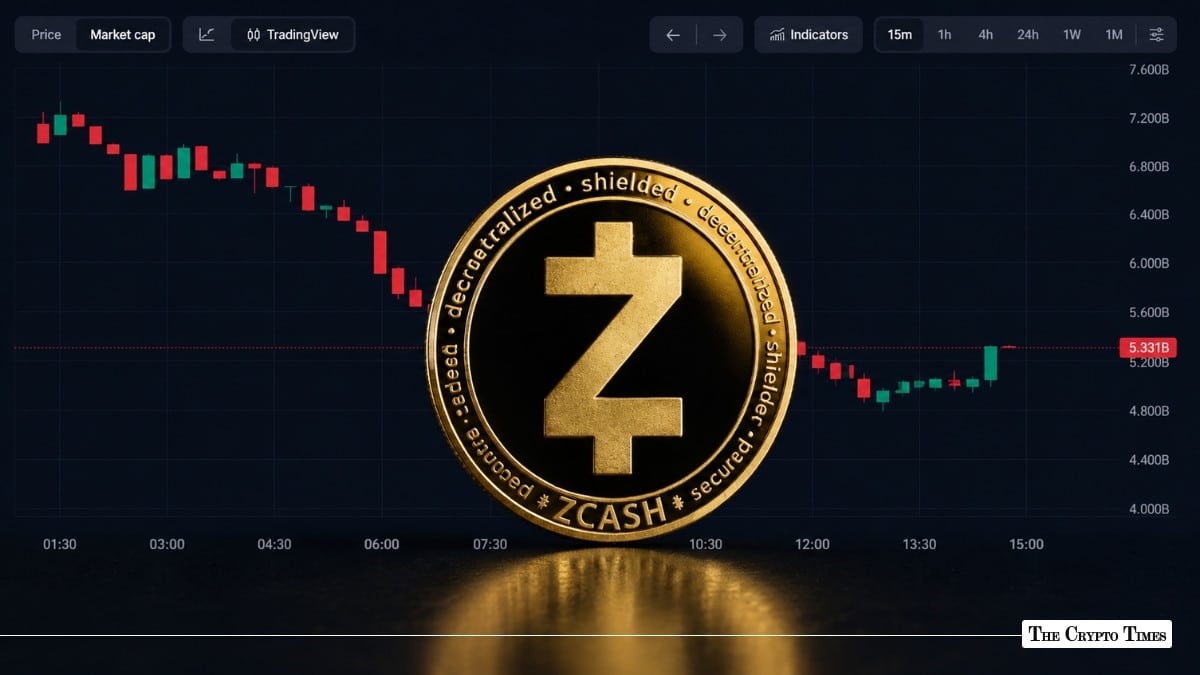
Zcash (ZEC), the pioneering privacy-focused cryptocurrency, has endured one of its most volatile episodes in recent memory. As of June 5, 2026, ZEC trades in the $310–$340 range after a brutal 40% single-day plunge that saw it wick as low as $250 on leading crypto exchanges.
Currently trading at $319, ZEC markets went through explosive volume exceeding $2.9 billion for the past 24 hours. Its market capitalization sits near $5.3 billion, reflecting a roughly $3 billion evaporation in value amid widespread liquidations estimated at $82 million.
The downtrend has thrown ZEC at 18th place among largest cryptocurrencies, which was at 11th prior to the latest price slump.
Despite the steep correction, ZEC has clawed back above the psychologically important $300 level from intraday lows, sparking cautious optimism among holders. The dramatic move follows a strong May rally that propelled ZEC toward $600–$690 highs, fueled by broader crypto momentum and renewed interest in privacy coins.
However, a critical technical disclosure shattered that momentum overnight.
The Soundness Vulnerability: Root Cause of the Decline
The sharp decline stems directly from the public disclosure of a critical soundness bug in Zcash’s Orchard shielded pool, the protocol’s advanced zero-knowledge proof privacy layer activated in May 2022.
Security researcher Taylor Hornby identified the flaw during an AI-assisted audit on May 29. The vulnerability theoretically allowed invalid state transitions that could enable unlimited counterfeit ZEC minting or double-spending within shielded transactions—a nightmare scenario for a coin whose entire value proposition rests on privacy and supply integrity.
Despite such a scope of vulnerability, no evidence of actual exploitation emerged. Analysts credit Zcash’s built-in “turnstile” mechanism that prevents over-issuance at the protocol level. Still, the mere possibility triggered panic.
The Zcash Foundation and developers responded swiftly with an emergency two-phase upgrade:
- A soft fork (Zebra 4.5.3) temporarily disabled Orchard transactions.
- The NU6.2 hard fork on June 3 restored functionality with a corrected zero-knowledge proof circuit.
While the patch was executed efficiently—described as one of the most complex upgrades in Zcash history—the disclosure itself eroded market confidence. High-profile selling, amplified by social media commentary and leveraged positions, accelerated the cascade.
Privacy coins are inherently sensitive to such events; any perceived weakness in cryptographic guarantees can lead to rapid de-risking by investors.
Technical Rebound and Market Reaction
ZEC’s partial recovery above $300 demonstrates short-term resilience.
The cryptocurrency’s 1D chart illustrates this perfectly: a towering green-to-red daily candle breaking below all major EMAs (20 at ~$536, 50 at ~$492, 100 at ~$429, and 200 at ~$366). The 200-day EMA now acts as significant overhead resistance, while volume spiked dramatically, signaling capitulation.
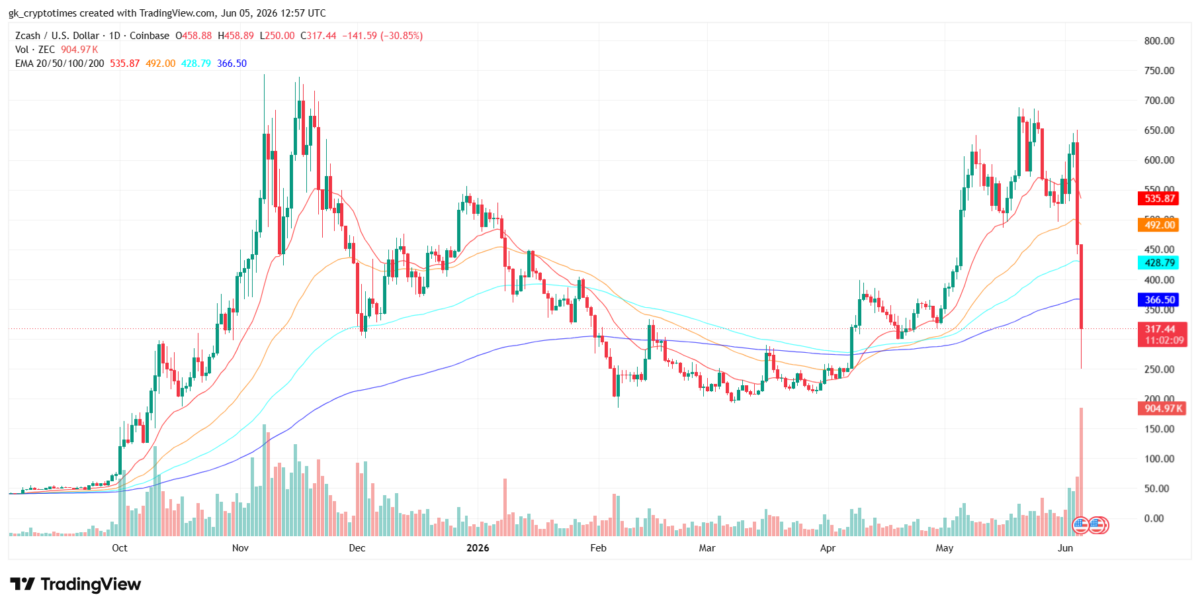
Next major support held near the $250–$260 wick lows, and buyers stepped in amid oversold conditions. However, the broader structure remains bearish in the very short term. Price sits well below its recent May highs and the cluster of EMAs, suggesting any sustained rebound requires reclaiming $366–$400 first.
Trading activity has been frenetic for ZEC with 24-hour volume surged over 120%—reflecting both panic exits and opportunistic dip-buying. Compared to its all-time high near $5,900 from 2016 (or more recent cycle peaks), ZEC remains nearly 95% below peaks but has still delivered substantial year-to-date gains for early 2026 entrants before this wipeout.
Sentiment across platforms mixes fear with defiance. Some traders joke about “full port” calls gone wrong, while others highlight the team’s rapid response as a positive signal of maturity. The lack of confirmed exploits and successful fork helped limit downside, but trust in shielded pools will take time to rebuild through further audits and transparency.
What Could Be Next for Zcash?
Looking ahead, ZEC faces a classic crypto crossroads: technical repair versus fundamental recovery. Near-term scenarios include:
- Bullish case: Stabilization above $300–$320 followed by a retest of $366 (200 EMA) and potentially $428–$492. Successful post-fork audits, positive on-chain metrics, and a broader crypto market rally could drive ZEC back toward $500–$600 in coming weeks. Long-term privacy demand—especially amid growing regulatory scrutiny on transparent chains—remains a tailwind. Some pre-crash forecasts targeted $600–$900+ for 2026.
- Bearish case: Failure to hold $300 could see retests of $250 or lower supports around $200. Zcash’s lingering reputational damage or macro weakness might prolong consolidation.
Analysts emphasize that Zcash’s core technology—shielded transactions offering optional full privacy—stays intact. The swift patch demonstrates proactive governance, a rarity in decentralized projects. However, privacy coins navigate unique regulatory risks, and events like this underscore the high-stakes nature of cryptographic soundness.
Zcash has survived its latest stress test with the network secure and supply provably intact. The rebound above $300 buys time, but reclaiming trust and technical momentum will determine whether this dip becomes a footnote in a larger uptrend or the start of deeper correction. For now, broader Bitcoin and altcoin trends will heavily influence direction.
Also read: Zcash vs. Monero: The 2026 Privacy Coin War Just Got Decided in One Week