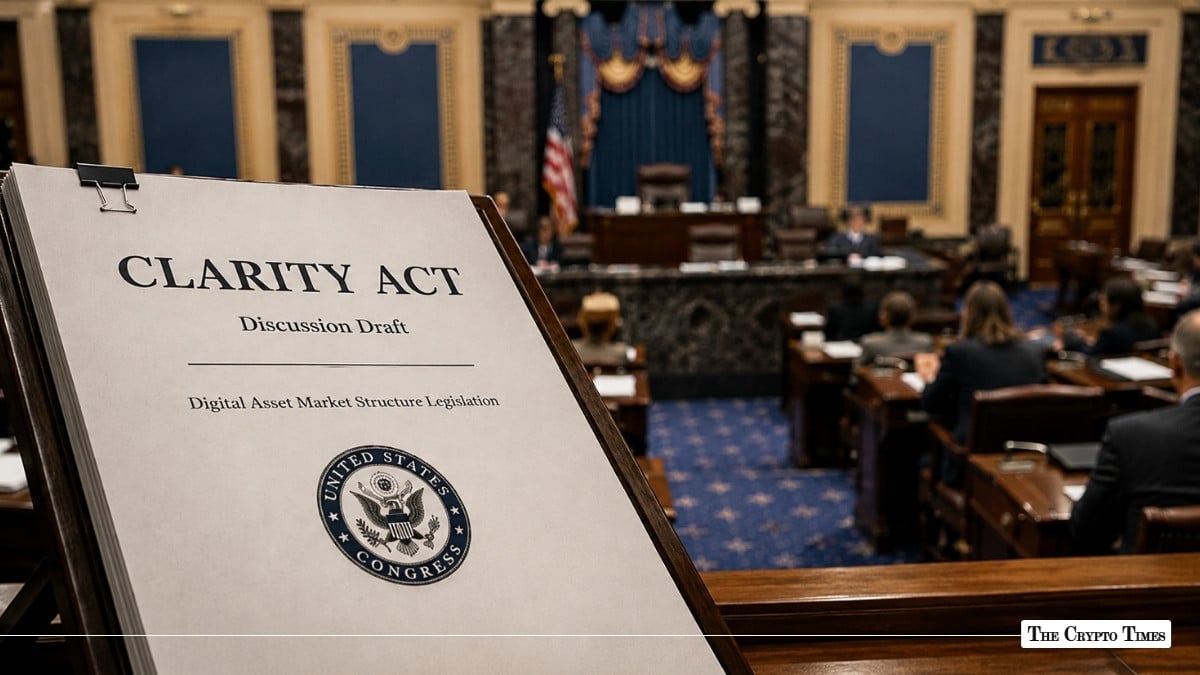
Seven Senate Democrats whose votes the CLARITY Act cannot pass without said the Republican-proposed text falls short, in a joint statement issued Wednesday after Republicans shared the updated draft.
What They Said
The statement was signed by Senators Angela Alsobrooks of Maryland, Cory Booker of New Jersey, Catherine Cortez Masto of Nevada, Ruben Gallego of Arizona, John Hickenlooper of Colorado, Mark Warner of Virginia, and Raphael Warnock of Georgia.
“The Republican-proposed text of the CLARITY Act as it currently stands falls short,” they wrote. “Key provisions including those addressing ethics for elected officials, consumer protection, illicit finance, conflicts of interest, and market integrity must be strengthened.”
The closing line matters as much as the criticism. “We have been working in good faith with our Republican colleagues for the past year and will continue doing so to get this over the finish line.”
That is not a rejection of the bill. It is a rejection of this version of it, paired with an explicit commitment to keep negotiating—a distinction that leaves the legislation stalled rather than dead.
Why These Seven
The signatories are not the bill’s opponents. They are the group that has been negotiating it and the only realistic path to 60 votes.
Alsobrooks and Gallego were the only two Democrats to vote the bill out of the Senate Banking Committee in May, and both said at the time that their committee votes were about continuing negotiations rather than committing to support on the floor. Booker has been involved in the portions of the legislation falling under the Senate Agriculture Committee’s jurisdiction. Cortez Masto has led Democratic negotiations on the developer-protection provisions, and Warner has tied his vote to law enforcement sign-off.
Their objection is procedural as well as substantive. “The new Clarity text is a Republican text,” Booker said. “There’s only one way to get there, which is a bipartisan pathway.”
The Ethics Mechanism at Issue
The ethics language in Wednesday’s draft came from an agreement struck between the White House and Republican senators, which President Trump approved earlier this week. Democrats were not party to those negotiations and had not seen the text when it was finalized.
Alsobrooks has been specific about her objection. She has publicly described the draft’s Justice Department-based enforcement mechanism as unserious, pointing to a structural problem: placing enforcement of the president’s crypto ethics obligations with a department whose leadership reports to the president recreates the conflict the provision is meant to resolve.
The dispute has been building for more than a year, tracing back to the Senate’s work on the GENIUS Act, but sharpened considerably after Trump’s financial disclosure showed more than $1.4 billion in crypto-related income for 2025. The new draft does introduce limitations on how senior government officials can invest in digital assets; the Democrats’ position is that those limitations are too weak.
The White House has framed the resistance as obstruction, warning that if Senate Democrats block the legislation after the administration accommodated their concerns, stakeholders should conclude the Democrats were never serious about a legislative outcome.
Thune Is Moving Anyway
Majority Leader John Thune’s office said he still intends to move forward in the coming days, setting up a decision about whether to bring a bill to the floor that its necessary votes have publicly criticized.
The arithmetic is unforgiving and, at present, disputed. The bill needs 60 votes to invoke cloture. Reporting has placed the Republican count at either 52 or 53 seats following the death of Senator Lindsey Graham, putting the required Democratic crossovers at seven or eight if every Republican votes yes. Some assessments put the figure as high as ten, accounting for the possibility that Senators Josh Hawley and Rand Paul—both of whom opposed the GENIUS Act—withhold support and for Senator Mitch McConnell’s absence.
Under any of those counts, the seven senators who signed Wednesday’s statement are not a bloc that can be worked around. They are the bloc.
The Senate leaves for its summer recess after August 7, and other legislation is competing for floor time. Lawmakers have widely treated that date as the last realistic window for the bill this year, with the post-recess calendar filling with midterm politics.
What Would Have to Change
The statement names five areas requiring strengthening: ethics for elected officials, consumer protection, illicit finance, conflicts of interest, and market integrity. Three of those—ethics, conflicts of interest, and illicit finance—have been contested since the spring, and the illicit-finance objection connects to the separate fight over developer protections in Section 604, where law enforcement groups have resisted shielding non-custodial developers.
Whether Republicans reopen the text or force a vote on it is the decision of the next several days. A floor vote that fails would burn the calendar with nothing to show for it. Further negotiation risks running out of time.
What Wednesday established is that the White House’s agreement with Senate Republicans did not resolve the ethics question. It answered it for one side.
Also Read: XRP Lawyer Slams Democrats Over CLARITY Act Support Pullout