Meme-coin trading is soaring across crypto, with launchpads and trading terminals now among the highest-revenue protocols on public fee dashboards.
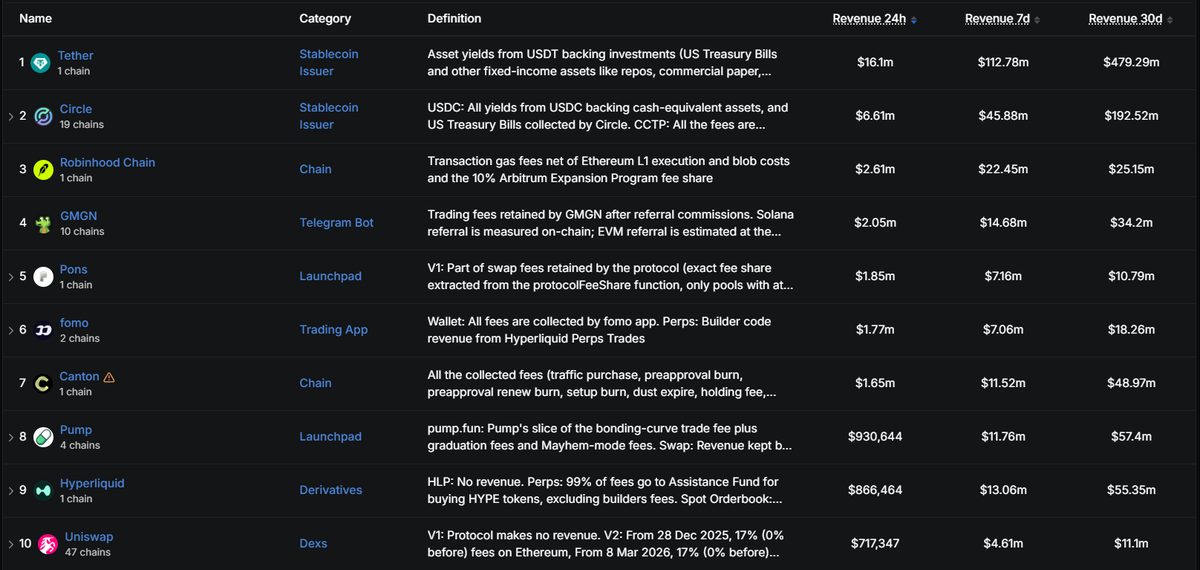
Public data on DeFiLlama’s protocol revenue dashboard show launchpads and meme-token trading terminals clustered near the top of retained-fee rankings. The same table still places dollar-stablecoin issuers—Tether and Circle—first, respectively.
What the ranking shows
DefiLlama ranks names by revenue—fees or yields a protocol retains—not by total fees users pay. On the current dashboard, Tether led at $16.1 million over 24 hours. DeFiLlama defines that line as yield on assets backing USDT, including Treasury bills, repos, commercial paper, money-market funds, and secured loans. Circle was second at $6.61 million, from USDC reserve yield and CCTP fees. Third was Robinhood Chain at $2.61 million.
DeFiLlama records that as transaction gas after Ethereum layer-1 execution and blob costs and after a 10% share under the Arbitrum Expansion Program. The chain page listed about $908.65 million in DeFi total value locked, $2.9 million in 24-hour chain fees, $4.21 million in 24-hour application revenue, and $1.368 billion in 24-hour decentralized-exchange volume.
Fourth was GMGN at $2.05 million in 24-hour revenue, $14.68 million over seven days, and $34.2 million over 30 days. Fifth was Pons, a token launchpad tracked on Robinhood Chain, at $1.85 million in the same ranking snapshot. Sixth was the fomo trading app at $1.77 million.
Seventh was Canton at $1.65 million, listed as chain fees that are burned. Eighth was Pump at $930,644 over 24 hours and $57.4 million over 30 days, almost entirely on Solana. Hyperliquid and Uniswap followed at $866,464 and $717,347.
Combined protocol revenue on the dashboard was about $39.37 million over 24 hours and $1.118 billion over 30 days.
How the leading apps record fees
GMGN.AI describes itself as a multi-chain meme-token trading terminal for new-token monitoring, holder analysis, copy trading, and automated execution. DefiLlama classifies it as a Telegram bot and says users pay a 1% trading fee. Fees are those payments.
Revenue is the amount kept after referral commissions. Solana referrals are measured on-chain; EVM referrals are estimated at the measured Solana rate of about 16%. Activity spans Robinhood Chain, BNB Chain, Solana, Base, Ethereum, and other networks.
Pons is tracked only on Robinhood Chain. DeFiLlama’s methodology says version 1 applies a 1% swap fee on launched tokens in pools with at least $200 in total value locked, plus 0.0005 ETH per launch, and retains a protocol share plus all launch fees. Version 2 adds bonding-curve fees and post-graduation Uniswap v4 swap fees.
Pump’s DeFiLlama page splits revenue across pump.fun bonding-curve and graduation fees, a 0.05% PumpSwap protocol fee, terminal fees after cashback and referrals, and the mobile app. Cumulative tracked revenue exceeds $1.28 billion, almost all on Solana.
fomo is listed as a trading app. DeFiLlama counts fees collected by the app and builder-code revenue from Hyperliquid perpetual trades.
Meme-coin frenzy on Robinhood Chain
Robinhood Chain has become one of the main venues for the current meme-coin cycle. DeFiLlama lists the network at $2.61 million in 24-hour chain revenue and $1.368 billion in 24-hour decentralized-exchange volume, with application revenue on the chain running higher than the chain’s own gas take. That gap is the tell: traders are not merely moving assets across an empty rollup. They are paying launch and swap fees inside apps that mint, list, and route meme tokens all day.
The fee stack on the chain is concentrated in those apps. Pons records launch fees and a protocol share of swap flow from tokens that start on a bonding curve and graduate into Uniswap v4 pools. GMGN takes a 1% cut on trades routed through its terminal, and Robinhood Chain is now one of its largest sources of retained revenue.
Uniswap still clears a share of the same spot flow after tokens leave the pad. Together they turn a new layer-2 into a meme-issuance market: chain gas rises because token launches and speculative trading are running through the same few interfaces.
Read: Robinhood Chain Activity Raises Questions Over New-User Adoption
What the list does and does not measure
Meme-coin market structure is what the ranking is capturing. After the two dollar issuers, the next names are a layer-2 carrying meme-launch traffic, a meme trading terminal, a meme launchpad, a consumer trading app used for the same flow, and Pump. That cluster is why launchpads and terminals belong in the headline: they are not a footnote on the list; they are the first application layer beneath reserve yield.
The distinction between fees and revenue works in their favor. GMGN, Pons, and Pump keep a direct cut of each launch or routed trade, so speculative volume shows up as protocol revenue instead of being paid mostly to liquidity providers. Uniswap can clear large notional flow and still rank lower because it retains only a defined protocol share.
Tether and Circle lead on reserve yield, which is a different business. On trading activity itself, meme issuance and execution are the lines moving the application rankings.
The figures also hold up across windows, not only on a single 24-hour print. Pump’s 30-day revenue of $57.4 million—as shows in DeFiLlama dashboard—remains among the largest application totals on the dashboard. Moreover, GMGN’s $34.2 million over 30 days and Pons’s concentration on Robinhood Chain show the same demand repeating day after day.
Dashboard prints move, but the pattern does not: meme launchpads and trading terminals are now core fee businesses in crypto, sitting immediately below dollar issuers and lifting the chains that host them.
Also read: Robinhood CEO Follow Sends AMC-Paired $MEME Coin Surging 150%