Robinhood Chain, the Arbitrum Orbit Layer-2 blockchain launched on July 1, 2026, has rapidly established itself as one of the most dynamic new networks in the cryptocurrency space. Backed by the retail trading giant Robinhood, with its nearly 28 million users, the chain blends traditional finance accessibility with decentralized finance (DeFi) capabilities.
While focused on tokenized real-world assets (RWAs), yield products, and high-speed trading, it has delivered impressive on-chain activity driven largely after meme coins narrative in just three weeks. Recent data confirms substantial month-over-month (MoM) surges in Total Value Locked (TVL) and Daily Active Users (DAU), signaling strong user adoption and liquidity inflows.
Explosive Growth in Key Metrics
As of 22 July 2026, Robinhood Chain’s DeFi TVL stands at approximately $305 million, reflecting an 11% increase in the last 24 hours and consistent upward momentum since launch. This marks a dramatic rise from early figures around $100 million within the first two weeks.
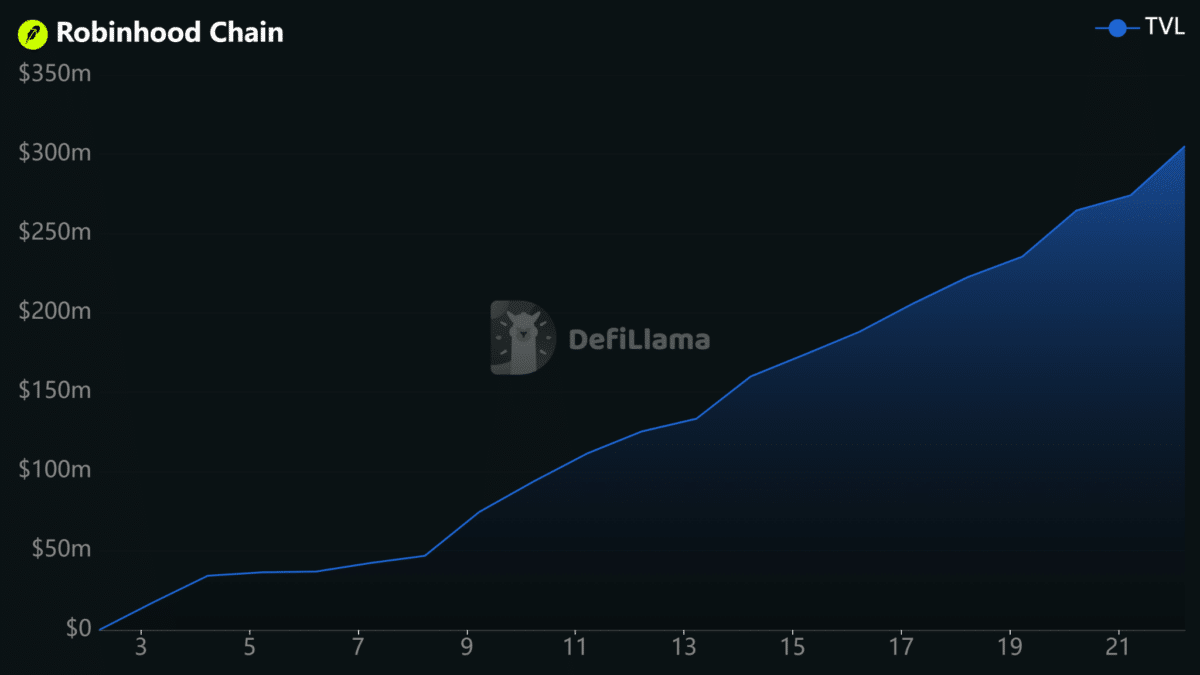
DeFiLlama data shows that stablecoin market capitalization of Robinhood Chain has reached $439 million, up nearly 30% over seven days, with USDG dominating at about 64%. Bridged TVL exceeds $950 million when including native and canonical assets.
Daily active addresses have climbed into the hundreds of thousands, with peaks near 245,000–300,000. Weekly active addresses recently surpassed 1 million, contributing to a reported 50%+ MoM surge in DAU alongside TVL.
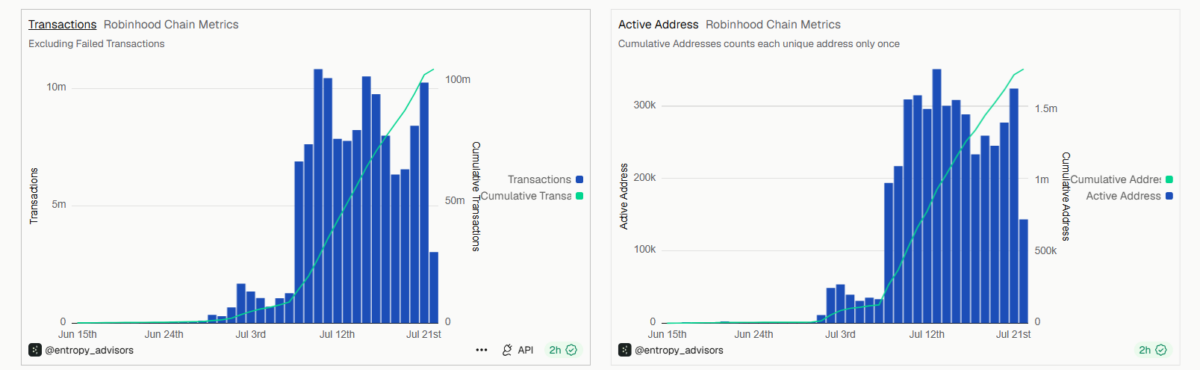
Dune dashboards show transaction volumes remain exceptionally high: $561 million in 24-hour DEX volume and nearly $4 billion over seven days. This velocity, often 10–30x the TVL, highlights intense trading activity. Cumulative DEX volume since launch exceeds $9 billion in some trackers. Chain fees reached $198,000 in 24 hours, with app fees adding $3.19 million, pointing to robust revenue potential.
These metrics position Robinhood Chain among top performers for new L2s, rivaling or briefly surpassing established networks like Hyperliquid in daily DEX volume during peak periods. Tokenized RWAs contribute a growing but smaller slice, with an active market cap around $63 million, including tokenized stocks like NVDA, AAPL, and GOOG held by over 53,000 unique addresses, already 9.7% of the broader tokenized equity market.
Drivers Behind the Surge: Memecoins, Lending, and Distribution Power
Several factors fuel this traction. Robinhood’s massive user base provides unparalleled distribution. The chain underpins Robinhood Earn, a yield product powered by Morpho Blue, which leads TVL at roughly $196 million. Institutional seeding, such as Ethena’s deposits into USDG vaults, provided early liquidity. Uniswap follows with $78 million in TVL, enabling seamless DEX trading.
Memecoins on Robinhood Chain, particularly tokens like CASHCAT launched via the NOXA platform, drove explosive early volume. At its peak, CASHCAT reached a $200 million market cap, contributing tens of millions in daily trades. While 75–80% of initial DEX volume was memecoin-related, this has diversified somewhat as infrastructure matures. Other protocols like Arcus, Spark, and Lighter add depth in lending and derivatives.
Read: CASHCAT Trader Loses 72% From $3.8M Peak as Token Crashes
The technical foundation as an Arbitrum Orbit chain enables low fees and high throughput, with 10% of net protocol revenue flowing back to Arbitrum. Ethereum benefits as the gas token, drawing over $70 million in bridged ETH in the first week alone. Integrations with Chainlink, Alchemy, and BitGo from day one enhanced reliability. Robinhood’s fee subsidies for the initial 90 days further lowered barriers, attracting both retail traders and DeFi natives.
RWA tokenization remains a core narrative. Users in 120+ countries can access tokenized U.S. stocks and ETFs on-chain for 24/7 trading, lending, and collateral use. While RWAs currently represent a fraction of activity compared to memes and lending, growth here could differentiate the chain long-term.
Outlook, Challenges, and Broader Implications
Robinhood Chain’s performance underscores how traditional finance platforms can accelerate blockchain adoption. It has quickly joined the top five chains by DEX volume, with over $3.1 billion in its first full week. If sustained, annualized revenue run rates could reach tens of millions, benefiting Robinhood’s stock (HOOD) and the broader ecosystem.
Currently, the 50%+ MoM surges in TVL and DAU reflect genuine momentum. With $305 million TVL, nearly $440 million in stablecoins, and billions in trading volume within weeks, Robinhood Chain demonstrates the power of brand, distribution, and timely product-market fit in crypto.
While early days, its trajectory suggests a meaningful player in the convergence of TradFi and DeFi. Stakeholders should monitor retention metrics and RWA adoption as the initial hype normalizes. The coming months will reveal whether this becomes enduring infrastructure or a notable but temporary launch success.
Also read: Zilliqa Reveals Five-Year Ledger Wallet Vulnerability Exposing Private Key