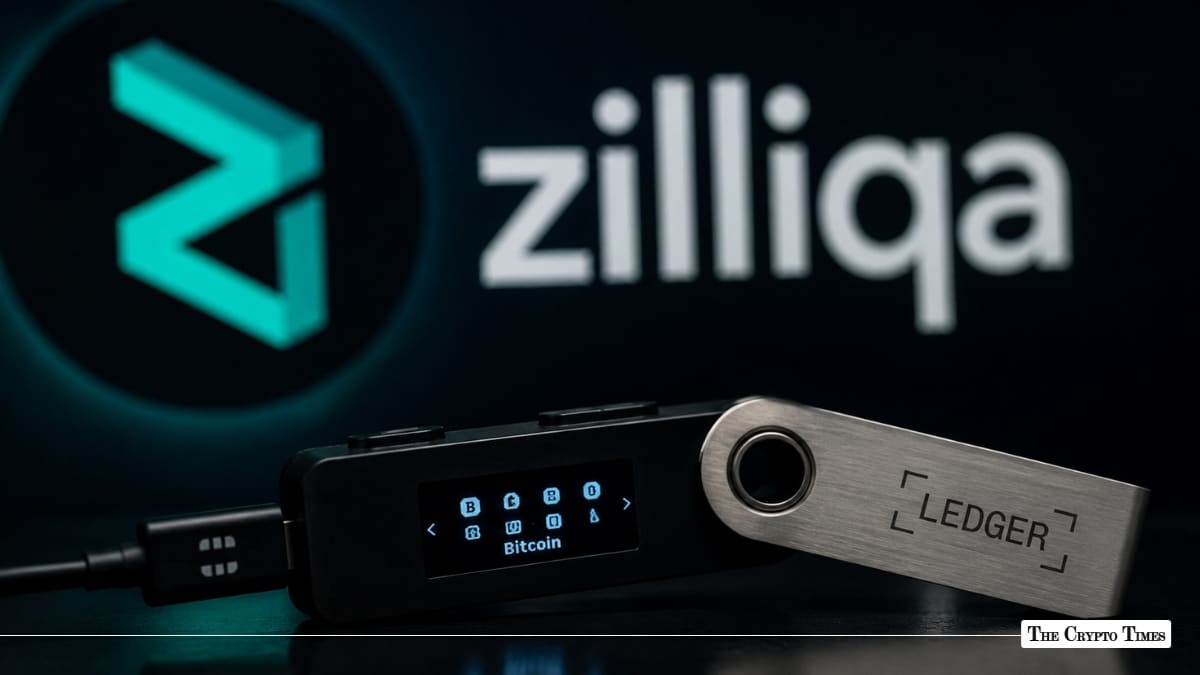
Zilliqa has publicly disclosed a serious, long-standing vulnerability in its official Ledger hardware wallet application that allows attackers to recover private keys belonging to users who have signed multiple native (non-EVM) Zilliqa transactions.
The issue, present in every version of the Zilliqa Ledger app since its launch in 2019, stems from a flaw in ephemeral nonce generation during Schnorr signature creation. As a result, the most significant 64 bits of every affected nonce were fixed at zero, enabling private key recovery from as few as five on-chain signatures using standard lattice reduction techniques.
Investigation and clarification
The disclosure follows an investigation launched after on-chain activity consistent with active exploitation was observed on July 20, 2026. Initially, suspicion fell on exchange wallet management, but Zilliqa’s probe quickly ruled this out. In a July 20 update, the project confirmed no evidence pointed to exchange-side issues and instead isolated the problem to a technical flaw in the Ledger app’s native transaction signing path.
KuCoin played a central role in the investigation. The exchange reported the issue, recovered affected private keys from publicly available on-chain data, and helped confirm ongoing exploitation. Zilliqa praised KuCoin’s “professionalism, technical expertise, and cooperation.”
Root cause
Zilliqa native transactions use EC-Schnorr signatures over the secp256k1 curve. Each signature requires a fresh, uniformly random 256-bit ephemeral nonce (k). The signing routine correctly generated 40 bytes of randomness and reduced it modulo the curve order to produce a uniform value. However, when copying the result into the nonce buffer, the code selected the wrong 32 bytes — retaining eight zero-padding bytes from the reduction process and discarding eight bytes of actual entropy.
This caused every generated nonce to satisfy k < 2¹⁹². With 64 known bits, each signature leaks information about the private key. After roughly five such signatures, the private key can be reconstructed efficiently on commodity hardware.
The bug was confined exclusively to the Ledger app’s native (non-EVM) signing path. EVM-compatible transactions and all official Zilliqa software development kits (zilliqa-js, gozilliqa-sdk, pyzil) remain unaffected.
Impact
Any account that has broadcast approximately five or more native Zilliqa transactions signed through the Zilliqa Ledger app should be considered compromised. Because the weakened signatures are permanently recorded on-chain, the exposure cannot be reversed by updating the app. Affected private keys must be retired.
Zilliqa emphasized that simply transferring funds out would be ineffective and potentially unsafe. An attacker in possession of the derived private key could attempt to front-run any legitimate transaction once activity resumes.
Protective measures and remediation
As soon as the root cause was confirmed on July 21, Zilliqa suspended native (non-EVM) transactions as a protective measure. This has halted further draining of affected accounts.
A corrected version of the Ledger app, restoring full-width nonce generation, has been prepared in coordination with Ledger. Release details will be announced separately. However, the fix only prevents future weakened signatures — it does not protect keys already exposed through prior transactions.
A coordinated remediation plan to secure affected balances is being finalized and will be published through official Zilliqa channels. Until then, users who have signed native Zilliqa transactions with a Ledger device are advised to take no independent action and to rely solely on official communications.
Broader context
The incident highlights the critical importance of correct nonce handling in elliptic-curve signature schemes and the permanent nature of on-chain data. While hardware wallets are widely trusted for key security, implementation bugs in supporting applications can still create systemic risks.
Zilliqa stated it will publish a full post-mortem, including detailed technical findings and recommended actions, once the investigation concludes.
Users holding or transacting ZIL exclusively through EVM-compatible tooling or non-Ledger wallets are not affected by this vulnerability. Zilliqa continues to work with Ledger and ecosystem partners on the remediation plan. The project has urged the community to monitor official channels for further updates.
Also Read: Coinbase Outage: Kubernetes Config Conflict Cause 50-Min Disruption