Ethereum (ETH) has faced significant price pressure throughout much of 2026, trading well below its August 2025 all-time high near $4,950. As of July 22, 2026, ETH hovers in the $1,900 range, reflecting broader market caution and underperformance relative to Bitcoin. Yet beneath the surface volatility, core fundamentals remain robust.
The network continues to attract staking capital at scale, institutional investors are returning via spot ETFs after periods of outflows, and the developer and builder community maintains strong conviction despite retail sentiment turning fearful. These dynamics point to a tightening supply picture and long-term structural support, even as short-term price action remains choppy.
The Vanishing Exit Queue: Surging Staking Demand Tightens Supply
One of the clearest signals of Ethereum’s underlying strength lies in its validator queue dynamics. The exit queue, representing ETH that validators wish to fully unstake and potentially sell, has effectively disappeared.
Recent data shows the exit queue at zero ETH with essentially no wait time. This marks a dramatic reversal from its peak of approximately 2.67 million ETH in September 2025.
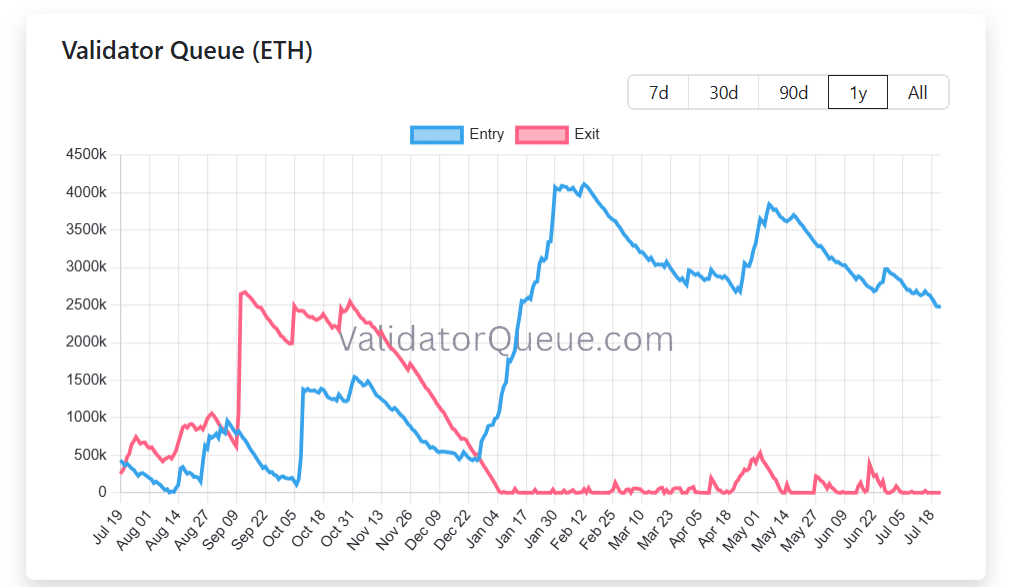
In contrast, the entry queue remains substantial at around 2.49 million ETH, with wait times stretching to roughly 43 days. This imbalance highlights robust demand for staking. As of the latest figures, Ethereum boasts approximately 885,000 active validators securing over 40.9 million ETH—equivalent to about 33.56% of the total supply. The staking APR currently sits near 2.64%, offering an attractive yield for long-term holders and institutions alike.
This staking surge has meaningful economic implications. When large amounts of ETH are locked into the proof-of-stake system, it reduces the liquid circulating supply available for trading. Combined with Ethereum’s deflationary mechanics (via EIP-1559 fee burns during periods of network activity), the result is a structural reduction in sell pressure.
Major entities, including corporate treasuries and staking-focused institutions, have accelerated deposits into the entry queue. Historical patterns suggest that sustained high entry demand and minimal exits often precede periods of reduced volatility or upward price momentum, as available supply on exchanges tightens.
Analysts note that this dynamic improves Ethereum’s supply-demand balance. With over one-third of ETH now staked and exits near zero, the network effectively removes significant capital from immediate market circulation. This is not merely a technical curiosity—it represents genuine conviction from participants who prefer earning yield over liquidating holdings amid uncertain macro conditions.
Institutional Confidence: Spot ETF Inflows Rebound Strongly
Parallel to on-chain staking growth, traditional finance continues to show renewed interest through U.S. spot Ethereum ETFs. After experiencing net outflows earlier in 2026 and a stretch of negative weekly flows, the segment has seen a clear rebound in July.
Recent daily data from SoSoValue shows inflows of approximately $38.09 million on July 20, over $37.47 million on July 21, and additional positive sessions shortly thereafter. BlackRock’s ETHA product has frequently led these gains.
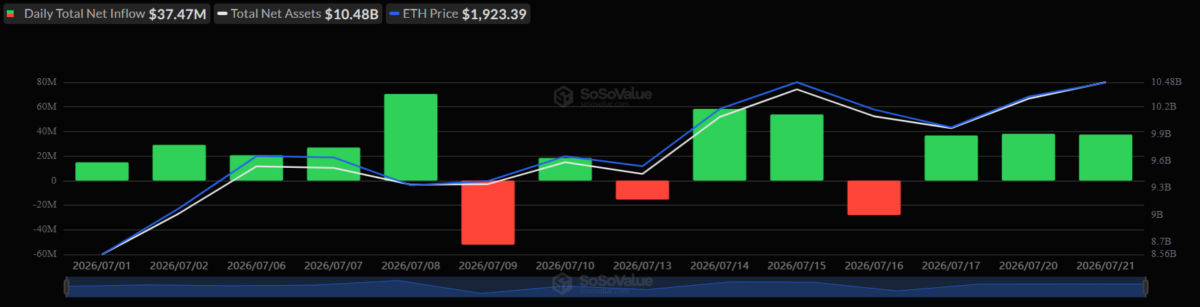
Cumulative net inflows into spot ETH ETFs now stand around $10.48 billion since their launch. Total assets under management across the products exceed $13 billion in recent readings, with leading funds holding billions in ETH. Several products, including staking-enabled variants, now pass through yields directly to investors, enhancing their appeal as income-generating vehicles rather than pure speculative bets.
These flows matter for multiple reasons. First, they represent regulated, accessible exposure for traditional investors, pension funds, and advisors who previously lacked straightforward pathways into ETH. Second, ETF purchases often involve buying and holding (or staking) actual ETH, further removing supply from the open market. While flows remain volatile day-to-day, reflecting broader risk sentiment and competition from Bitcoin ETFs, the July rebound after an eight-week outflow streak signals returning institutional appetite.
The presence of staking yields in select products differentiates ETH ETFs from many other crypto vehicles. In an environment where institutions seek both growth and income, this feature positions Ethereum favorably as a treasury or reserve asset. Sustained or accelerating inflows could provide consistent buying pressure, supporting price stability and potentially fueling rallies if macro conditions improve.
Community Sentiment: Surface-Level Fear Masks Deeper Strength
Public and retail sentiment around Ethereum has been notably cautious in 2026. Social metrics have at times entered “extreme fear” territory, driven by prolonged underperformance versus Bitcoin, competition from faster Layer-1 chains, and broader crypto market fatigue. On-chain analytics platforms have highlighted low social dominance and a high ratio of negative commentary relative to positive posts.
However, this surface-level pessimism contrasts sharply with on-the-ground reality in the Ethereum ecosystem. Active addresses and network usage metrics remain elevated, comparable to levels seen during previous bull market phases.
Stablecoin activity and decentralized finance (DeFi) leadership continue to anchor real utility on the network and its Layer-2 scaling solutions. Developer activity stays among the highest in the industry, with ongoing work on major upgrades that promise improved scalability, efficiency, and security.
Community leaders and builders emphasize Ethereum’s unmatched liquidity, composability, tooling maturity, and role as the settlement layer for tokenized real-world assets (RWAs). Initiatives outside the core Ethereum Foundation, such as community-driven efforts to boost institutional adoption, underscore a decentralized, resilient ecosystem stepping up where needed. While price action has disappointed many retail participants, those focused on long-term infrastructure view current conditions as a period of consolidation rather than decline.
The divergence between fearful retail commentary and strong builder conviction is classic in crypto cycles. Extreme fear zones have historically coincided with local bottoms or setups for rebounds, as capitulation reduces weak hands and positions assets for recovery when catalysts emerge.
Current ETH Price Action: Recovery Amid Persistent Discount to Fundamentals
As of July 22, 2026, Ethereum trades near $1,915, reflecting a modest July recovery after testing multi-year lows near $1,566 in late June. The asset remains approximately 60% below its August 2025 all-time high near $4,950, with performance lagging Bitcoin amid broader market caution.
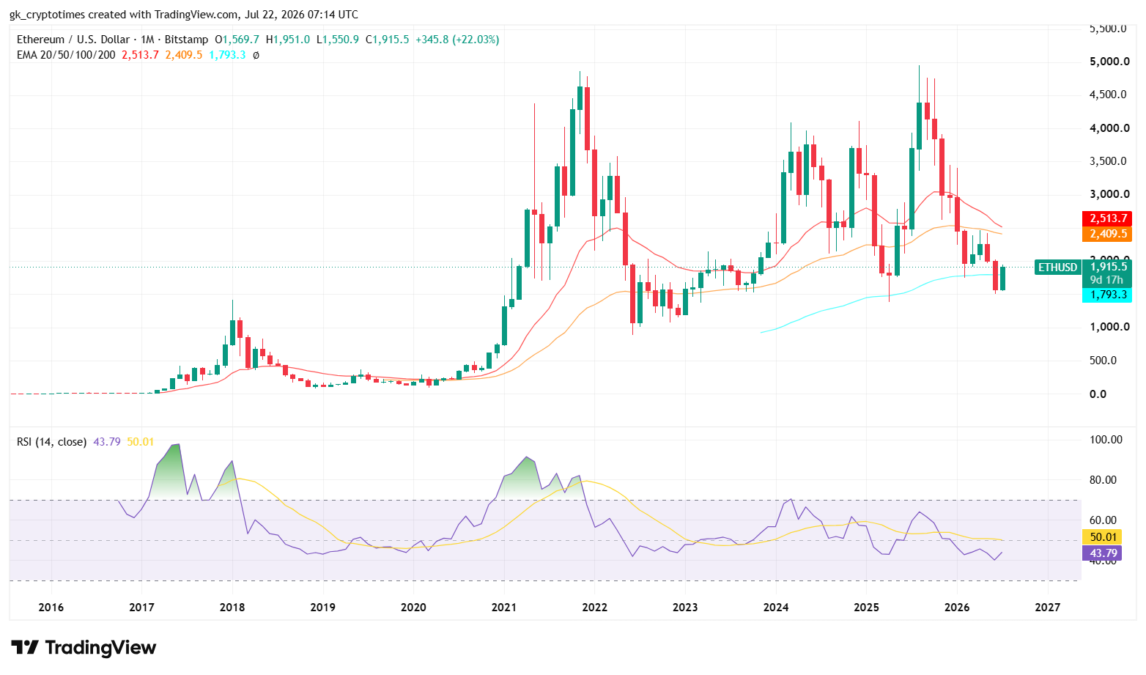
However, recent positive ETF flows and on-chain strength have helped stabilize sentiment, with ETH posting double-digit percentage gains for the month so far. Technical analysts are closely monitoring the $1,800–$2,000 zone, where a clear breakout could signal the start of a more sustained rebound.
On 1-hour timeframe, ETH price remains well below the 50-day and 200-day EMAs (around $1,830–$2,194), indicating the broader downtrend is still intact, though the RSI at 62.6 suggests short-term momentum is neutral-to-bullish and not yet overbought.
A sustained move above the $1,936–$2,000 resistance zone would be needed to challenge the longer-term moving averages and improve the technical outlook; otherwise, the $1,800 support area remains key for bulls. Overall, the chart reflects cautious recovery within a longer-term corrective phase.
What’s Ahead for Ethereum
Ethereum’s fundamentals in mid-2026 tell a compelling story of resilience. A near-zero validator exit queue paired with massive entry demand is locking up supply at scale. Spot ETF inflows have rebounded, bringing fresh institutional capital and yield opportunities. And while social sentiment reflects short-term price frustration, the builder community and on-chain metrics reveal enduring strength and utility.
These factors do not guarantee immediate price appreciation—crypto markets remain influenced by macroeconomics, Bitcoin dominance, and regulatory developments. They do, however, paint a picture of a network with tightening supply dynamics, growing institutional infrastructure, and a committed ecosystem prepared for the next phase of growth.
Also read: Solana Co-Founder Defends AI Training on Public Online Content