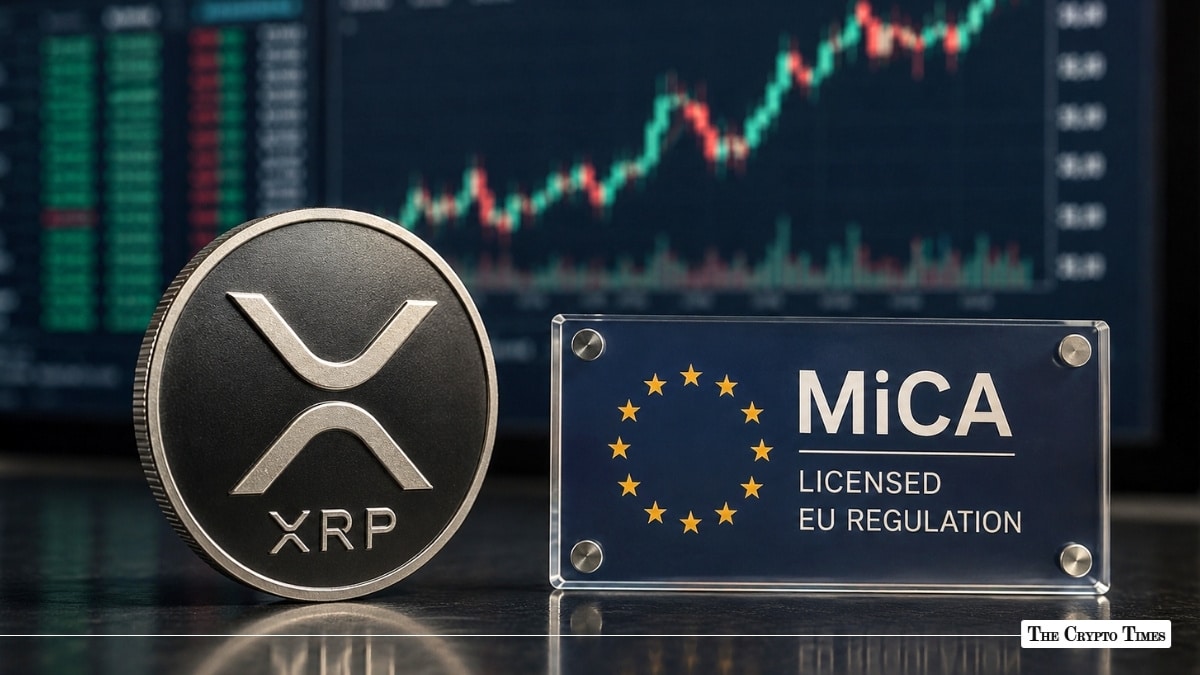
Ripple’s full MiCA license in Europe has given XRP a fresh recovery narrative, but the token’s next move will depend on whether regulatory approval turns into real payment volume and stronger market demand.
Ripple said on July 6 that it received full Crypto Asset Service Provider authorization from Luxembourg’s Commission de Surveillance du Secteur Financier (CSSF). The approval makes Ripple fully MiCA-compliant for cryptoasset services across the European Economic Area.
Key Highlights
- Ripple received full CASP authorisation from Luxembourg’s CSSF, making it fully MiCA-compliant for cryptoasset services across the EEA.
- XRP could benefit if Ripple’s European license leads to higher payment activity, liquidity demand, and institutional usage.
- Santiment data shows XRP’s 30-day and 365-day MVRV are deeply negative, suggesting a relief rally setup but not a confirmed reversal.
The company said its regulated crypto payments product is now available to financial institutions, corporates, and businesses across all 30 EEA countries. The license follows Ripple’s preliminary approval in June and comes just after Europe’s MiCA transition period ended on July 1.
For XRP traders, the immediate question is simple: will this help XRP price recover?
The answer is yes, but only indirectly. Ripple’s license improves the company’s institutional position in Europe, but it does not guarantee an immediate XRP rally. XRP still needs real transaction demand, stronger liquidity, and a technical breakout before the MiCA news can become a lasting price catalyst.
At the latest market snapshot, XRP was trading near $1.05, leaving the token close to the support zone already discussed in our XRP price prediction for July 2026.
Why Ripple’s MiCA License Matters for XRP
Ripple’s MiCA license matters because Europe has now moved from a transition phase into a stricter licensing regime. The CSSF said cryptoasset services in the EU may only be provided by authorised CASPs after the end of the transition period, while providers without authorisation must wind down their EU activities.
That makes the approval a market-access win for Ripple. It gives the company a regulated path to offer crypto payment services across Europe at a time when firms without MiCA authorisation face restrictions.
The development also fits into a wider shift in Europe’s crypto market. ESMA’s latest MiCA register update recently added major names including Standard Chartered and FalconX, as covered in our report on MiCA-licensed crypto firms. That shows MiCA is becoming a filter between regulated firms and platforms still trying to preserve EU access.
Ripple’s approval gives the company a cleaner compliance story than firms facing MiCA license pressure in Europe. For institutional clients, that matters because banks, payment firms, and corporates are less likely to use crypto payment rails without a licensed provider.
How XRP Could Benefit
The bullish case for XRP comes from Ripple’s own business model.
Ripple said its solutions span global payments, custody, liquidity, and treasury management. It also said RLUSD and XRP underpin these solutions, allowing Ripple and its customers to move, store, exchange, and manage value.
That is the strongest official link between the MiCA license and XRP. If Ripple uses the license to expand payment corridors, liquidity services, or treasury products in Europe, XRP could gain from higher institutional attention and deeper liquidity demand.
This does not mean every Ripple client will use XRP directly. It also does not mean RLUSD growth automatically pushes XRP higher. As we noted earlier in our report on XRP price pressure despite bullish news, Ripple’s corporate progress and XRP’s price action do not always move together.
Still, the MiCA approval gives XRP a stronger institutional narrative at a time when traders are already watching regulation, ETF flows, and support levels.
Data Shows XRP Is in a Pain Zone
The stronger short-term price support comes from on-chain data.
Santiment Intelligence said XRP Ledger average trading returns are historically low, implying a relief rally is probable. The post noted that XRP’s 30-day MVRV is around -45%, while its 365-day MVRV is around -47%.
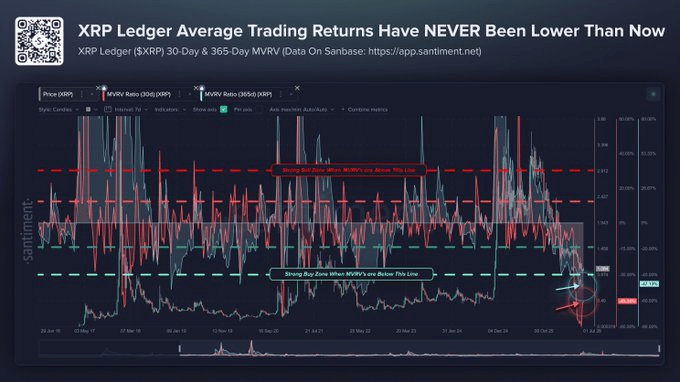
That means both short-term and long-term XRP traders are deeply underwater. According to Santiment, XRP has never shown lower average returns across those two timeframes in its roughly 12-year trading history.
MVRV, or market value to realized value, is often used to track whether holders are sitting on profits or losses. Deeply negative MVRV readings suggest many holders have already absorbed heavy downside, which can reduce selling pressure if broader market conditions stabilize.
This does not mean XRP cannot fall further. Santiment also warned that price can still dip if crypto markets remain weak. But from a risk-reward view, historically depressed average returns can create the setup for a relief rally when sentiment improves.
XRP Supply Tightening on Binance
Analysts on CryptoQuant have added another on-chain signal to the recovery case, the analytics platform said Binance’s XRP Scarcity Index has hit its highest level since mid-2024. Its Quicktake from ArabxChain noted that the index rose to around 0.77, pointing to a tighter supply balance for XRP on Binance.
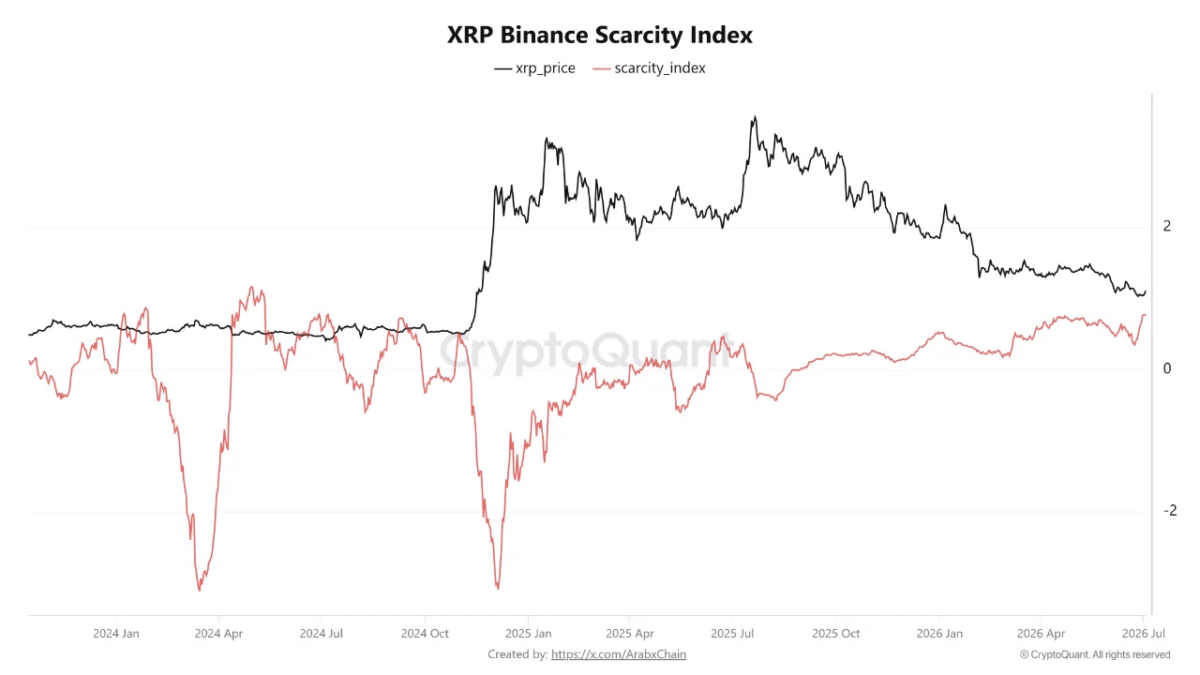
Binance remains one of the most important venues for XRP spot and derivatives activity. When XRP becomes scarcer on a major exchange, it can reduce immediate sell-side liquidity if demand starts to return.
In simple terms, Santiment is showing trader pain, while CryptoQuant is showing tighter Binance supply. Together, they create a more complete recovery setup: many XRP holders are already sitting on losses, and fewer tokens appear readily available on one of the largest trading platforms.
However, this is still not a guaranteed supply squeeze. The scarcity index is Binance-specific and can change quickly if holders deposit XRP back to the exchange. It also does not prove that new buyers are entering the market.
XRP now has a stronger setup for a relief rally, not a confirmed reversal.
XRP Price Still Needs a Breakout
The MiCA license and MVRV data give XRP two supportive narratives: a regulatory catalyst and an on-chain recovery setup.
But price still needs confirmation.
XRP has spent recent weeks struggling near the $1 area. The token needs to defend that support and reclaim higher resistance levels before traders can call the move a confirmed recovery. In our earlier XRP July outlook, the $1.20 zone remained an important confirmation level for a stronger bullish shift.
A move above the recent $1.16 area may help XRP stabilize in the short term. But a daily close above $1.20, backed by rising volume and open interest, would be a cleaner signal that buyers are returning.
Without that breakout, Ripple’s MiCA approval may remain a sentiment boost rather than a confirmed trend reversal.
What Else Could Help XRP Price?
XRP’s recovery will not depend on MiCA alone.
The token still needs help from broader crypto market sentiment, Bitcoin stability, and institutional flows. Earlier this year, XRP reacted strongly when the CLARITY Act advanced, with the token breaking above $1.50 as regulatory optimism improved. That move showed how sensitive XRP remains to legal and policy catalysts, as covered in our report on CLARITY Act optimism lifting XRP.
ETF flows are another factor. XRP ETFs have already attracted attention during periods when Bitcoin and Ethereum products saw weaker flows, as noted in our coverage of XRP ETF inflows.
For now, traders are likely to watch four signals: whether XRP holds $1, whether it reclaims $1.20, whether Ripple announces real European payment clients under the new license, and whether Santiment’s MVRV setup leads to actual buying pressure.
Bottom Line: Will Ripple’s MiCA License Help XRP Recover?
Ripple’s MiCA license can help XRP recover, but not by itself.
The license gives Ripple a regulated path to scale crypto payment services across Europe. It also strengthens XRP’s institutional narrative because Ripple says XRP and RLUSD underpin its broader financial infrastructure solutions.
However, the approval is for Ripple as a cryptoasset service provider. It is not a direct regulatory endorsement of XRP as an investment product, and it does not change XRP’s supply or market structure.
The strongest near-term case now comes from the combination of two factors: Ripple’s regulatory win and Santiment’s deeply negative MVRV data. Together, they suggest XRP has a better recovery setup than before.
But the market still needs proof. XRP must hold support, break resistance, and show that Ripple’s European license is creating real usage. Until then, the MiCA approval is a promising catalyst, not a confirmed price reversal.
Also Read: Ripple Secures Full EU MiCA License via Luxembourg’s CSSF