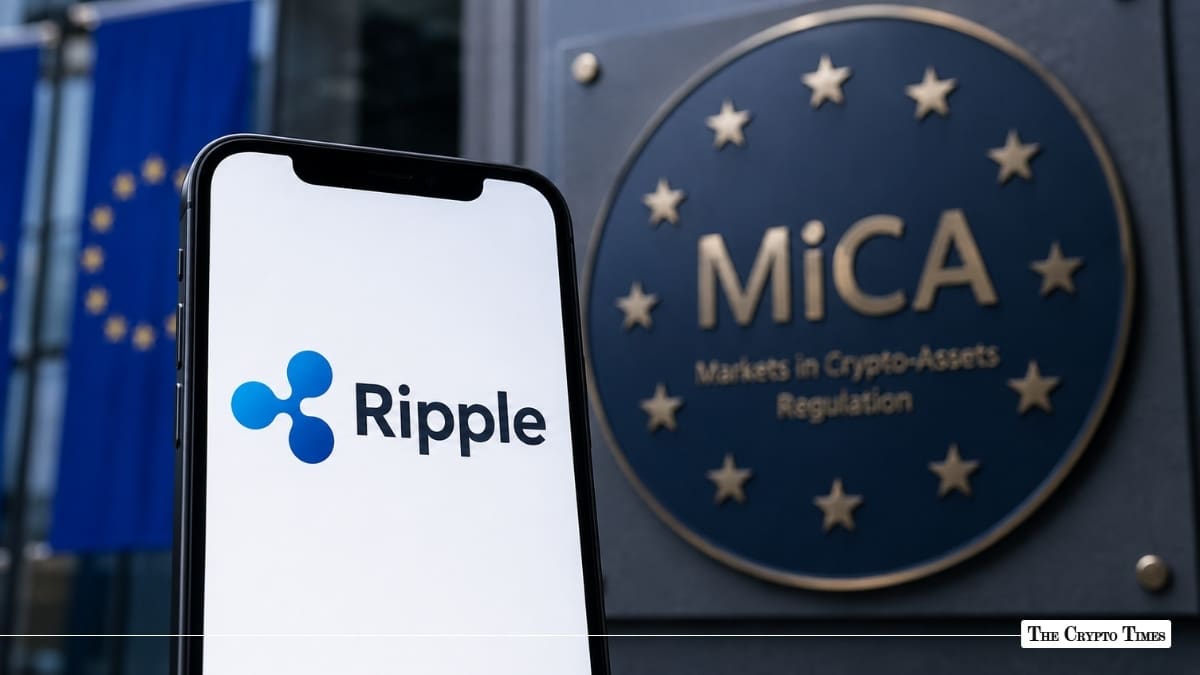
Ripple has planted a fully regulated flag in Europe. On July 6, the blockchain payments company announced it had received authorization of its Crypto-Asset Service Provider (CASP) license from Luxembourg’s Commission de Surveillance du Secteur Financier (CSSF), completing its requirements under the EU’s Markets in Crypto-Assets Regulation (MiCA) and confirming the firm as fully compliant across the European Economic Area.
The approval, which follows a preliminary green light in June, arrives at a defining moment for European crypto, just days after MiCA’s transitional period expired on July 1, 2026, redrawing the map of who can legally operate in the bloc.
What Ripple secured
With the CASP authorization in hand, Ripple can now offer its end-to-end regulated crypto payments product to financial institutions, corporates and businesses across all 30 countries of the EEA, using MiCA’s single-passport model in which one national license unlocks the entire bloc.
“This CASP authorisation means Ripple enters the post-transitional MiCA era fully compliant and ready to scale,” said Cassie Craddock, Ripple’s Managing Director for the UK and Europe, adding that European institutions increasingly want to build digital-asset services alongside regulated partners.
The full stack: CASP plus EMI
What makes Ripple’s position notable is that the CASP license does not stand alone. Combined with its EU Electronic Money Institution (EMI) license, the authorization makes Ripple one of only a small number of digital-asset firms to hold full authorization under MiCA, and it adds to a global portfolio of more than 75 regulatory licenses. The pairing matters for Ripple’s stablecoin ambitions: under MiCA, fiat-backed stablecoins are classified as e-money tokens whose issuers must hold an EMI or banking license, while the CASP license governs services like custody, exchange, and payments. Holding both gives Ripple a compliant path to offer its dollar-pegged stablecoin RLUSD and its XRP-powered payment rails to European institutions within a single regulated structure.
Luxembourg emerges as a MiCA hub
Ripple’s choice of jurisdiction is telling. The CSSF has become a magnet for the industry’s most compliance-focused players, most prominently Coinbase, which became the first major US exchange to win a MiCA license from Luxembourg (granted in June 2025) and made the Grand Duchy its official European home. Coinbase opened a physical regional hub there and migrated its EU operations into a new entity, Coinbase Luxembourg S.A., after abandoning an earlier plan to base itself in Ireland, citing Luxembourg’s regulatory clarity and pro-innovation stance. Ripple now follows the same path to the same regulator.
Together, the two authorizations cement Luxembourg, alongside Malta and Ireland, as one of the primary gateways for global firms seeking EU-wide passporting under MiCA. The Grand Duchy has actively courted digital-asset business with a whole-of-government approach to blockchain and a series of dedicated laws, including its Blockchain Law IV accommodating digital securities and tokenization, and it is fast becoming the institutional address of choice for compliance-first crypto companies entering Europe.
The compliance contrast
The timing throws Ripple’s win into sharp relief. It lands in the immediate aftermath of the MiCA deadline that forced roughly 80% of pre-MiCA firms to exit, geofence, or wind down — most visibly Binance, whose bid for a license in Greece collapsed, leaving the world’s largest exchange without EU authorization.
Ripple instead joins the growing roster of fully licensed players that includes Coinbase, OKX, Kraken, and Bybit, in a market that is rewarding firms that treated compliance as a competitive moat rather than an obstacle. The divergence is stark: as some giants are shut out, Ripple is cleared to scale.
Why it matters for XRP and RLUSD
For Ripple, the license is the regulatory foundation beneath its European institutional strategy. It clears the way to market XRP-based cross-border payments, custody, and treasury services to EU banks and corporates on a fully compliant basis, and it gives RLUSD a regulated route into a market where Circle’s USDC and EURC have dominated the compliant-stablecoin conversation.
Coming shortly after Ripple spotlighted its push into on-chain institutional credit through the XRP Ledger’s lending framework, the MiCA authorization reinforces a consistent thesis: Ripple is positioning itself as regulated financial infrastructure for institutions, not a retail-facing exchange. Following the resolution of its long-running US legal battle, that global, license-heavy expansion has become the company’s defining strategy.
The bigger picture
MiCA was designed to professionalize European crypto, and the early post-deadline landscape suggests it is doing exactly that: concentrating activity among well-capitalized, compliance-native firms while pushing others out. Ripple’s full authorization, spanning both services and e-money, positions it to compete for the institutional payments and stablecoin business that MiCA has made newly accessible to licensed players. In a bloc of some 450 million people where legal certainty is now the price of entry, Ripple has paid it, and intends to build on it.
Also Read: MiCA’s July 1 Deadline: What It Means for Your Crypto in Europe