
Bitcoin price fell below $62,000 on July 6 as market sentiment turned sharply cautious following Strategy’s revelation that it had sold part of its Bitcoin reserve.
BTC was trading near $61,800 at the time of writing, down about 1.38% in 24 hours. The asset had earlier climbed near $63,900 before reversing sharply, with market volume rising more than 38% to about $24.68 billion.
Key Highlights
- Bitcoin dropped below $62,000 after Strategy revealed it had sold 3,588 BTC for about $216 million.
- The disclosure changed market sentiment because Strategy has long been seen as the strongest public symbol of corporate Bitcoin accumulation.
- Liquidation data showed longs absorbed most of the damage, suggesting leverage accelerated the decline after the Strategy news hit sentiment.
The drop came as traders reacted to Strategy’s disclosure that it sold 3,588 BTC for about $216 million between June 29 and July 5. The company said the proceeds were used to fund preferred-stock distributions and replenish its USD reserve. Strategy still held 843,775 BTC as of July 5.
The timing has put one question at the center of the market: Is Strategy behind today’s Bitcoin crash?
Strategy Revelation Changed Bitcoin Market Sentiment
Strategy’s Bitcoin sale is important not only because of its size, but because of what it signals.
For years, Strategy and Michael Saylor built one of the strongest corporate Bitcoin accumulation stories in the market. The company repeatedly raised capital to buy Bitcoin and became a public proxy for institutional conviction in BTC.
That sentiment changed after the latest disclosure.
The sale showed that Strategy’s Bitcoin reserve is no longer only an accumulation vehicle. It can now also become a funding source for preferred-stock distributions, USD reserves, and balance-sheet management.
That is why the market reaction was sharper than the raw sale size may suggest. Strategy’s $216 million BTC sale was small compared with Bitcoin’s daily trading volume, but the revelation hit a sensitive part of market psychology: the belief that Strategy would keep adding Bitcoin rather than selling it.
Bitcoin Price Drop Was Not Just About Spot Selling
The Strategy disclosure appears to have acted as the main sentiment trigger, but the actual price decline was amplified by leverage.
CoinGlass liquidation data showed $95.74 million in crypto liquidations over one hour, with longs accounting for $90.76 million. Over four hours, total liquidations reached $109.96 million, including $99.84 million in long positions.
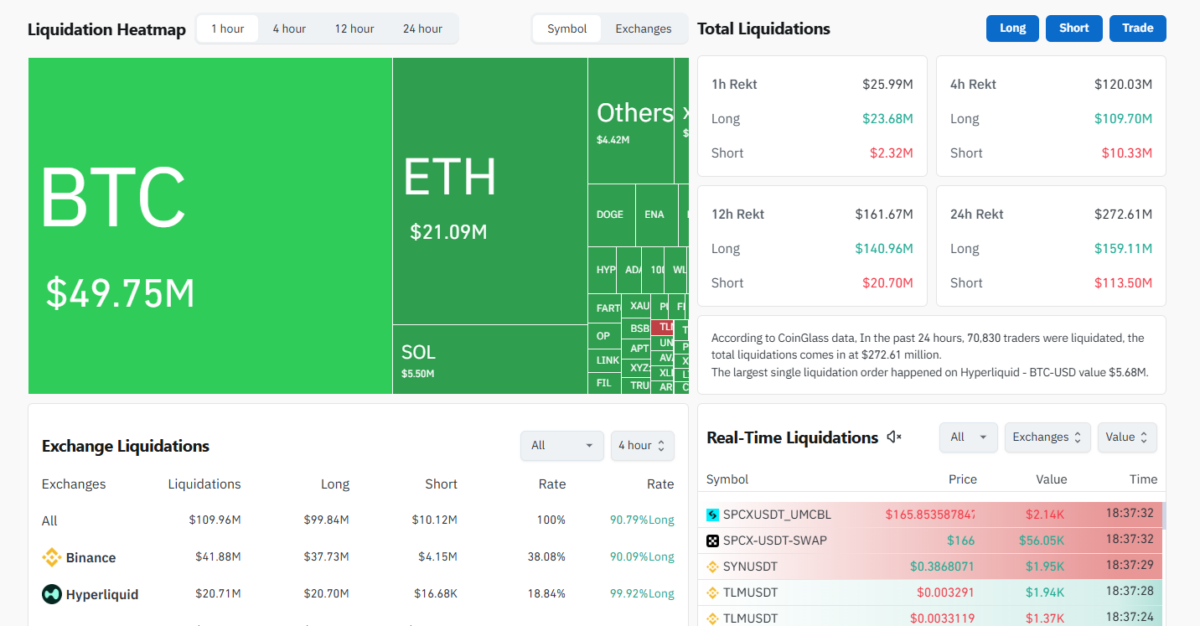
Bitcoin led the liquidation heatmap with $49.75 million wiped out, followed by Ethereum at $21.09 million and Solana at $5.50 million. This shows that traders were heavily positioned for upside before the reversal. Once BTC lost the $62,500–$62,000 range, forced selling from leveraged longs accelerated the decline.
In other words, Strategy changed the market mood. Leverage turned that mood shift into a sharper price move.
Did Strategy Directly Cause the Bitcoin Crash?
Strategy should be treated as a major reason behind today’s sentiment shift, but not the only mechanical driver of the crash.
The company’s sale was completed across June 29 to July 5, according to the disclosure. That means the market was not reacting only to a live sell order. It was reacting to a new reality: the largest corporate Bitcoin holder had sold BTC to meet financial obligations.
That matters because Bitcoin traders often respond more strongly to narrative changes than to isolated transaction sizes.
The sale raised three immediate concerns:
First, Strategy may sell Bitcoin again if preferred-stock obligations or reserve targets require more liquidity.
Second, corporate Bitcoin treasuries may face more scrutiny if BTC remains below their average cost basis.
Third, MSTR’s treasury model may now carry a different risk premium because Bitcoin can be used to fund liabilities.
The liquidation wave then supplied the second leg of pressure. As BTC broke lower, long positions were forced out across major venues, adding speed to the fall.
Bitcoin Levels to Watch After Strategy’s BTC Sale
Bitcoin now needs to reclaim the $62,500 to $63,000 zone to show that the drop was mainly a sentiment shock and liquidation flush.
If BTC fails to recover that range, the market may turn its focus back to $60,000, which remains the major psychological support level.
| Bitcoin Level | Market Meaning |
|---|---|
| $63,000 | Recovery level after the selloff |
| $62,500 | Broken intraday support |
| $61,500 | Near-term defense zone |
| $60,000 | Major psychological support |
| Below $60,000 | Risk of deeper liquidation pressure |
A move back above $63,000 would weaken the crash narrative. But if Bitcoin loses $60,000, Strategy’s sale could become a bigger bearish talking point for traders already worried about treasury selling and corporate BTC reserves.
Why This Matters for Bitcoin
The Strategy sale marks a major change in Bitcoin market psychology.
Until now, Strategy’s Bitcoin activity was mostly seen as a bullish signal. Purchases supported the idea that corporate treasuries would keep absorbing supply. The latest disclosure changed that perception.
The market is now being forced to price a new question: if the most aggressive public Bitcoin treasury can sell BTC to fund obligations, will traders continue treating corporate Bitcoin reserves as one-way accumulation vehicles?
That question is now weighing on BTC price more than the sale amount itself.
What’s Next?
Bitcoin’s next move depends on whether buyers can defend the $61,500–$60,000 zone and whether Strategy’s sale is treated as a one-off liquidity decision or the beginning of a recurring treasury-risk theme.
For now, the stronger read is clear: Strategy’s revelation triggered a sentiment break, while leveraged long liquidations intensified the downside.
Bitcoin has not crashed because of Strategy alone. But Strategy gave the market the reason it needed to sell.
Also Read: MSTR Price Prediction: Will Strategy Stock Crash After Bitcoin Sale?