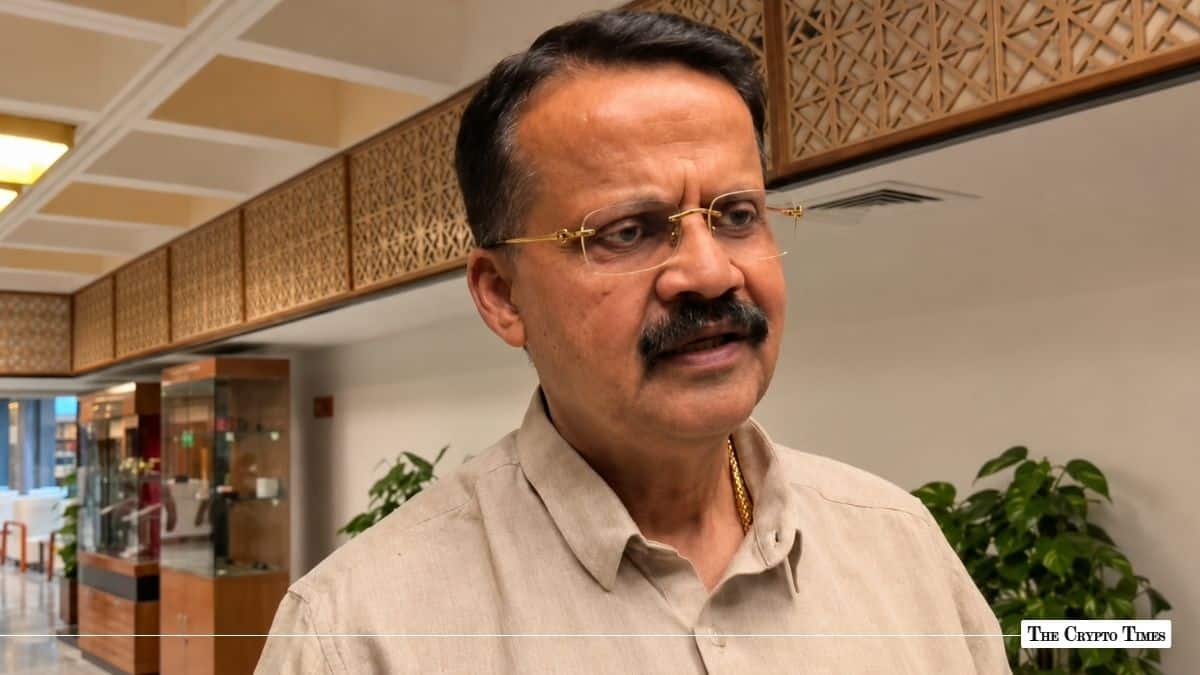
The Reserve Bank of India (RBI) has not recommended granting legal status to cryptocurrency in India. Standing Committee on Finance Chairman Bhartruhari Mahtab confirmed this in a media interaction with ANI after today’s sitting, shutting down any speculation that the central bank may be softening its decade-long opposition to private crypto.
When a reporter from ANI directly asked whether the RBI has spoken about or suggested giving cryptocurrency legal status in India, Mahtab’s response was a flat “No.”
That one word carries weight. This was the first time the RBI appeared before the parliamentary panel to present its views on Virtual Digital Assets (VDAs) directly. And the central bank used that appearance to hold the same line it has maintained since December 2013.
What happened in today’s meeting
The Standing Committee on Finance held its 7th sitting on July 2, 2026, at Parliament House Annexe, New Delhi, under the subject “A Study on Virtual Digital Assets (VDAs) and Way Forward.” The day was split into three sessions.
The RBI appeared in the first session from 11:00 AM to 12:30 PM and presented its assessment of VDAs, covering financial stability risks, monetary policy impact, and concerns around money laundering and investor protection.
The Institute of Chartered Accountants of India (ICAI) appeared in the second session from 12:30 PM to 1:30 PM. Mahtab confirmed that ICAI has been auditing virtual digital assets under the existing income tax framework but noted there are “certain constraints” and that “India should find a way out.”
A third closed session was scheduled from 3:00 PM to 4:00 PM for the committee to deliberate internally on the evidence recorded.
RBI’s CBDC is “not flourishing,” Chairman admits
Perhaps the most telling remark came when the reporter asked about the RBI’s Central Bank Digital Currency (CBDC) pilot, which has been running for over three years since its launch in December 2022.
Mahtab said that in comparison to other digital assets, “RBI’s digital asset is not a flourishing asset.”
That is a significant admission from the chairman of the committee overseeing this study. The Digital Rupee (e-rupee) has crossed 150 million transactions in volume with a total value exceeding Rs 34,000 crore, but its adoption has struggled against the dominance of the Unified Payments Interface (UPI), which processes over 300 million transactions daily. The e-rupee currently has roughly 10 million users, representing just 0.42% of India’s population. Daily transaction volumes, which hit 1 million in December 2023 through bank-driven incentives, dropped to around 100,000 shortly after.
Why does this sitting matter more than the previous seven
This was the first time the RBI appeared before the panel on VDAs. All seven previous sittings heard from crypto exchanges (CoinDCX, Coinbase, CoinSwitch, Binance, WazirX, ZebPay), the Financial Intelligence Unit (FIU-IND), the Central Board of Direct Taxes (CBDT), the Revenue Secretary, the Income Tax Department, the International Financial Services Centres Authority (IFSCA), and the Secretary of Corporate Affairs.
The RBI’s direct testimony matters because the central bank is the single biggest reason India still does not have a crypto regulation framework. A crypto regulation discussion paper, reportedly in its final drafting stages under a working group led by the Department of Economic Affairs (DEA) since May 2025, has been shelved at least five times. The delay has been attributed primarily to the RBI’s persistent opposition.
The central bank has consistently argued that legitimizing crypto through regulation could allow the sector to become systemic and pose risks to financial stability, monetary sovereignty, and the integrity of India’s payments infrastructure.
The bigger picture: 119 million users, no law
India continues to lead the Chainalysis Global Crypto Adoption Index for the third consecutive year, with an estimated 119 million crypto users. Yet the country still has no comprehensive law governing VDAs.
What India does have is a tax regime: a 30% flat tax on crypto gains with no loss offset, 1% Tax Deducted at Source (TDS) on every transaction, and 18% Goods and Services Tax (GST) on trading fees. The effective tax burden pushes past 49%, and the result has been predictable.
An estimated 72.7% of India’s crypto trading volume has migrated to offshore platforms. MP Raghav Chadha noted during the Union Budget 2026-27 debates that nearly 73% of VDA trading now takes place on foreign exchanges, over 180 Indian crypto startups have moved abroad, and around 12 crore investors use offshore platforms.
Meanwhile, the CBDT informed the committee during its January 7, 2026, sitting that approximately Rs 888.82 crore in undisclosed income related to VDA transactions had been identified, and notices had been sent to over 44,000 taxpayers. The Enforcement Directorate (ED) has also uncovered unauthorized cross-border crypto transactions worth over Rs 2,500 crore.
What this does not mean
Today’s sitting was a consultation, not a verdict. The committee is still in its study phase. Chairman Mahtab has previously outlined three categories of global approaches the panel is examining: countries that regulate crypto (the United States, the United Kingdom, the European Union), countries that ban it outright (China), and countries that attempt to govern it through existing laws (Japan, Brazil).
No legislation, no policy announcement, and no regulatory framework change came out of today’s meeting. The 30% tax stays. The 1% TDS stays. And the RBI’s opposition to private crypto stays.
The committee’s next steps will determine whether its final report recommends India move toward a dedicated regulatory framework or continue relying on taxation and enforcement alone.
Also Read: From GENIUS Act to MiCA: India’s RBI Notes Global Regulatory Steps on Stablecoins