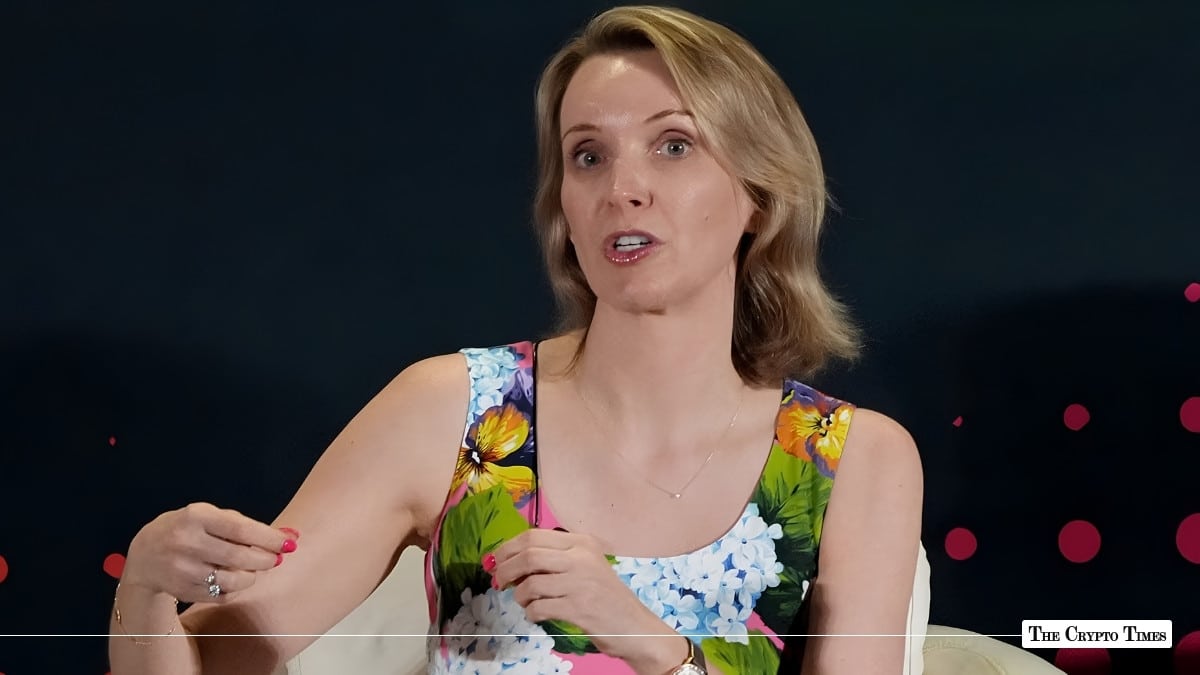
As doubts mount over whether the CLARITY Act can clear the Senate this year, Kristin Smith, President of the Solana Policy Institute and former head of the Blockchain Association, has made a public case that the bill still has a realistic path to the president’s desk before the August recess.
In a thread posted to X, Smith addressed what she described as growing worry in the crypto community about the bill’s progress. Legislation is never guaranteed, she wrote, but she believes there is a path to get the CLARITY Act enacted, and she said she has “never been more optimistic” that it can be done.
The timing is what makes the intervention notable. It arrived as the bill’s prospects have visibly cooled: closed-door negotiations over ethics language broke down earlier this month, the talks have fractured into competing tracks, and prediction markets now price the bill’s 2026 passage near 48%, down from roughly 74% a month ago.
Smith’s thread was highlighted by journalist Eleanor Terrett, who shared it as the on-the-record illustration of a broader shift she reported: a renewed sense of urgency among Republican lawmakers to get the CLARITY Act passed. According to Terrett, that urgency is being driven by political pressure spilling over from an unrelated housing bill fight and a growing awareness that time is running short, with senators leaving Washington this week with key issues, including ethics, still unresolved.
When they return on July 13, she noted, they will have just 20 working days to move the bill through the Senate and back to the House before the August recess. Terrett added that the pressure was not fazing some industry leaders, citing a16z’s Miles Jennings, who argued the time constraints could ultimately create the conditions needed to strike a deal, before pointing readers to Smith’s thread as the fuller version of that optimistic case.
The case Smith is making
Smith’s argument rests less on any single breakthrough than on the texture of the process. She said conversations are actively ongoing between Senate Democrats, Senate Republicans, the White House, and the industry, with daily in-person meetings between key negotiators at the member level—activity she argued would not be happening if the participants did not believe a deal was reachable. In Congress, she noted, time is scarce, and CLARITY is commanding a large share of it.
She pointed to bipartisan champions on both sides of the aisle, naming Republicans Cynthia Lummis and Bernie Moreno, alongside Democrats Kirsten Gillibrand, Ruben Gallego, and Angela Alsobrooks, argued there are no other major issues before Congress right now that both parties are willing to do the hard work to resolve. Industry advocacy, she said, is the strongest and most sophisticated it has ever been, a “pro-crypto army on the ground,” reflecting a sector that has matured and a Washington that now understands it better.
Crucially, Smith framed the looming recess not as a threat but as a forcing function. The Senate returns on July 13 and breaks in early August, leaving what she called four critical weeks to put CLARITY on the agenda and move it. Deadlines, she argued, force compromise, and this one is real; negotiators know the bill needs to move before the break. She closed by urging the community to “stay focused” and “stay positive,” casting the moment as the culmination of years of work that “deserves to be finished.” Her optimism was echoed by other industry figures, including a16z’s Miles Jennings, who has suggested the time pressure could itself create the conditions for a deal.
The math her optimism has to clear
Smith’s case is a genuine one, but it runs into arithmetic that has not moved in the industry’s favor. The CLARITY Act sits on the Senate Legislative Calendar, eligible for a floor vote, but it must clear a 60-vote cloture threshold to escape a filibuster.
With Republicans holding roughly 53 seats, that requires at least seven Democratic crossovers, and so far only two Democrats, Gallego and Alsobrooks, have backed the bill, both in the May committee markup, and both explicitly cautioned that their committee votes do not commit them to support final passage. That gap of seven-plus Democratic votes is, for now, the entire ballgame, and Majority Leader John Thune has not yet scheduled floor time.
The substantive objections have also hardened rather than faded. Section 604, the provision shielding non-custodial developers and DeFi infrastructure from certain registration and reporting rules, drew a letter from four major law enforcement organizations warning that their concerns remain unresolved and a separate letter from roughly 80+ anti-trafficking advocates urging tighter safeguards.
On the other side of the debate, crypto’s own founders have drawn lines on what they will accept, and Senator Elizabeth Warren, who filed dozens of amendments in committee, has called the bill a threat that would “blow up the economy.” Smith has rejected the framing that CLARITY weakens oversight, arguing it adds consumer protections and extends enforcement tools—but that contest over the bill’s character is itself unsettled.
The ethics standoff at the center
The single most contested fault line is ethics. Democrats have tied their support to language addressing conflicts of interest connected to the Trump family’s crypto holdings, and the closed-door talks on that language collapsed earlier this month.
Republicans and the White House withdrew support for a state-attorney-general enforcement mechanism and offered a narrower alternative limiting enforcement to the U.S. Attorney General, a substitution Democrats rejected as circular, given that the Attorney General serves at the president’s pleasure. An offer to treat impeachment as the remedy for presidential ethics violations was likewise declined. Until that knot is untied, the seven Democratic votes Smith’s optimism depends on are unlikely to materialize.
A four-week window, and a real deadline
What Smith gets right is that the window is not yet closed. The House has already passed its version and signaled it will move quickly on any Senate text, compressing one procedural step; the July 17 field hearing in New York keeps the bill in the spotlight; and Lummis has publicly committed to a July floor vote, the first hard date from a lead sponsor. Backers warn that missing the pre-recess window could push enforceable rules years down the road, by Lummis’s own estimate, potentially to 2030.
But optimism is not a vote count. For all the daily meetings and bipartisan goodwill Smith describes, the bill still needs an ethics deal that just fell apart and seven Democrats who have not yet stepped forward, inside a four-week sprint also competing with unrelated legislative fights for floor time. Her thread is a credible articulation of why the door remains open. Whether anyone walks through it before August will be settled not by sentiment, but by whether negotiators can convert a forcing deadline into the specific compromises that have eluded them for months.
Also Read: Senator Lummis Fires Back at Jamie Dimon Over CLARITY Act Criticism