Key Highlights
- Aave DAO approved the V4 upgrade proposal with 100% community support to start the deployment process on Ethereum.
- The upgrade has undergone 345 days of security review and will use precise risk rules for safer lending.
Aave DAO has passed the Snapshot vote for the activation of Aave V4 on the Ethereum mainnet, with the proposal receiving 100% support and moving to the next governance stage ahead of deployment. The vote was held for over four days from March 19 to March 23.
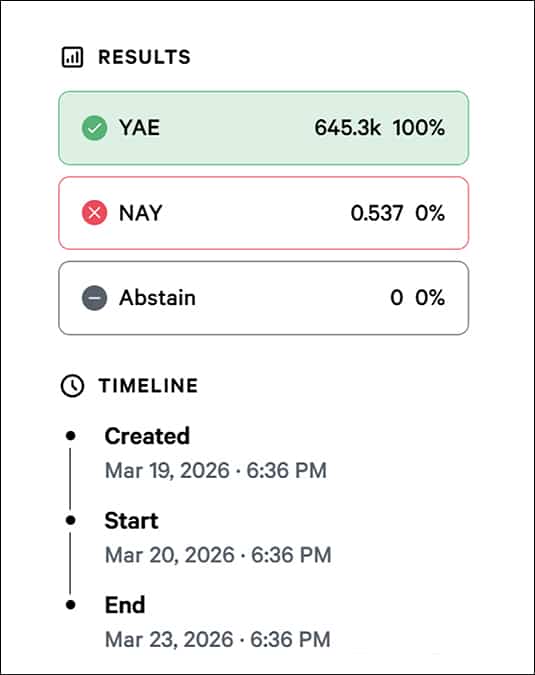
The vote marks a step forward for Aave’s next major protocol upgrade, but it does not yet represent the final on-chain activation. Under the governance process outlined in the proposal, the next step is an Aave Improvement Proposal (AIP), which will include deployed contract addresses and the final launch parameters reviewed by risk providers.
This is the first step in the Aave Request for Comment (ARFC) process, which allows the community to give feedback before a final on-chain vote.
Changing Aave’s lending approach
Aave V4 is the protocol’s next major upgrade. Aave remains one of the largest on-chain lending platforms. It has a new system called Hub and Spoke. The liquidity Hub will be the main pool where all supplied assets are kept, and Spokes are smaller units with their own rules for lending, risk, and collateral. This makes it easier to manage different markets separately and fixes past problems with isolated funds from earlier versions.
In addition, the upgrade includes better integration of Aave’s GHO stablecoin and a redesigned system for liquidations, which is how the protocol handles unpaid loans.
According to the snapshot proposal, “Taken together, these changes evolve Aave beyond a single generalized lending design. Liquidity depth is maximized, risk is priced with precision, and a wider range of lending activity can be supported onchain, within one framework, while segregating risk. This positions Aave to become the infrastructure for global onchain finance.”
Initial Ethereum rollout will be deliberately narrow
The initial deployment on the Ethereum mainnet is designed as a conservative launch rather than a full-scale expansion. The proposal says Aave V4 will go live with a deliberately narrow activation surface, minimal assets, and conservative supply and borrow caps so the DAO can monitor liquidity routing, utilization concentration, and credit-line draw behavior before expanding further.
The candidate setup under discussion includes three Hubs — Core, Prime, and Plus. Core is positioned as the default liquidity and routing venue, Prime is aimed at suppliers seeking a more controlled collateral posture, and Plus is designed for strategy-heavy stablecoin activity that can scale behind separate caps and pause conditions.
Within that framework, the proposal outlines several Spokes and supported assets, including major crypto collateral such as wETH, wstETH, wBTC, cbBTC, USDT, USDC, LINK, and AAVE, alongside assets tied to newer stablecoin and structured credit markets, including GHO, RLUSD, USDG, USDe, PT-USDe, PT-sUSDe, and XAUt. Final parameter values, however, will only be confirmed in the AIP after review by risk service providers.
Managing risk and different types of collateral
The V4 supports new types of loans by isolating risk and keeping them diverse. It can handle assets that have fixed maturities, limited redemption, or outside risks.
It can also support loans that are tied to income from real-world projects, with terms and repayment rules that match the loan. Spokes take liquidity from the Hub but keep each market’s rules separate. This way, stronger positions are not weakened by weaker ones, and suppliers earn based on the real risk they take.
The system also keeps track of supply and debt through shares, so each Spoke can work with its own rules while the overall system stays balanced. There is also a risk pricing system at the collateral level, which helps lenders and borrowers know the real risk for each market.
Next step for the upgrade
Aave Labs, led by Stani Kulechov, will now prepare the Aave Improvement Proposal and work with security and risk teams to set the final rules.
The V4 has been reviewed for about 345 days with audits, formal checks, tests, and a public security contest, funded by a $1.5 million security budget approved by the DAO. The upgrade is expected to make the platform more flexible and support new markets.
Also Read: Ethereum’s Quantum Defense? Vitalik Buterin Backs EIP-8141 Upgrade