
Key Highlights
- Spot gold jumped 1.2% to $5,163.60/oz and silver rose 3.1% as investors moved defensive.
- Bitcoin’s drop coincided with a $238M liquidation burst in an hour, dominated by longs with their $232M loss.
- Whale exchange deposits, miner treasury selling, and inconsistent ETF flows added supply into the decline.
- Prediction markets show traders pricing higher odds of a $45K drop than a return to $100K in 2026.
Gold climbed to a three-week high as the U.S. dollar weakened after fresh tariff uncertainty, with spot gold up 1.9% to $5,188.1/oz and silver up 5.6% to$86.9/z in the same session, according to data from derivatives marketplace CME group.
At the same time, Bitcoin (BTC), the largest cryptocurrency by market capitalization, is in hot waters as it just broke down below $65,000 again.

With volumes of gold and silver also raising, it opens up possibilities for further upside. That kind of metals bid is usually a clean tell: macro hedging demand is rising.
According to CoinMarketCap data, today’s low for BTC is already at $64,350. Bitcoin’s decline reads like three forces hitting at once: leverage, supply, and a softer “institutional absorption” bid.
Leverage unwind made the move violent
The slide accelerated during a liquidation burst: At the time of writing, $419 million has been liquidated in the 12 hours time frame. Most of the liquidations are coming from longs, as bullish traders lost $398 million, while only $21 million short bets were liquidated.
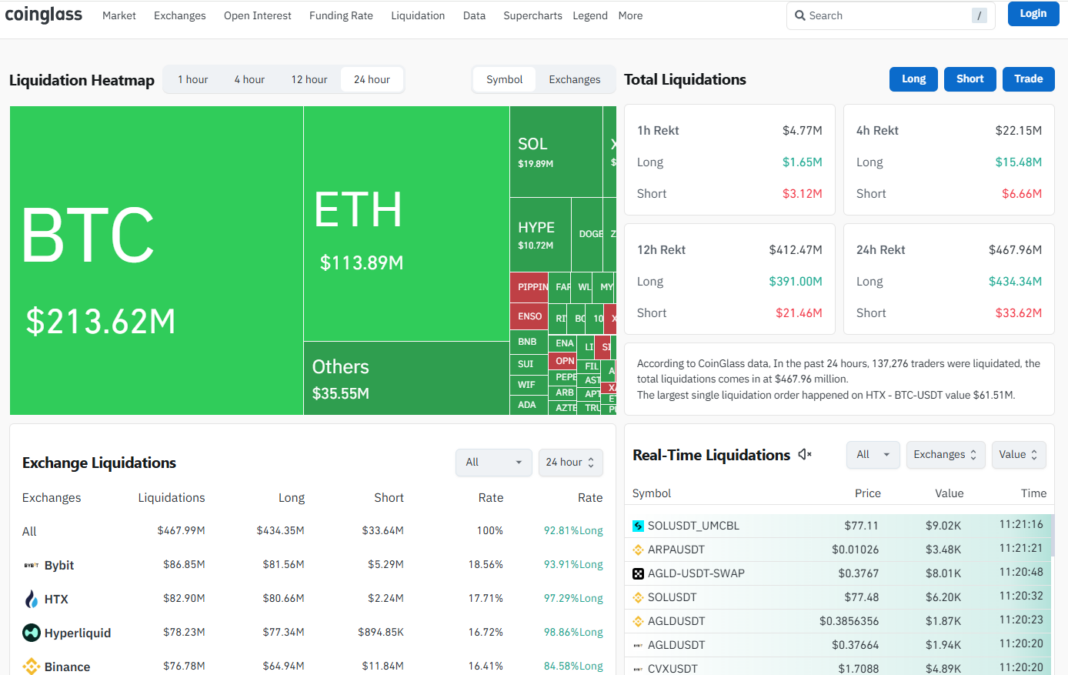
Coinglass data also reveals that in the past 24 hours over 139,131 traders were liquidated, with most of it coming up on CEX Bybit and HTX, followed by the trending DEX Hyperliquid.
Liquidations aren’t “opinions” — they’re forced market sells that mechanically push price lower. Market commentator The Kobeissi Letter shared $238 million liquidated in an hour.
Whales driving exchange deposits
CryptoQuant flagged a sharp rise in whale-led exchange inflows: the exchange whale ratio climbed to 0.64, which it described as the highest level since 2015—meaning the biggest deposits are making up an unusually large share of total inflow. Translation in plain English: large holders were the marginal supplier into the tape.
Arkham Intelligence also highlighted that Gerret Jin linked Hyperunit Whale is sending Bitcoins to Binance. With most recent $760M BTC transfer its most likely assumed that he is cashing out after making over $7 billion in on BTC and ETH.
Miner supply: Bitdeer liquidated its BTC treasury to zero
One of the cleanest, on-the-record signals of miner sell pressure came from Bitdeer. In its latest update, the firm disclosed that its proprietary Bitcoin holdings (excluding customer deposits) fell to 0 BTC as of February 20, after it sold 189.8 BTC of mined output during the week and liquidated an additional 943.1 BTC from reserves.
That’s not a routine “sell some production to cover costs” move—going to zero is a strong statement that treasury BTC became market supply. In a fragile market, that kind of miner liquidation can weigh on bids because it removes a potential buyer-of-last-resort (the miner treasury) and replaces it with supply.
Institutions: ETF flow data shows a choppy bid
Another reason the downside extended is that the “steady institutional bid” looked inconsistent heading into the week.
Per Farside Investors’ daily U.S. spot Bitcoin ETF flow table:
- February 18: -$133.3M net outflow
- February 19: -$165.8M net outflow
- February 20: +$88.1M net inflow
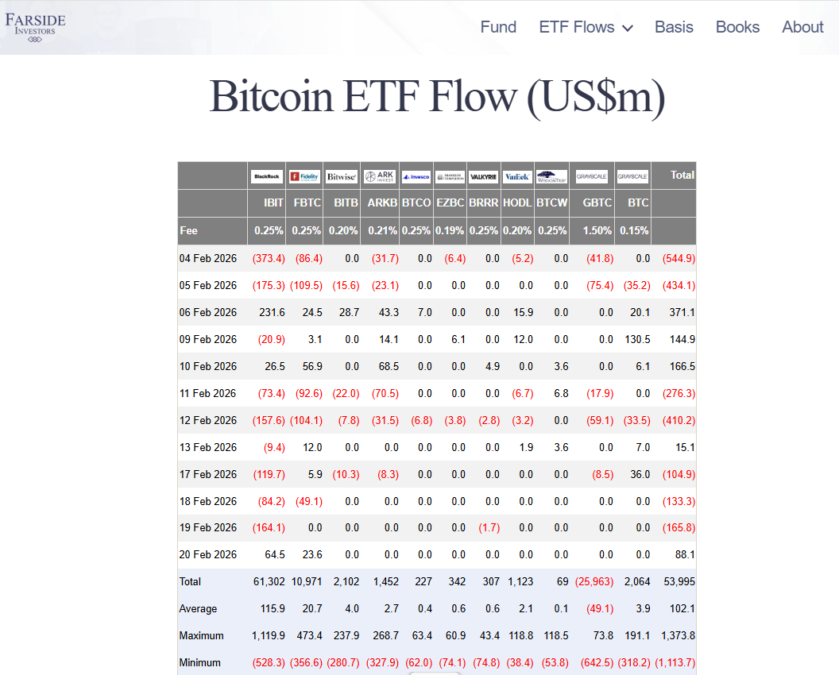
That pattern isn’t “institutions are gone,” but it does signal that flows were not one-way supportive. In a leveraged flush, uneven ETF demand can make it harder for spot to absorb forced selling and new supply.
Market sentiment is negative
Beyond flows, the sentiment tape is turning openly negative. Prediction-market positioning on Polymarket has shifted toward downside scenarios, with traders assigning higher probability for a Bitcoin crash to $45,000 than to it reclaiming $100,000 this year.
The same market also shows 72% odds that BTC touches $55,000 in 2027, even as the “base-case rebound” view remains that BTC could still trade back above $75,000 before year-end. In practice, that setup signals a market that expects volatility and downside risk to dominate near-term, which tends to keep dip-bids cautious during liquidation-driven selloffs.
So why is Bitcoin falling while metals rise?
Metals up signaled risk-off hedging. Bitcoin down because:
- leverage snapped (forced selling),
- whales dominated exchange deposits (sell-side supply),
- miner-linked flows added incremental liquidity,
- and ETF demand was choppy in the days leading into the move.
That’s why this session looked like a “store of value divergence”: gold/silver traded as hedges, Bitcoin traded like a leveraged risk asset.
Also Read: Venezuela May Swap Oil for Bitcoin Under Machado Plan