Key Highlights
- XRP jumped over 9% to $2.27 after Franklin Templeton and Grayscale launched their spot XRP ETFs on NYSE Arca.
- The ETF wave follows Ripple’s $125M SEC settlement, giving institutions the clarity needed to enter the XRP market.
- Institutional demand is rising as XRP’s fast, low-fee payment technology gains global relevance in cross-border settlement.
XRP jumped more than 9% to trade at $2.27 on Monday, marking one of its sharpest intraday gains this month, after Franklin Templeton and Grayscale officially launched their spot XRP ETFs on NYSE Arca.
The move signals a turning point for the token, with Wall Street institutions now accelerating their entry into XRP only months after Ripple settled its long-running legal battle with the U.S. Securities and Exchange Commission (SEC).
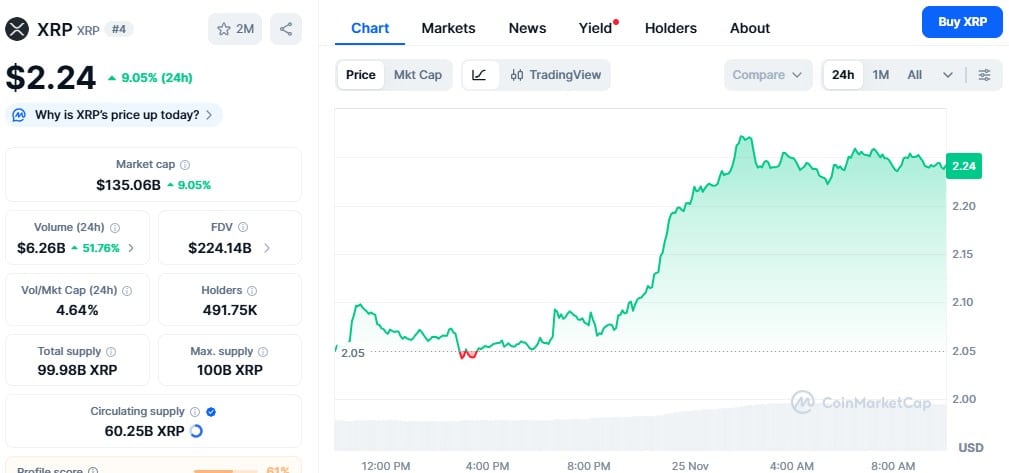
The rally coincided with a broader rise in XRP trading activity. At the time of writing, XRP was trading at $2.24, up 9.05% in the last 24 hours, with a market cap of $135.06 billion, according to CoinMarketCap.
A wave of institutional ETFs marks a new phase for XRP
Franklin Templeton, a $1.69 trillion asset manager, made a high-profile entry into the XRP market by debuting the Franklin XRP ETF (XRPZ) on NYSE Arca.
The fund provides regulated exposure to XRP through a grantor trust structure, tracking the CME CF XRP-Dollar Reference Rate. Coinbase Custody serves as the custodian, while BNY Mellon handles administration.
In its announcement, Franklin Templeton said XRP plays a “foundational role in global settlement infrastructure,” describing the ETF as a simple, transparent way for investors to follow XRP’s price without holding the asset directly. Early trading activity reflected strong interest, with 768,692 shares traded on day one.
Grayscale, the world’s largest digital asset manager, launched its own XRP Trust ETF (GXRP) the same day, offering a zero-fee introductory period to attract initial institutional demand.
Bitwise, which launched its XRP ETF a week earlier, reported $118 million in inflows, signaling strong appetite for regulated XRP products.
The clustering of ETF launches shows major asset managers were waiting for regulatory clarity, clarity that arrived earlier this year when Ripple finally closed its multi-year battle with U.S. regulators.
Regulatory resolution clears the path for Wall Street
The legal issues surrounding Ripple kept the XRP at bay over several years, restricting institutional access and barring financial companies to provide regulated products associated with the token. This was reversed in May 2025, when the company settled with SEC on a final basis.
Under the agreement required Ripple to pay the SEC $50 million directly and the extra $75 million was deposited in escrow, putting an end to the case without any admission of wrongdoing.
The agency officially ended the matter in August 2025 under new leadership. This regulatory resolution removed the biggest barrier to institutional participation. With the lawsuit behind it, XRP is now as regulatory clear as Bitcoin (BTC) and Ethereum (ETH), and ETFs, custodial integrations, and large-scale corporate interest are now possible.
The entry of Franklin Templeton is particularly interesting due to its size and presence in the world markets. The company has already dealt with Bitcoin and Ethereum investment products and has recently introduced a wider digital asset index fund.
Its decision to include XRP signals growing confidence in the asset’s long-term utility. Still, ETF prospectuses warn of risks, XRP’s price volatility, lack of diversification, and continued uncertainty in non-U.S. jurisdictions. The funds hold only XRP and cash, making them unsuitable for fully balanced portfolios.
Why institutions are interested: XRP’s technical strengths
XRP’s appeal to institutions isn’t driven only by legal clarity it’s also rooted in technology. The XRP Ledger (XRPL) is designed for fast, low-cost payments. The network processes transactions in 3–5 seconds, offers small fees, and has already handled more than 3.3 billion transfers, according to XRPL documentation.
XRPL’s efficiency makes it attractive for cross-border payments, an area dominated by slow, expensive systems like SWIFT. Reports from Franklin Templeton and Grayscale Research highlight XRP’s usefulness as a bridge currency, especially in emerging digital settlement systems.
These features differentiate XRP from cryptocurrencies like BTC, which primarily functions as a store of value rather than a settlement asset. Rising open interest in XRP futures further supports the case for growing institutional activity.
Global developments boost XRP’s relevance
Beyond ETFs, global financial trends are aligning with XRP’s use cases. Analysts at Black Swan Capitalist suggest that XRP could play a supporting role in new cross-border payment corridors across Asia, the Middle East, and Africa.
They also noted China’s indirect exposure to XRP through the BRICS New Development Bank and Japan’s SBI Holdings, though direct adoption remains limited by China’s policies.
In April 2025, the BRICS Business Council suggested the use of more powerful digital settlement systems in international trade, which is oriented in the direction of the design of XRP.
In the meantime, the European central bank is considering cross-border payments as part of the Project Nexus that seeks to connect regional payment systems.
What this means for the market
The introduction of several XRP ETFs in the U.S. is a milestone to both XRP and the digital asset market in general. It is a sign of maturity, increased regulation, and a more significant role in thinking that blockchain-based settlement systems will be significant in world finance.
With risks still present, institutional acceptance, technology benefits, and new regulatory clarity put XRP at the heart of a new digital payment innovation wave.
Also Read: CME Group to Launch Spot-Quoted XRP & SOL Futures