Stablecoins have become the backbone of cryptocurrency trading, DeFi, payments, and cross-border transfers. With a total market capitalization exceeding $317 billion as of early 2026, they offer the stability of traditional fiat while operating on blockchain rails. But not all stablecoins are created equal—what truly backs them determines their reliability, risk profile, and suitability for different use cases.
Understanding the collateral (or lack thereof) behind a stablecoin is critical. Whether you’re a trader seeking liquidity, a DeFi user pursuing yields, or an institution moving value on-chain, knowing the backing mechanism helps you assess peg stability, counterparty risk, and regulatory compliance. This guide breaks down the four main types—fiat-collateralized, crypto-collateralized, algorithmic, and those incorporating real-world assets (RWAs)—with the latest 2026 data, real-world examples, and key risks.
What Does “Backed By” Actually Mean?
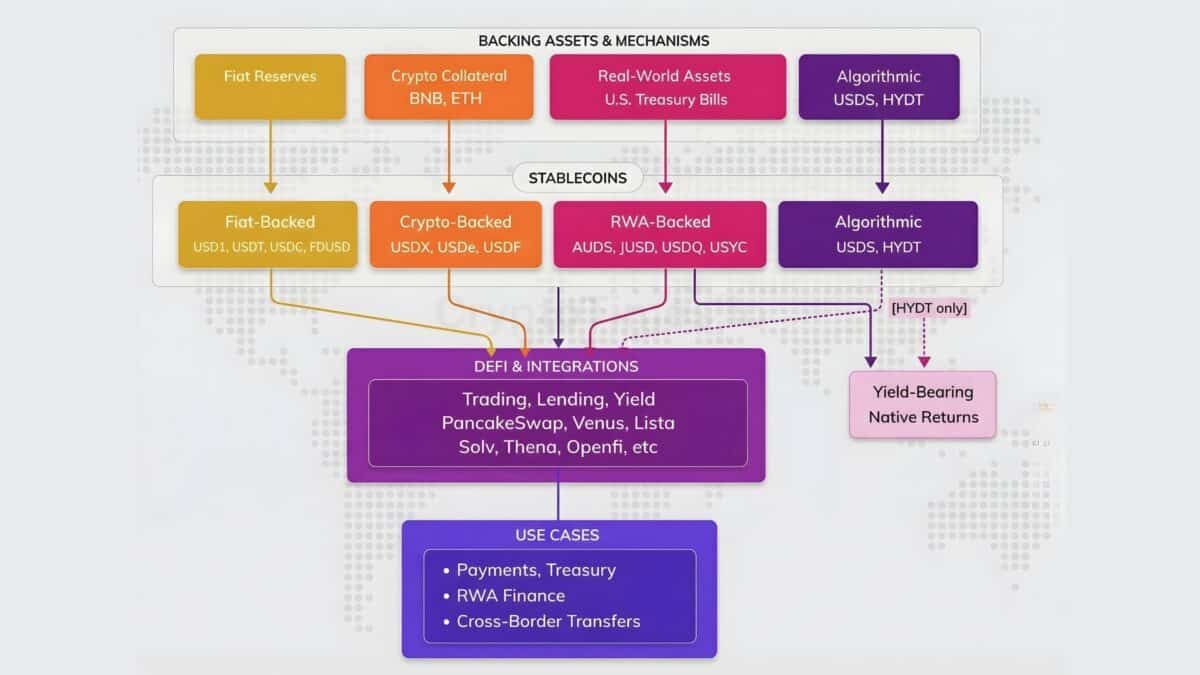
A stablecoin aims to maintain a 1:1 peg to a reference asset (usually the USD). “Backing” refers to the mechanism that enforces this peg:
- Collateralized stablecoins hold reserves (fiat, crypto, or RWAs) equal to or greater than the tokens in circulation.
- Algorithmic stablecoins use smart contracts and incentives to adjust supply dynamically, often with minimal or no collateral.
Transparency, audits, and over-collateralization are hallmarks of more functional designs. In 2026, regulators worldwide (the EU’s MiCA and the U.S. GENIUS Act) mandate 1:1 reserves for most payment stablecoins, along with regular disclosures and redemption rights.
The Four Main Types of Stablecoins by Backing
Here’s a high-level comparison:
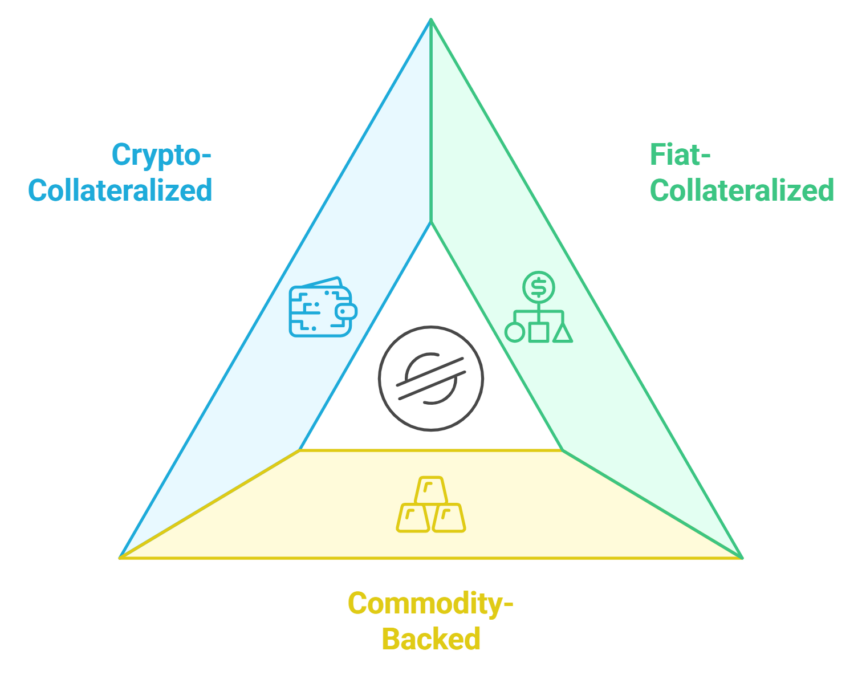
| Type | Backing Mechanism | Examples | Pros | Cons | Approx. 2026 Market Share |
|---|---|---|---|---|---|
| Fiat-Collateralized | 1:1 cash, Treasuries, bank deposits | USDT, USDC, PYUSD | High liquidity, low volatility | Centralized issuer risk | ~85–90% |
| Crypto-Collateralized | Over-collateralized crypto assets + RWAs | DAI (hybrid) | Decentralized, programmable | Liquidation risk in volatility | ~5–8% |
| Algorithmic | Smart-contract supply adjustments | FRAX, USDe (synthetic) | Capital-efficient | High de-pegging risk | <5% |
| RWA-Integrated | Tokenized Treasuries, bonds, and credit | USDY, PAXG, parts of DAI/USDe | Yield-generating, institutional | Regulatory & custody complexity | Growing (embedded in others) |
1. Fiat-Collateralized Stablecoins (The Dominant Standard)
These are backed 1:1 by traditional fiat reserves—primarily USD cash, short-term U.S. Treasury bills, and repos held in regulated banks or custodians. Issuers like Tether and Circle attest to reserves regularly.
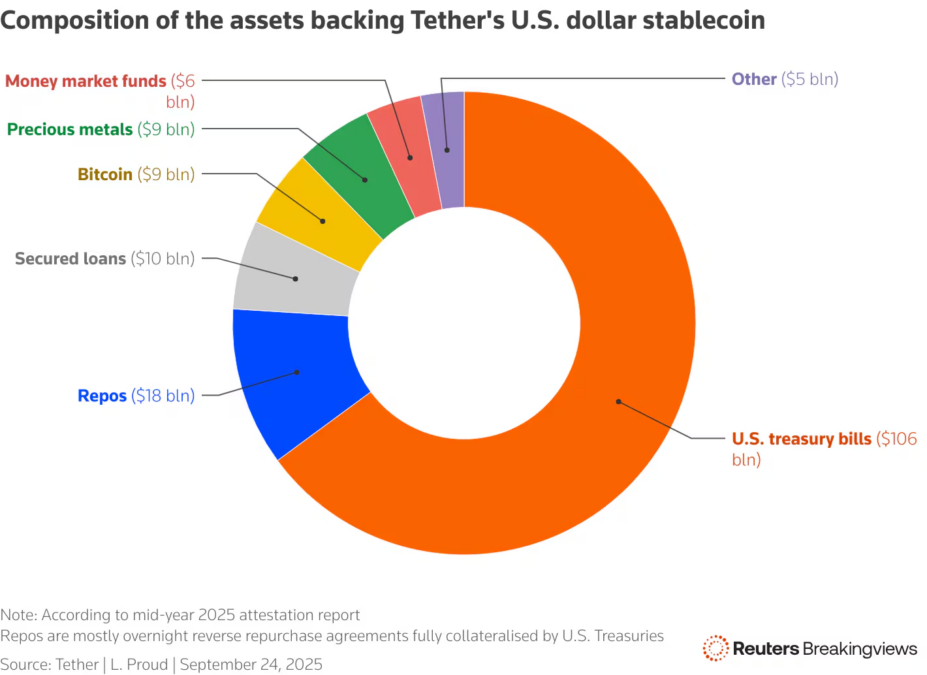
- Tether (USDT): The liquidity leader with a $184–184.6 billion market cap (58%+ of the total stablecoin market). As of the December 2025 reserves report, total assets stood at $192.9 billion against $186.5 billion in liabilities, providing a safety buffer. The composition includes U.S. Treasuries (majority), repos, secured loans, Bitcoin, precious metals, and money-market funds. Tether began daily attestations and, in March 2026, engaged a Big Four auditor for its first full financial statement audit.
- USD Coin (USDC): The compliance-focused option at ~$78 billion market cap. As of April 6, 2026, reserves totaled $77.9 billion (slightly above circulation). Breakdown: ~90% in short-duration U.S. Treasuries and overnight repos (managed via BlackRock’s Circle Reserve Fund), with the rest in cash at systemically important banks. Monthly Deloitte audits and weekly disclosures make USDC one of the most transparent fiat-backed options.
Fiat-backed stablecoins dominate because they offer tight pegs and seamless on/off-ramps to traditional finance.
2. Crypto-Collateralized Stablecoins (Decentralized Alternative)
These use smart contracts to lock volatile crypto assets (ETH, WBTC, staked ETH) as over-collateralized collateral—typically 150–175% of the stablecoin issued. Liquidations help maintain the peg.
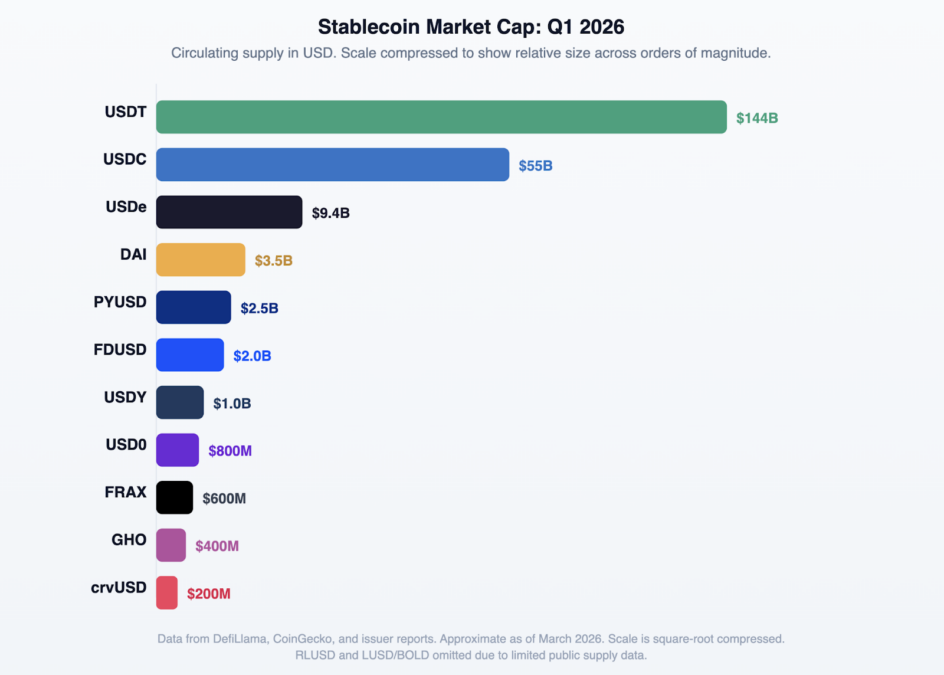
DAI (MakerDAO / Sky ecosystem): Now ~$4.7–5.4 billion in supply. It has evolved into a hybrid: ~60% crypto collateral, ~30% RWAs (U.S. Treasuries and private credit), and ~10% Peg Stability Module (PSM) buffers like USDC. Over-collateralization ratio hovers around 155%. Revenue from RWAs helps stabilize yields for DAI holders.
These stablecoins appeal to DeFi purists who want to avoid centralized custodians entirely.
3. Algorithmic Stablecoins (High-Risk, Experimental)
Pure algorithmic designs use algorithms to expand or contract supply via seigniorage shares, rebasing, or arbitrage incentives—without full collateral backing.
Examples include FRAX (fractional-algorithmic) and Ampleforth (rebase). Ethena’s USDe (~$5.8 billion market cap) is a popular synthetic/hybrid version: it maintains its peg through delta-neutral strategies (staked ETH long + perpetual futures short) rather than traditional reserves. It offers a native yield but de-pegged sharply (to $0.65) during the October 2025 market stress.
Warning: History shows vulnerability—Terra’s UST collapsed in 2022’s “death spiral.” Algorithmic coins remain a small, high-risk niche in 2026.
4. RWA-Backed or RWA-Integrated Stablecoins (The 2026 Growth Story)
Real-world assets (tokenized Treasuries, bonds, private credit, and even gold) are increasingly used as collateral or yield sources. RWAs aren’t a standalone “type” yet, but power hybrids:
- Fiat reserves often invest in tokenized Treasuries.
- DAI and Ethena USDe incorporate RWAs heavily.
- Pure RWA yield-bearers like Ondo’s USDY, Paxos gold (PAXG), and MetaMask mUSD are backed by physical gold, short-term Treasuries, and deliver on-chain yields.
The tokenized RWA market (excluding pure stablecoins) exceeds $19–36 billion, with Treasuries alone at ~$12–13 billion. This trend bridges TradFi yields with DeFi efficiency.
Stablecoin Market Overview – April 2026
Top 5 by Market Cap (approximate, early April 2026):
- USDT: $184B+
- USDC: $78B
- USDS (Sky Dollar): ~11.5B
- Ethena USDe: $5.8B
- USD1: $4.2B
Total market cap: ~$319B+. Fiat types still command 85–90% dominance.
Risks, De-Pegging Events & Regulation in 2026
No stablecoin is risk-free:
- Counterparty/Issuer Risk: Centralized fiat issuers could face insolvency or freezes.
- De-Pegging: USDC dropped to $0.88 in 2023 (SVB crisis); USDe hit $0.65 in 2025.
- Smart Contract & Liquidation Risk: Crypto-collateralized coins can cascade in volatility.
- Regulatory Risk: MiCA (EU) bans yield on certain stablecoins; the U.S. GENIUS Act requires licensed 1:1 reserves and prohibits interest to holders.
Always verify reserves via official transparency pages (tether.to/transparency, circle.com/transparency) and check audit dates.
Why Backing Matters for Your Portfolio & DeFi Strategy
In 2026, the safest stablecoins for everyday use remain fiat-collateralized (USDC and USDT for liquidity).
For decentralized yield farming and staking, crypto/RWA hybrids like DAI or USDe offer higher APYs—but with added volatility. RWAs are increasingly shaping the next phase of on-chain yields.
Key Takeaway: Always DYOR on the latest reserves report before holding large amounts. The right backing can mean the difference between steady $1.00 and a painful de-peg.
Can stablecoins be backed by nothing?
Yes, purely algorithmic stablecoins are not backed by physical collateral like cash or bonds. Instead, they use smart contracts, arbitrage incentives, or synthetic hedging (like shorting perpetual futures) to maintain their peg. However, history has shown that uncollateralized stablecoins carry a much higher risk of completely collapsing, as seen with Terra’s UST in 2022.
Which stablecoin has the safest backing?
In 2026, fully regulated, fiat-collateralized stablecoins like USD Coin (USDC) are widely considered the safest. USDC is backed 1:1 by highly liquid cash and short-duration U.S. Treasury bills, and it undergoes rigorous monthly audits by top-tier accounting firms to prove its reserves exist.
What happens if a stablecoin loses its backing?
If a stablecoin’s reserves fall below the amount of tokens in circulation—or if the market loses faith in the issuer’s transparency—a “de-pegging” event occurs. The token’s value will drop below $1.00. Depending on the severity, the stablecoin may recover once liquidity is restored, or it may enter a “death spiral” and become worthless.
How do I verify what a stablecoin is backed by?
You should never trust a stablecoin blindly. Always visit the issuer’s official transparency page (such as tether.to/transparency or circle.com/transparency). Look for recent, independent audit reports from reputable accounting firms that explicitly list the breakdown of their reserve assets (cash, Treasury bills, or commercial paper).
Disclaimer:
Some elements of this content may have been enhanced with the help of our artificial intelligence (AI) assistants for purposes such as basic refinement, review, image generation, and translation to deliver high-quality news in a shorter time frame. However, all AI-assisted content is reviewed and approved by our team to ensure accuracy, fairness, and editorial integrity.