Key Highlights
- Bitcoin reached a new all-time high of $126,000 in October 2025, while Ethereum briefly climbed above $4,700 before both gave back part of their gains.
- Political events, including U.S. tariffs, regulatory decisions, and a government shutdown, caused sharp market swings and periods of low trading activity.
- New rules for stablecoins, more exchange-traded funds, and institutional interest helped the market stay stable at the end of the year.
The year 2025 has been a dramatic one for the crypto market. Prices lurched, paused, settled, and collapsed at different moments.
Major cryptocurrencies like Bitcoin (BTC) hit a new high record, reaching a peak of $126K, before losing part of the value just a few months later. Ethereum (ETH) also saw its price reach almost $5K this year, which is a peak not seen since 2021, but now, it’s tumbled below $3,000 and seems to be closing the year down 19%.
However, numbers are just the autopsy report. What makes this year fascinating is the journey, especially the how. How did we go from champagne corks popping at the beginning of the year to the hollow silence of trading desks as of today? How did regulatory promises turn into a speculative frenzy, coupled with other factors, including the global trade war, and how did the market react to this event throughout the year?
How 2024’s political earthquake set the stage for crypto
Before we talk about the market behavior in 2025, we must first feel the atmosphere in which the year began. The end of 2024 set up the stage as the market ended the year in a victory lap.
Major tokens saw their prices surge during December. For instance, Bitcoin, in a stunning rally, shattered the $100,000 barrier for the first time following the current U.S. President Donald Trump’s presidential election victory.
His campaign at the time had been a masterclass in courting the digital asset community: promises to “stop the war on crypto,” to fire Securities and Exchange Commission’s (SEC’s) former Chair Gary Gensler, to create a crypto reserve, and to ensure America “minted the future, not stifled it.”
In short, the market didn’t just start the year with hope; it started with a belief. That belief was priced in with every upward tick. The election opened doors for institutions, which had already peeked through the door via Bitcoin ETFs and Ethereum ETFs, which were approved early in the year.
By New Year’s Eve, the crypto market settled high, with the Fear & Greed Index flashing “Extreme Greed.” The market was primed, pumped, and confident of what 2025 would bring, with institutions and analysts like Bitfinex already estimating tokens like Bitcoin to reach $200K in 2025.
Q1 2025: The calm before the storm
The first quarter of 2025 unfolded with the crypto market in an unusual, almost unsettling state. The market consolidated while waiting on political promises.
January–February: The ETF inflow slowdown
With the inauguration of Trump at hand, the market slowed down, with the exchange-traded fund (ETF) market witnessing steady inflow. Daily net inflows in the U.S. spot Bitcoin ETF, which regularly topped $500 million in December 2024, began to normalize.
As a result, the crypto market retraced, and Bitcoin (BTC) entered a tight consolidation range between $85,000 and $105,000. Altcoins like Ethereum (ETH) ranged between $3,600 and $3,200. The market wasn’t selling off, but it was catching its breath.
In late January to February, the crypto market dropped into the red after speeches from Fed Chair Jerome Powell that signaled a delay in rate cuts. The crypto market responded immediately. Crypto assets began moving in lockstep with U.S. tech stocks. The correlation between the two sectors, which had loosened in late 2024, snapped back into place. When the stock surges, the crypto market surges as well.
The decentralized finance (DeFi) market also felt the impact, with total value locked dropping, but was able to stay above the $100 billion mark.
March 2025: U.S. crypto reserve and EU MiCA enforcement
While all eyes were on Bitcoin, the altcoin market spiked up in March 2025 after Trump announced a strategic crypto reserve that included Bitcoin and Ethereum.
At the time, the crypto market responded with XRP, SOL, and XRP seeing a price jump of about 35%, 25%, and 70% in a single day. Other altcoins surged as well at significant rates. However, the excitement quickly faded when prices dropped a bit moments later after investors got disappointed that the reserve would only include Bitcoin and not altcoins.
As the U.S. market was struggling with volatility after the reserve event, the European Union had started strictly enforcing its crypto rules as MiCAR became applicable to CASPs as of December 30, 2024. Stablecoins and crypto exchanges have to follow the rules closely, or they cannot operate in the region.
During this period of March, the “grace period” for stablecoins that were not following the rules ended. Because of this, many European exchanges like Coinbase and OKX had to remove stablecoins that did not pass the strict audits that were set by the European Banking Authority (EBA).
Q2 2025: Politics and Crypto IPOs take control
The second quarter was chaotic and dramatic. Politics began to move the market. Trump played the tariff card, which destabilized the market for a while.
April: The tariff trump card
April started with a sharp drop amid fear of Trump’s tariff against several countries, including China, Canada, and Mexico, which caused uncertainty in the market. Bitcoin, at the time, saw its price drop to $82K, while the altcoin market followed. Meanwhile, the new tariffs had not been announced at the time, but the uncertainty was enough to trigger the market.
On April 8, Trump imposed a 104% tariff on China. Tension escalated even more when China refused and responded. Following the news, 87% of the entire crypto market bled within 24 hours, with the market losing 1.5% in market cap. Bitcoin lost its support at $81K and dropped below $75K in a single day.
The behavior during this sell-off indicated a dry-up in liquidity, with traders moving their assets to stablecoin. Leverage was wiped out quickly, with the whole market in panic as the total market cap dropped to $2.5 trillion.
However, the crypto market recovered shortly after Trump paused the tariff. Altcoins felt the relief the most as tokens like XRP surged over 18% as of April 10. Meanwhile, Bitcoin, with momentum, surged back above $100K for the first time since January and even reached a new all-time high of $111K on “Bitcoin Pizza Day.”
June: IPO session
During the same period, crypto firms that went public surged in numbers. For instance, Circle, the issuer of USDC stablecoin, went public with a $1.1 billion initial public offering (IPO). The crypto market’s reaction to the launch was overwhelmingly positive, with the company’s stock hitting almost 200% gains in a single day. During this period, the crypto market stayed high as investors gained confidence in the sector due to institutional interest.
June is also the month when price action accelerated, as capital allocation became more selective. Projects without users or revenues struggled to sustain rallies, while protocols with real cash flows quietly absorbed liquidity.
Q3 2025: Regulation provides a floor
By mid-year, a market battered by geopolitical swings craved stability. It found an unexpected source of support not in soaring prices, but in regulatory clarity.
July–September: Stablecoin bill and market expansion
By mid-year, the crypto market has settled with major tokens in green as Trump moves through his decision to approve the Guiding and Establishing National Innovation for US Stablecoins (GENIUS) Act, a bill set to clear the path for stablecoins to be recognized as legitimate payment tools.
Following the Senate vote in May, the overall crypto market has already surged by 3.8% to a market cap of $3.96 trillion. By the time President Trump passed the bill into law, the crypto market responded by climbing further to a new record of $4 trillion in market capitalization. The spike was due to the impact of the bill, which gave clarity in the regulatory approach to cryptocurrency.
The market stayed up and steady throughout the remaining months of Q3, thanks to interest from corporate firms that followed the U.S. reserve model and created their own crypto reserve. Strategy, an American software company, topped this trend by maintaining a steady purchase of Bitcoin in millions weekly.
Other firms also joined in. Bitmine, a Bitcoin mining company, rebranded itself into an Ethereum treasury firm to stake the second-largest cryptocurrency. This, together with asset managers filing for more ETFs in other cryptocurrencies, kept the matter steady for a long while.
At the same time, news of Hong Kong publishing its first stablecoin licenses hit the market. The milestone was noticeable as the framework was designed to support the use of fiat-backed assets. Subsequently, by the end of July, the Hong Kong Monetary Authority (HKMA) published this licensing regulation for all stablecoin users. As a result, the stablecoin market saw a push in volume.
In August, Ethereum reached a new all-time high of $4,948, driven by record inflows in U.S. Spot Ethereum, with more than $1 billion being pulled in on a single day. Corporate treasuries have also begun to pile up ETH.
DeFi fundamentals strengthened as total value locked (TVL) climbed toward $170 billion, with lending protocols accounting for nearly half that figure. On-chain derivatives matured, particularly on faster execution environments, while real-world assets crossed $10 billion in deployed value as per data from rwa.xyz.
Q4 2025: New highs, politics, and exhaustion
The final quarter of the year delivered a masterclass in market psychology. Policies continued to move the market, with investors anticipating more regulatory breakthroughs and easier access to the crypto space. Many firms filed for additional ETFs, but key regulatory officials were not in their seats.
October: Bitcoin reaches $126,000 amid U.S. government shutdown
The crypto market hit a significant milestone in the first week of October, with Bitcoin breaking a new barrier and hitting $125K on October 6, the highest it had gone so far. The altcoin market also followed the same price action. Ethereum saw its price break above a key resistance zone and reached a high of $4,750 at the same time. In short, the market was on a high note during this period.
However, the market was soon hit by another uncertainty after the U.S. government shutdown, which drained liquidity from the market. The shutdown happened because lawmakers in Washington failed to agree on funding, so the federal government responded by closing the operation. This shutdown started on October 1 and ended after 40 days on November 12, 2025.
During this period, agencies like the U.S. Securities and Exchange Commission (SEC) and the Commodity Futures Trading Commission (CFTC) operated with few staff. This led to a delay in regulatory decisions, including on crypto-related filings and ETFs. As a result, volume in the market was low, with prices trading sideways. By the time the month of “Uptober” ended, Bitcoin and major altcoins had lost some of their gains. Bitcoin was back below $110K while dragging other currencies down with it as well.
November–December: Profit-taking and market exhaustion
As the year closed, the crypto market gradually lost momentum. The excitement from October’s new highs faded, and trading behavior shifted from aggressive risk-taking to preservation.
One of the clearest patterns during this period was profit-taking by whales and institutional players who had accumulated positions earlier in the year. On-chain data and exchange flows during November showed large Bitcoin transfers moving toward centralized exchanges, a common sign that long-term holders and funds were locking in gains.
Exhaustion set in. Volatility declined. Speculative mania was gone. And prices stabilized at levels well below their peaks but far above pre-2024 ranges. The reopening of the U.S. government in mid-November brought regulatory agencies back to full operation, but instead of igniting a rally, it reinforced a sense of waiting.
As of today, December 23, the crypto market has entered what many traders describe as a “cool off phase.” Currently, the Fear and Greed index is at 29, which indicates “extremely free” in the market. The overall crypto market valuation is at $2.97 trillion, a large percentage down from its peak of $4.2 trillion, while trading volume has reduced as well. In short, traders are now cautious while they wait for an opportunity and for what 2026 would bring.
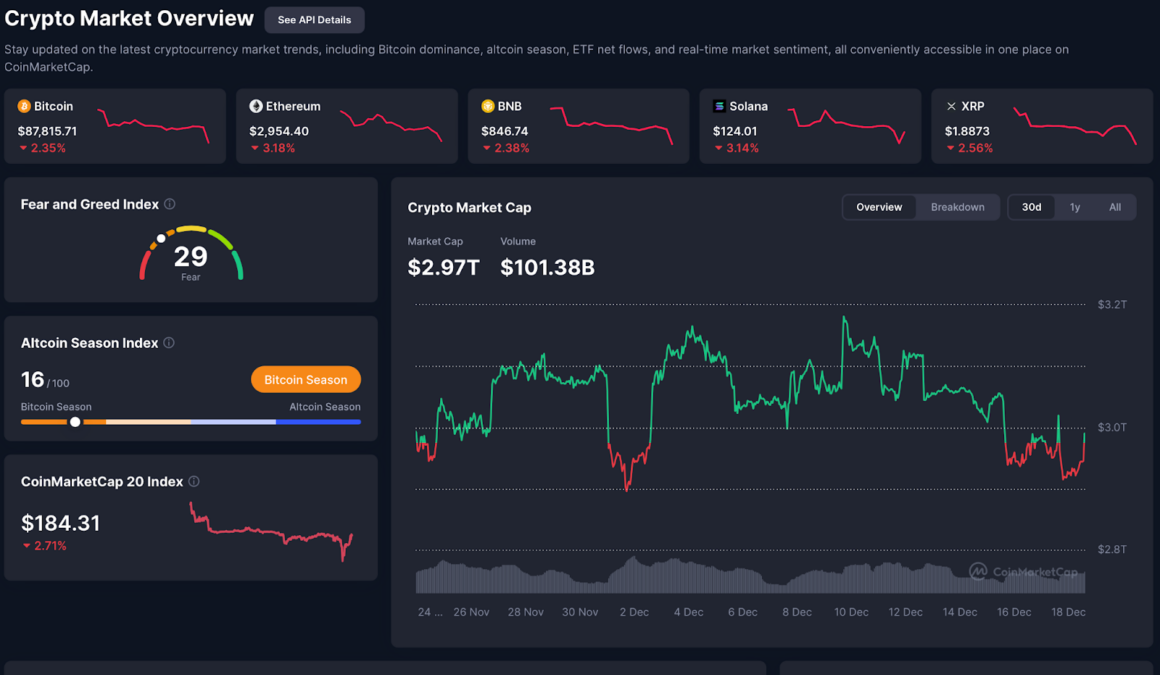
On the other hand, stablecoin supply keeps rising, as the year is ending with $310 to $320 billion. DeFi TVL retraced to around $120 billion, largely reflecting price drops rather than systemic failures.
What 2025 ultimately revealed
The crypto market entered 2025 with confidence and high expectations. Political support, institutional access, and regulatory optimism created the belief that the market would move steadily higher. Instead, the year delivered something less expected.
Prices scaled to new records, but maintaining them was difficult. Still, the year marked progress compared to previous years. Regulatory engagement was more structured than hostile. Stablecoin rules advanced, while ETFs expanded as well. These changes did not guarantee higher prices, but they reduced uncertainty.
The crypto market ended 2025 not as a rebellion, but as a system learning how to survive under pressure and preparing for whatever comes next.
Also Read: Learn Crypto: Courses and Lessons