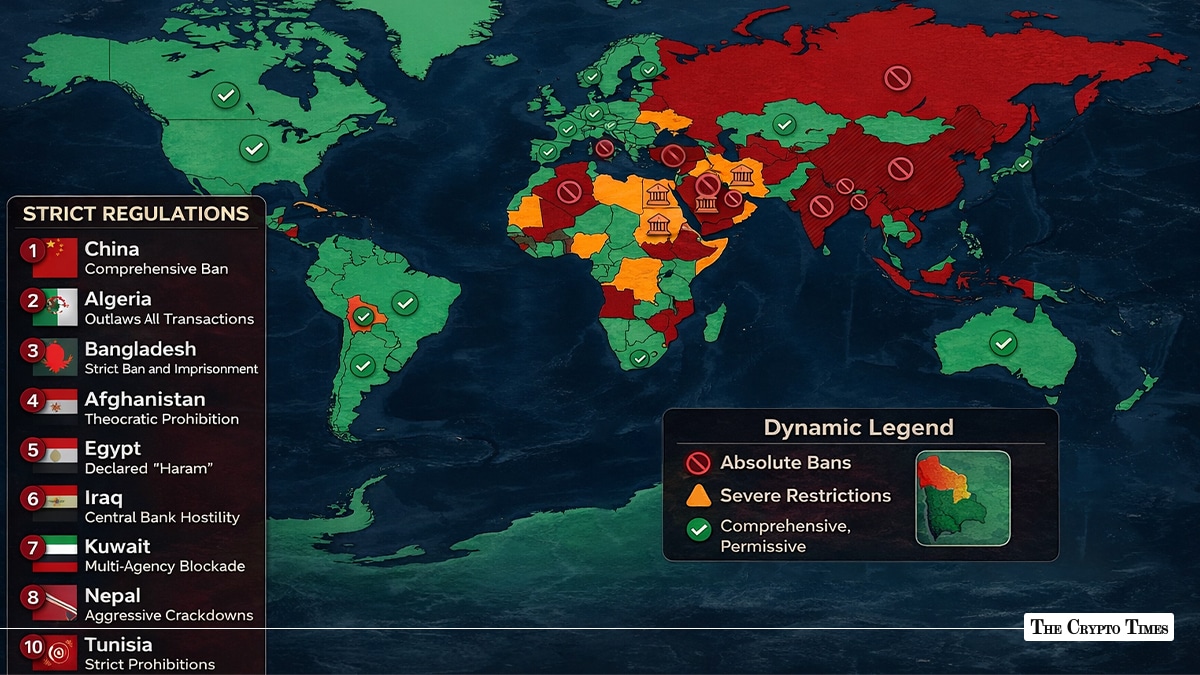
If you search for the legal status of Bitcoin and other digital assets today, you will find that the global financial ecosystem is deeply divided. On one side, mainstream adoption is accelerating, with regulated stablecoins and institutional Bitcoin ETFs becoming the norm in Western markets.
Then in a stark contrast on the other side, several countries have a hostile stance toward cryptocurrencies, ranging from strict regulations to outright bans, primarily to control capital flight, financial instability, and money laundering.
For these nations, crypto is not viewed as the future of finance. Instead, it is seen as a direct threat to monetary sovereignty. In 2026, the regulatory hostility in these jurisdictions is manifesting as absolute prohibitions, severe criminal penalties (including up to 12 years in prison in some nations), aggressive multi-agency enforcement actions, and total banking blockades.
As we progress further into 2026, the top countries prohibiting or severely restricting crypto include China, Algeria, Bangladesh, Bolivia, Egypt, Iraq, Nepal, Qatar, Morocco, and Tunisia.
Why Do Countries Ban Cryptocurrency?
Before we dive into understanding the regulations of these countries, it is important to understand the macroeconomic and ideological drivers behind why they have banned crypto.
Hostile regulatory frameworks in 2026 are generally constructed upon three foundational pillars:
- Protecting Monetary Sovereignty: Nations experiencing severe currency devaluation or acute shortages of foreign exchange reserves frequently use bans to enforce capital controls. Cryptocurrencies offer citizens a frictionless way to externalize wealth, which central banks view as a catalyst for economic collapse.
- Mitigating Illicit Finance: The pseudo-anonymous nature of blockchain transactions creates blind spots for anti-money laundering (AML) and counter-terrorist financing (CFT) monitors. For developing nations lacking sophisticated blockchain forensic tools, outright prohibition is perceived as the safest defense.
- Ideological and Religious Doctrines: In several jurisdictions governed by strict interpretations of Islamic jurisprudence, the highly speculative, unbacked nature of cryptocurrencies is deemed inherently incompatible with foundational financial principles (haram).
The Top 10 Countries That Hate Crypto in 2026
The following 10 jurisdictions maintain the most stringent, hostile, and uncompromising stances against decentralized digital assets globally.
1. China: Comprehensive Ban
The People’s Republic of China (PRC) implemented a comprehensive ban on all crypto transactions, mining, and offshore exchanges (2021-2025). The Chinese government instituted this sweeping, absolute prohibition to protect domestic financial stability and ensure energy security.
However, China’s absolute ban has not eradicated crypto; rather it has become a catalyst that has driven it underground. By late 2025 and into 2026, China’s share of the global Bitcoin network hash rate rebounded forcefully to approximately 14.4% (roughly 145 EH/s), making it the third-largest mining nation globally. Miners tap into surplus electricity in remote regions using off-grid data centers to mask their digital footprints.
Furthermore, Chinese capital continues to flow into digital assets through offshore vehicles; recently, a mysterious Hong Kong-based entity named Laurore Ltd. poured $436 million into a U.S. Bitcoin ETF, highlighting the unstoppable demand for crypto exposure.

2. Algeria: Outlaws All Transactions
Algeria outlaws all cryptocurrency transactions, including holding or trading crypto, following a 2018 finance law. The statutory language of the Algerian ban is exceptionally broad and intentionally designed to be inescapable, prohibiting the purchase, sale, use, and mere possession of virtual currencies. Engaging in any cryptocurrency transaction in Algeria is treated as such a severe criminal offense that it has direct punitive measures and potential imprisonment for offenders.
3. Bangladesh: Strict Ban and Imprisonment
Bangladesh has continued to maintain a strict ban on Bitcoin since 2017, with violations punishable by imprisonment. The state considers cryptocurrency to be inherently hostile to its economic stability.
Transactions involving decentralized digital currencies are strictly illegal under the Foreign Exchange Regulation Act of 1947 and the Money Laundering Prevention Act of 2012. The enforcement is draconian: individuals caught transacting with or holding digital currencies in Bangladesh can face a devastating penalty of up to 12 years in prison. Despite the global shift toward regulation, Bangladesh remains steadfast in its absolute criminalization of the sector.
4. Afghanistan: Theocratic Prohibition
Following the regime change in 2021, many Afghan citizens desperately turned to cryptocurrencies and stablecoins as a lifeline to preserve their savings while the traditional banking system collapsed. However, in August 2022, the Taliban regime abruptly classified this digital financial independence as a threat to their authority and ideological doctrine, imposing an absolute ban.
The government officially deemed cryptocurrency haram (forbidden under Islamic law). Security forces responded by physically shutting down local crypto exchanges, confiscating funds, and arresting traders. Today, Afghanistan’s population is legally cut off from the global digital economy, though underground peer-to-peer networks persistently survive out of pure economic necessity.
5. Egypt: Declared “Haram”
Egypt is another country that has declared cryptocurrencies haram under Islamic law in 2018 and severely restricted trading. The country maintains a deeply entrenched cryptocurrency prohibition, distinguished by the powerful convergence of secular legislative frameworks and supreme Islamic religious decrees.
The legal mechanism enforcing this hostility is the Central Bank and Banking Sector Law No. 194 of 2020, which explicitly forbids the issuance, trading, or promotion of cryptocurrencies without a formal license from the Central Bank of Egypt (CBE). Because the CBE fundamentally rejects decentralized assets, no licenses are issued. Violators face immediate imprisonment and staggering financial penalties of up to EGP 10 million.
6. Iraq: Central Bank Hostility
Iraq enforces a highly restrictive environment for cryptocurrencies, driven primarily by profound concerns over systemic corruption, terrorist financing, and the circumvention of state financial surveillance. The Central Bank of Iraq has been historically hostile, prohibiting the use of digital assets.
The Central Bank prohibits all commercial banks and electronic payment providers from engaging in transactions involving virtual assets. This is rigorously enforced under the uncompromising Anti-Money Laundering and Counter-Terrorist Financing Law No. 39 of 2015. The government has historically executed nationwide crackdowns, resulting in the physical confiscation of thousands of underground cryptocurrency mining rigs.
7. Kuwait: The Multi-Agency Blockade
In the Middle East, Kuwait has formalized its hostility through an inescapable, multi-agency regulatory blockade. In July 2023, the State of Kuwait issued an “absolute prohibition” on all operations involving cryptocurrencies.
This highly coordinated strike involved the Central Bank of Kuwait, the Capital Markets Authority, and the Ministry of Commerce and Industry. The framework strictly prohibits the use of virtual assets as a payment method, bans any form of cryptocurrency investment, entirely outlaws mining, and forbids the issuance of commercial licenses to virtual asset providers.
The government justifies this stance by arguing that cryptocurrencies carry no legal status and are driven by rampant speculation that endangers retail citizens.
8. Nepal: Aggressive Crackdowns
Nepal has adopted an aggressive approach, cracking down on unauthorized exchanges. The nation enforces a rigorous and unyielding ban on all forms of cryptocurrency, driven by the Nepal Rastra Bank (NRB). The central bank has repeatedly issued directives declaring that cryptocurrency is not legal tender, is not recognized as foreign currency, and is absolutely prohibited for investment or remittance purposes.
The legal consequences in Nepal are severe. Trading or investing in crypto can result in up to three years of imprisonment, combined with staggering fines that can reach up to three times the total transaction amount. The NRB has aggressively partnered with the Cyber Bureau of the Nepal Police to track down and arrest citizens utilizing peer-to-peer features on major platforms.
9. Qatar: Trading Bans and Excluded Tokens
Qatar implemented a comprehensive ban on trading. Qatar’s relationship with blockchain technology exemplifies a sophisticated, surgical hostility. While Qatar is eager to embrace institutional asset tokenization, it has explicitly banned decentralized, public cryptocurrencies.
In September 2024, Qatar launched its Digital Assets Framework. While this progressive legislation permits the tokenization of traditional assets like real estate and bonds, it aggressively maintains its hostile stance toward public cryptocurrencies by legally classifying them as “Excluded Tokens.” Because Bitcoin and stablecoins fall under this excluded category, the overarching 2018 banking ban on crypto trading remains in full, vigorous effect.
10. Tunisia: Strict Prohibitions
Tunisia implements strict prohibitions on digital currency usage. A stringent 2018 directive from the Central Bank of Tunisia (BCT) explicitly criminalizes virtually all public virtual currency activities, covering public trading, operating exchange services, and using crypto for commercial payments.
The state’s enforcement mechanisms are extraordinarily severe, with individuals found violating these directives facing heavy financial fines and up to five years of imprisonment.
Other Regions with Significant Restrictions
Beyond the top 10, other regions with significant restrictions include Turkey, which outlawed the direct and indirect use of cryptocurrencies for payments in 2021, and Russia, which maintains heavy restrictions on domestic transactions despite utilizing digital assets for international trade and sanctions evasion.



The Shadow Economy: The Unintended Consequence of Bans
The data gathered globally in 2026 suggests a highly complex and often contradictory reality: sovereign bans rarely extinguish digital asset activity. Instead, prohibition frequently drives transaction volumes out of the light of regulated exchanges and into subterranean economies.
By forcing legitimate users, retail investors, and local businesses into the exact same underground channels utilized by illicit actors, prohibitionist states inadvertently incubate systemic financial crime. For instance, Chinese-language money laundering networks operating in the shadows of strict Asian prohibitions processed over $16.1 billion in illicit funds in a single year. When countries completely ban access to global, highly regulated exchanges, users are forced to rely on unregulated, dark-net infrastructure that central banks are entirely unequipped to monitor.
The Futility of Prohibition: The Bolivian Case Study
The exhaustive analysis of hostile jurisdictions reveals a critical insight: absolute state prohibitions are ultimately futile against decentralized technology. When a state implements an absolute ban, it does not remove the powerful economic drivers that make cryptocurrency attractive. It merely destroys the state’s ability to tax and regulate that capital.
The most compelling evidence proving the failure of the prohibitionist model is found in the Plurinational State of Bolivia. For a full decade following its 2014 mandate, Bolivia maintained a strict, punitive ban on digital assets. However, facing acute domestic US dollar shortages and recognizing the impossibility of stopping peer-to-peer transfers, the central bank completely lifted the ban in June 2024. The macroeconomic results were staggering. Within months, transactions utilizing digital asset channels skyrocketed by 530%, surging to $294 million in the first half of 2025 alone. Rather than destroying the economy, legalization allowed the state to bring massive capital volume out of the shadows.
Conclusion
The global cryptocurrency landscape of 2026 is defined by the immense tension between the mathematical inevitability of decentralized technology and the desperate attempts of sovereign states to maintain absolute financial control. The top 10 hostile countries analyzed in this report—China, Algeria, Bangladesh, Bolivia, Egypt, Iraq, Nepal, Qatar, Morocco, and Tunisia—have deployed the full weight of their legislative and physical enforcement apparatuses to criminalize digital assets.
However, as major economies in the West and dynamic financial hubs implement sophisticated, compliant frameworks that successfully mitigate risks while fostering immense technological innovation, the isolation of prohibitionist states will transition from a defensive posture to a crippling economic liability. Ultimately, nations currently defining the hostile resistance will be forced to abandon the futile mechanism of absolute prohibition or risk permanently isolating their economies from the future of global finance.
Disclaimer:
Some elements of this content may have been enhanced with the help of our artificial intelligence (AI) assistants for purposes such as basic refinement, review, image generation, and translation to deliver high-quality news in a shorter time frame. However, all AI-assisted content is reviewed and approved by our team to ensure accuracy, fairness, and editorial integrity.