The way investors trade in crypto is changing. Centralized exchanges (CEXs) like Binance, Coinbase, and other platforms are regarded as the best for trading due to their speed and user-friendly interfaces. However, more and more traders are shifting away from them and heading towards decentralized exchanges (DEXs) due to greater transparency, self-custody, and freedom from regulatory restrictions.
This shift from CEX to DEX is not just about preference; it is about performance. In May 2025, DEXs acquired nearly 1/4th of the global crypto spot trading volume, where DeFi platforms like Uniswap and PancakeSwap are on top. Let’s have a look at how DEXs are dominating the crypto market and will they bypass CEXs in the future.
What is a Centralized Exchange (CEX)?
A centralized exchange (CEX) is a kind of crypto trading platform that is owned and run by a company that acts as the intermediary between the buyers and the sellers. Binance, Coinbase, Kraken, etc, are some examples of such platforms.
When using a CEX, you must sign up, complete KYC verification, and deposit your funds into the exchange’s custody. The exchange takes care of all trade matching and fund transfers which thus makes the process quick and user-friendly. However, it also means that you are relying on a middleman to store and manage your assets.
What is a Decentralized Exchange (DEX)?
A Decentralized Exchange (DEX) is a peer-to-peer trading platform that is powered by smart contracts on blockchain networks such as Ethereum, Solana, or BNB Chain. You do not need to register or deposit your funds to anyone when accessing it, as you can still access the platform directly from your crypto wallet.
DEX platforms like Uniswap, PancakeSwap, etc, not only allow users to remain in control of their assets, but also enable them to access the DeFi world without any barriers. Although it may require some technical skills, it offers a more permissionless and open way for you to trade crypto.
CEX vs. DEX Comparison
| Feature | Centralized Exchange (CEX) | Decentralized Exchange (DEX) |
|---|---|---|
| Fund Custody | Your crypto is held by the exchange, which means they control your assets. | In your own wallet, you retain full control of your funds. |
| KYC Required | Needs ID verification to comply with government regulations. | No KYC—only connect your wallet and start trading. |
| Trading Model | The platform matches trades by using order books that they manage internally. | Trustless trading uses smart contracts for secure exchange of assets and access to liquidity pools for efficient peer-to-peer trading. |
| Accessibility | Due to compliance rules, may ban users from some countries. | Open globally, with no restrictions on regions or identities. |
| Fiat Support | Can easily deposit or withdraw fiat such as USD or INR via banks. | Doesn’t receive fiat directly—it is necessary to have crypto to trade. |
The Rise of DeFi: Data Speaks Louder Than Words
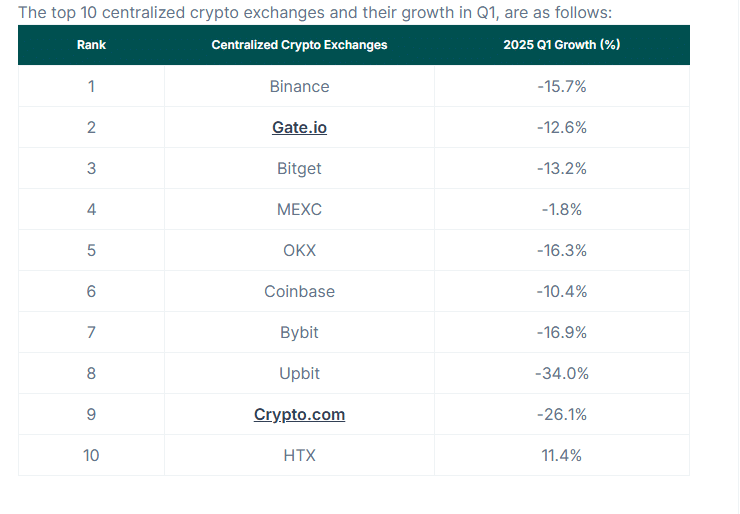
According to the data from CoinGecko, in the first quarter of 2025, the centralized exchange (CEX) has seen a massive decline in volume because eight out of the top 10 CEXs reported double-digit declines. Binance dropped by 15.7%, while Coinbase saw a 10.4% dip.
Upbit was hit the hardest, recording a significant 34% decline. In total, the top 10 CEXs lost around $1.1 trillion in volume compared to the previous quarter, which marked a 16.3% drop and bringing the total down to $5.4 trillion.
However, as per the data from DeFiLlama, the decentralized exchanges have shown a sharp rise in trading volume. As of writing, DEXs have processed $409.73 billion in trading volume over the past 30 days and approximately $12.78 billion in 24 hours. The overall growth chart shows a consistent upward movement since 2020 which highlights strong DeFi adoption despite regulatory concerns.
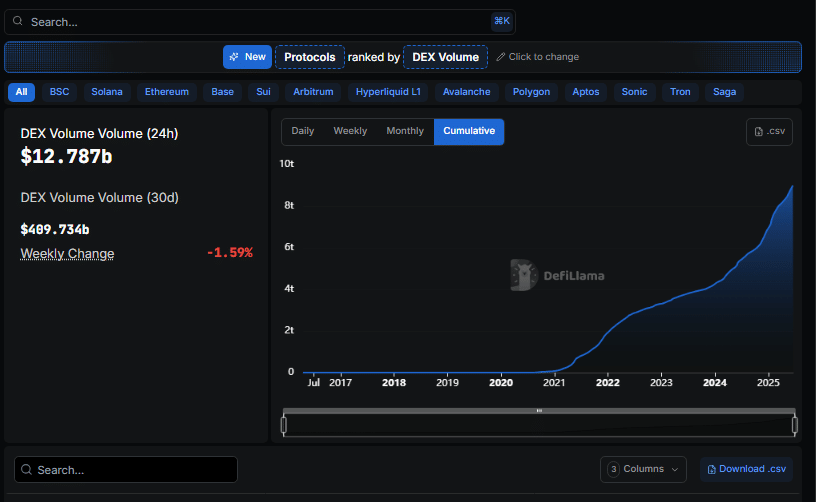
This shift shows a larger picture, while CEXs struggle to gain momentum, DEXs are gaining user trust. Traders are now using DeFi trading platform not just for control and privacy, but also because the data now shows that they can compete in real volume. As centralized platforms battle with regulations and user drop-offs, DeFi is proving that its growth is not just ideological but measurable.
Why are Traders Shifting From CEX to DEX?
Below are some reasons that highlight why users are moving toward DeFi trading platforms:
Self-Custody and User Control
CEXs require users to give up their asset control. With frequent hacks and frozen withdrawals, users are turning to self-custody. DEXs allow users to trade directly from their wallets, reducing dependence on third parties.
Lower Fees
CEXs charge traders both maker-taker and withdrawal fees, and sometimes even deposit charges. DEXs use smart contracts and AMMs, thereby lowering trading fees.
Open Global Access
CEX platforms usually impose certain restrictions on users according to their location, and they may need KYC verification. On the other hand, DEXs are accessible to anyone who has a crypto wallet. There is no registration process, no KYC, and no chance of being banned due to regulatory concerns.
Smooth DeFi Integration
DEXs are deeply connected with the broader DeFi world. They can do token swapping, liquidity providing, staking, and borrowing—all from one single interface. This interoperability is a game-changer for active crypto users who want more than just buying and selling cryptocurrencies.
The Challenges DEXs Still Face
Though DEXs are growing in popularity, they still face challenges that must be addressed to surpass CEXs:
User Experience Complexity
DEX interfaces can be very complicated for new users, especially those unfamiliar with wallets with wallets, slippage settings, and gas fees.
Gas Fees and Network Congestion
On the Ethereum blockchain, at peak hours, the gas fees are very high, and making even a small trade can be expensive.
Smart Contract Risks
Bugs and exploits in smart contracts can result in loss of funds. Users must have faith in the underlying code rather than in a support team.
Lower Liquidity for Niche Tokens
The major tokens can be regarded as highly liquid, but tokens that are small or new may face a shortage of liquidity.
Lack of Fiat On-Ramps
DEXs generally are not structured to receive direct fiat deposits or withdrawals; hence, it is more difficult for the new users to get started without using a CEX first.
Limited Customer Support
Since DEXs are decentralized, there’s no live support team. If you make a mistake or lose funds, there will be minimal options to recover.
Will DEXs Replace CEXs in the Future?
Experts are of the opinion that if the growth continues, the decentralized exchanges (DEXs) could dominate more than 50% of the market by 2030. DEXs have become quicker and cheaper due to the implementation of the gasless swaps, cross-chain trading, and Layer 2 scaling solutions.
That being said, it is still the case that CEXs will be the leaders in those sectors which involve derivatives, fiat gateways, and compliance-heavy services. The future may lie in hybrid models that combine the strengths of both systems: speed and support from CEXs, with transparency and control from DEXs.
Bottom Line
The battle between CEXs and DEXs is not necessarily a winner-takes-all situation. Each serves a purpose. While DEXs are for expert users who value control and decentralization, CEXs still offer ease of use, speed, and fiat support that many new users need.
The rise of DeFi signals a clear demand for greater control and transparency among users. The future of trading looks more decentralized, user-driven, and interoperable than ever before.