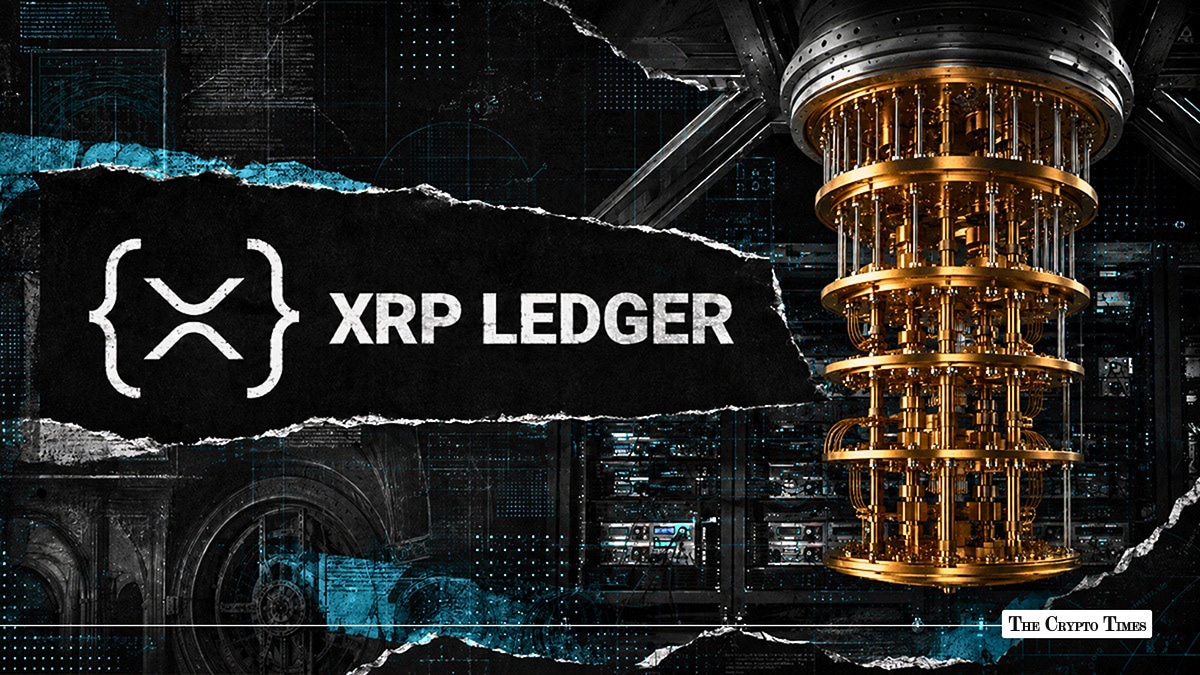
The conversation around quantum computing and blockchain security shifted from theoretical to operational in March 2026, when Google Quantum AI published research suggesting that breaking the elliptic curve cryptography securing Bitcoin, Ethereum, and the XRP Ledger may require significantly fewer resources than previously estimated. The paper compressed the perceived timeline for “Q-Day”—the moment quantum computers can crack current public-key cryptography—from comfortably distant to uncomfortably close.
For blockchain networks, the implications are concrete. Every transaction that exposes a public key on-chain becomes a future vulnerability under the “Harvest Now, Decrypt Later” attack model, where adversaries collect encrypted data today expecting to decrypt it once quantum capabilities arrive. Bitcoin and Ethereum, both built on cryptography that Shor’s algorithm can theoretically break, are exposed by design.
Ripple’s response, published on April 20, 2026, is one of the most concrete migration plans any major blockchain has produced to date. The XRP Ledger is targeting full post-quantum readiness by 2028, with execution organized across four distinct phases and a credible amount of code already shipped to test environments.
Why the XRP Ledger Started Earlier Than Most
Quantum computers leverage Shor’s algorithm to efficiently solve the discrete logarithm and factorization problems that underpin the ECDSA and Ed25519 signature schemes currently used by virtually all major blockchains. Current quantum hardware remains far from cryptographically relevant, estimates still suggest hundreds of thousands to millions of stable qubits would be required, but the pace of progress, particularly in error correction, has shifted the industry conversation from “if” to “when.”
The XRPL has two structural features that reduce its exposure relative to peer chains. The first is native account key rotation: users can change their signing keys without migrating funds to new addresses, which dramatically simplifies the eventual transition to post-quantum signatures. The second is seed-based deterministic key generation, which gives users a recoverable foundation independent of any single signing scheme.
The result is that Ripple estimates only about 0.03% of XRP supply currently sits in highly exposed, high-value accounts where public keys have been long-revealed on-chain. By comparison, Bitcoin’s pay-to-public-key (P2PK) addresses and any reused P2PKH addresses are permanently exposed, and Ethereum’s externally owned accounts reveal their public keys with every outbound transaction.
That lower baseline exposure does not eliminate the threat. With XRPL increasingly powering institutional payments, tokenized real-world assets, and stablecoin issuance, the cost of a single high-value compromise scales rapidly. Ripple’s calculation appears to be that proactive, structured migration is cheaper than reactive crisis management.
The Four-Phase Roadmap
The migration plan is organized around two parallel goals: preserving XRPL’s existing performance characteristics (sub-second finality, low fees, high reliability) while building strong contingencies against an earlier-than-expected Q-Day.
Phase 1: Post-Quantum Recovery
The foundational contingency phase focuses on emergency preparedness. If classical cryptography breaks suddenly, the network needs the ability to reject vulnerable signatures and force migration to quantum-safe accounts. The most novel element under exploration is the use of post-quantum zero-knowledge proofs (PQ-ZKPs), which would allow users to prove ownership of legacy keys and recover funds without exposing the vulnerable cryptographic material. This “recovery rail” is designed to minimize ecosystem chaos in a worst-case scenario.
Phase 2: Proactive Planning and Experimentation
This phase is active as of mid-2026. Ripple is conducting a full quantum vulnerability assessment across the XRPL ecosystem and testing NIST-standardized post-quantum algorithms, particularly ML-DSA, the Dilithium-based signature scheme finalized by NIST in 2024, under realistic XRPL workloads. The benchmarks measure impacts on signature size, verification time, storage, bandwidth, and overall throughput. Core engineer Denis Angell has deployed ML-DSA signatures on AlphaNet, and Ripple is working with Project Eleven, a specialized post-quantum cryptography firm, on validator testing, Devnet benchmarking, and early custody wallet prototypes.
Phase 3: Exploration of Post-Quantum Primitives
Building on Phase 2 results, Ripple plans to move to controlled integration in the second half of 2026. Candidate post-quantum signature schemes will run in hybrid mode alongside existing elliptic curve signatures on Devnet, allowing developers to experiment without mainnet risk. The scope extends beyond signatures to post-quantum-friendly primitives for zero-knowledge proofs and homomorphic encryption—building blocks that would support future privacy features like Confidential Transfers and more sophisticated tokenized asset structures.
Phase 4: Full Transition
The final phase, targeting 2028, involves proposing and activating a new XRPL amendment for native post-quantum cryptography support. This is the ecosystem-wide migration moment: validators, wallets, exchanges, and applications all coordinate around the new signature schemes, with performance optimizations folded in to keep XRPL’s user experience intact.
The Technical Cost of Going Quantum-Safe
Post-quantum signature schemes are not free. Dilithium signatures are substantially larger than Ed25519—roughly 2,420 bytes for ML-DSA-44 compared to 64 bytes for Ed25519—and the corresponding public keys are also significantly bigger. The verification process is slower, and the cumulative effect on transaction throughput, storage requirements, and bandwidth consumption is non-trivial.
Ripple’s team has publicly framed the question as “what works for XRPL at scale,” indicating that the migration is being evaluated as a system-level engineering problem rather than a simple cryptographic swap. The strengths of Ripple’s approach center on three design principles:
- Cryptographic agility: The XRPL is not being locked to one specific post-quantum algorithm. The architecture is intended to support future NIST standards as they emerge, recognizing that the post-quantum field itself is still maturing.
- Hybrid signatures: During the transition, accounts can be secured by both elliptic curve and post-quantum signatures simultaneously, preserving backward compatibility and reducing the operational risk of forced cutover.
- Native key rotation: XRPL’s existing key rotation feature dramatically simplifies user migration, since accounts can switch signing schemes without changing addresses or migrating balances.
The remaining challenges are coordination problems rather than purely technical ones. Validator alignment, wallet ecosystem readiness, exchange integration, and ensuring that the post-quantum transition does not introduce new fee or latency regressions are all multi-party negotiations that will determine whether the 2028 timeline holds.
How XRPL Compares to Other Chains
XRPL’s posture stands out primarily because of how concrete it is. Among the major Layer-1 networks, post-quantum readiness exists on a spectrum from active engineering to passive research, and most peer chains sit far closer to the passive end than to where Ripple is operating.
Solana
Solana has been the most active among non-XRPL chains in shipping actual post-quantum code. The Winternitz Vault proposal allows Solana users to protect funds with hash-based signatures (similar in design philosophy to Bitcoin’s BIP-360 hybrid approach), and early testnet experiments have explored Falcon and Dilithium integration.
The structural challenge is Solana’s high-throughput architecture: post-quantum signatures are larger and slower to verify than Ed25519, and Solana’s sub-second block times make those performance trade-offs more painful than they would be on a slower chain. No fixed deadline has been published, and the migration economics on a chain optimized for throughput are particularly unforgiving.
Ethereum
Ethereum is structurally better positioned than Bitcoin but still has no committed migration timeline. Vitalik Buterin has proposed what he describes as a “blood replacement” for Ethereum, a 7-fork plan to defeat quantum computers that would migrate the network through a sequence of upgrades to introduce post-quantum signatures, a public key registry to reduce harvest-now-decrypt-later exposure, account abstraction pathways for user migration, and Verkle tree integration to manage the larger storage footprint of PQ cryptography.
The advantage Ethereum has over Bitcoin is governance agility: EIPs can move faster, and account abstraction (EIP-7702 and related upgrades) creates a natural pathway for users to adopt new signature schemes without breaking existing wallets. The disadvantage is that no version of Ethereum’s PQ migration has reached the testnet rollout stage, and no public deadline exists comparable to Ripple’s 2028 commitment.
Bitcoin
Bitcoin faces the hardest migration path of any major network, and the gap between its threat profile and its preparation is widening. Roughly 4 million BTC sit in addresses where public keys have been permanently exposed on-chain, including early pay-to-public-key (P2PK) addresses, reused pay-to-public-key-hash (P2PKH) addresses, and Taproot outputs that reveal keys when spent. That includes Satoshi Nakamoto’s estimated 1 million BTC, which would be among the most attractive targets for any quantum-capable adversary. The Bitcoin community has begun building a response through proposals like BIP-360 and BIP-361 — a 7-year quantum shield plan that introduces hybrid post-quantum addresses and a phased migration window for vulnerable funds. But Bitcoin’s conservative governance model means consensus on any of them remains uncertain.
Even prominent figures like Adam Back have warned that the migration window is shorter than the community is treating it, and that the soft-fork mechanics required for a quantum-safe Bitcoin transition could take a decade or longer once a path is agreed.
XRPL’s combination of native key rotation, enterprise focus, and a stated 2028 deadline gives it a credible execution advantage, particularly for the institutional use cases — payments, tokenization, RWAs — that have become Ripple’s primary positioning. Those institutions are themselves under regulatory pressure to align with post-quantum cryptography (PQC) standards being developed by NIST, FIPS, and various national security frameworks. An XRPL that ships PQ-safe before 2030 fits that procurement requirement; one that doesn’t may not.
The competitive dynamic this creates is worth watching. If Ripple lands the 2028 deadline credibly, XRPL will be the only major Layer-1 with verified post-quantum security at a moment when institutional crypto adoption is accelerating into RWAs, stablecoins, and tokenized treasuries. That timing alignment—quantum-safe infrastructure ready at the exact moment institutional capital is making long-duration commitments to specific chains—is the underlying strategic bet of the entire roadmap.
What This Means in Practice
For XRP holders, the immediate guidance is conservative: avoid address reuse where possible, expect future key rotation guidance from wallet providers, and recognize that the overwhelming majority of accounts remain safe under current conditions. The 0.03% exposure figure is meaningful in absolute terms for the holders affected, but it represents a small fraction of overall supply.
For developers, the practical milestones to watch are the hybrid Devnet rollout in the second half of 2026 and the first published benchmark results from Phase 2. Both will indicate whether the 2028 amendment activation is realistic or whether the timeline slips.
For institutions, the roadmap strengthens XRPL’s credentials in a specific and measurable way. Banks, custodians, and tokenization platforms that are already navigating PQC procurement requirements for traditional financial infrastructure now have a clearer answer for how XRPL fits those requirements. That alignment may matter more for institutional adoption decisions over the next 12 to 24 months than any single technical benchmark.
The Honest Risks
A few criticisms deserve direct acknowledgment. The 2028 target, while concrete, is still two years out, and post-quantum signature schemes themselves continue to evolve, with some early candidates (notably SIKE) having been broken before they reached production. Cryptographic agility helps, but it does not eliminate the risk of building on a primitive that turns out to have weaknesses.
Performance trade-offs may slow optimization. Coordination across a decentralized validator set always carries execution risk. And, an earlier-than-expected Q-Day would test Ripple’s Phase 1 contingency mechanisms in conditions for which there is no historical precedent.
The counterargument to the criticisms is straightforward: blockchain post-quantum migrations will take years regardless of when they begin, and starting in 2026 with a concrete plan is materially better than starting in 2028 without one.
What to Watch Next
The most important near-term signals will come from three sources: published Phase 2 benchmark results showing the actual performance impact of ML-DSA on XRPL transaction throughput; updates from the Project Eleven collaboration, particularly around custody wallet prototypes; and any Devnet announcements signaling the start of hybrid signature testing in the second half of 2026.
If all three land on schedule, the 2028 amendment activation becomes credible. If any slip materially, the timeline likely extends — and Ripple’s position relative to peer chains looks less differentiated than it does today.
The quantum era is still distant in calendar terms, but the migration window is shorter than it appears. XRPL is not the only network preparing for it, but it is currently the only major Layer-1 with a published deadline, working code in a test environment, and a structured execution path. Whether that translates into a meaningful lead by 2028 depends on whether the next four phases land on time.
Also Read: How the Top Blockchains Are Racing to Survive Q-Day