A group of 37 European banks now has a licensed issuer for its euro stablecoin. The token itself still has no launch date.
Qivalis is the Amsterdam-based joint venture behind the project, and from December 2025 onward it said it would launch in the second half of 2026. With less than three months left in that window, the company now says issuance will begin in the coming months, without naming a date.
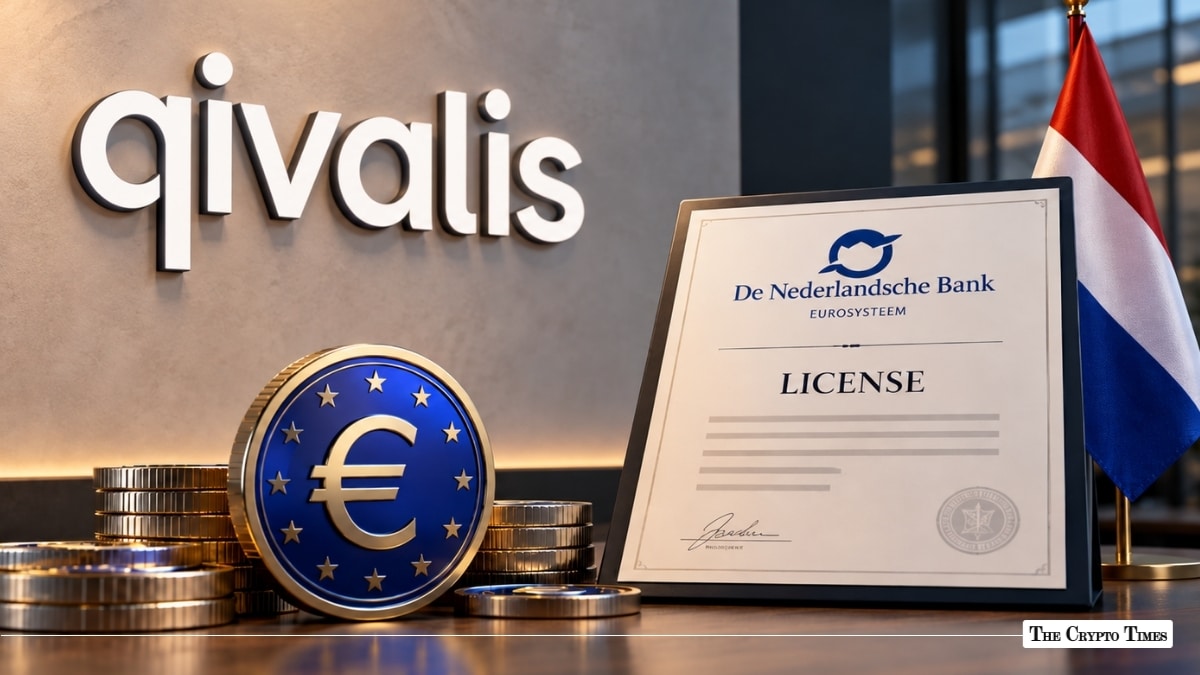
De Nederlandsche Bank (DNB), the Dutch central bank, has authorized Qivalis B.V. as an Electronic Money Institution (EMI) under the Dutch Financial Supervision Act, the company said in a press release published in Amsterdam on October 14, 2026.
What the DNB Authorization Covers
An EMI license lets a firm issue electronic money, a regulated digital stand-in for cash held at a bank. Under the EU’s Markets in Crypto-Assets Regulation (MiCA), a firm needs this license or a banking license to issue an electronic money token (EMT). An EMT is MiCA’s category for a stablecoin pegged to a single official currency.
According to the release, the authorization places Qivalis under ongoing DNB supervision and makes it eligible to issue euro-denominated EMTs. Before it issues any tokens, the company must meet MiCA’s requirements and publish a white paper, the disclosure document the regulation requires from crypto-asset issuers.
Qivalis says on the release page that it does not currently issue electronic money or provide payment services to the public.
“Europe’s currency deserves Europe’s rules – on-chain,” Chief Executive Jan-Oliver Sell said in the release. Sell called the authorization a very important step toward issuing a euro-denominated EMT. He said Europe should have an on-chain settlement asset for the euro, issued under European law.
The Earlier Launch Target
Qivalis announced its brand name on December 2, 2025. That day, member banks, including KBC, published a release saying the consortium planned to launch its euro stablecoin in the second half of 2026. In that release, Sell called the launch a watershed moment. Sir Howard Davies, former Chairman of NatWest Group and the UK Financial Services Authority, said the infrastructure was essential if Europe wanted to compete globally in the digital economy.
The company’s May 2026 fact sheet repeated the second-half target and said the DNB license was still pending. The October 14 release does not mention the second-half target. It says issuance is planned for the coming months, subject to MiCA requirements and the white paper.
From Nine Banks to 37
According to the fact sheet, the project began in September 2023 as an initiative of Danske Bank, ING, KBC, and Raiffeisen Bank International. Nine banks announced the consortium on September 25, 2025: Banca Sella, CaixaBank, Danske Bank, DekaBank, ING, KBC, Raiffeisen Bank International, SEB, and UniCredit.
BNP Paribas joined in December 2025, when the Qivalis name was announced. DZ Bank followed in January 2026 and BBVA in February. In May 2026, 25 more banks joined, bringing the total to 37.
According to the fact sheet, the May additions included ABN AMRO, Rabobank, Intesa Sanpaolo, Nordea, Groupe BPCE, Erste Group, Swedbank, Handelsbanken, and the National Bank of Greece. The October 14 release puts the consortium at 37 banks across 15 countries.
Governance and Distribution
Sir Howard Davies chairs the Qivalis supervisory board. He is a former chairman of NatWest Group and of the UK’s Financial Services Authority. According to the May fact sheet, the board has six members: three independent and three nominated by member banks.
The management board consists of Sell as CEO, Floris Lugt as chief financial officer, and Marco Hinz as chief operating officer. The release says the company is governed by an independent management team.
Qivalis says it will use a full-reserve model, meaning each token in circulation is to be backed by an equal amount of reserve assets. It plans to sell the token business-to-business-to-consumer: through eligible counterparties, which it lists as banks, exchanges, payment service providers, and market infrastructure participants, who then reach end users.
MiCA requires EMT issuers to hold part of their reserves as bank deposits, a share that rises to 60% for tokens classed as significant. On September 22, the ECB and EU national central banks proposed replacing those deposit quotas with liquidity-based rules.
What Qivalis Has Not Disclosed
The release does not name the token, its ticker, or the blockchain networks it will use. In September, Ethereum Institutional said in a post on X that the consortium’s stablecoin would run on Ethereum’s public blockchain; Qivalis has not confirmed this in its own releases. The company has also not identified the institutions that will hold its reserves, the composition of those reserves, or any exchange or payment partners, and it gives no capital figures.
Also Read: Illinois Crypto Tax Case Fast-Tracked as State Pauses 0.2% Levy Until July 2027