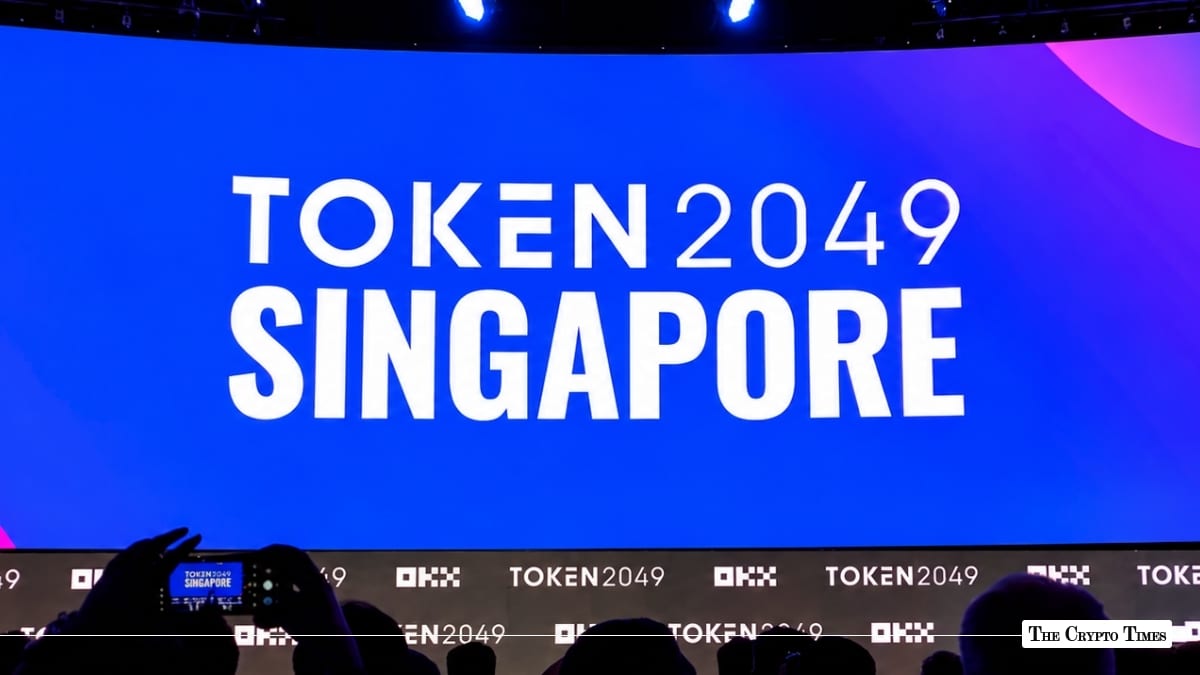
TOKEN2049 returned to Marina Bay Sands on Wednesday, October 7, for the first day of its Singapore conference. Organizers said the event has sold out with more than 25,000 attendees expected from more than 160 countries, alongside thousands of companies, hundreds of speakers and exhibitors.
The official TOKEN2049 agenda lists programming across markets, institutional finance, tokenization, artificial intelligence, DeFi, privacy, and other areas of the digital-asset industry. The first day also brought a major expansion announcement: TOKEN2049 will hold its first dedicated U.S. edition in New York in June 2027.
TOKEN2049 Is Coming to New York
TOKEN2049 announced that its inaugural New York edition will take place on June 16–17, 2027, marking the conference series’ first dedicated U.S. event. Organizers said they expect approximately 15,000 attendees for the New York edition.
The announcement adds New York to TOKEN2049’s flagship event calendar alongside Singapore and Dubai. It also reflected a strong U.S.-focused thread running through several Day 1 sessions, including discussions around tokenization, stablecoins and the future of financial markets.
That theme was particularly visible around OKX, whose founder Star Xu appeared on the Main Stage for a session titled “Building Markets for the Intelligence Age.”
OKX has also been expanding its U.S. presence. This week, OKX and NYSE owner ICE filed with the SEC to launch tokenized U.S. stock trading for 63 companies, with Uniswap v4 infrastructure expected to play a role in the proposed venue. OKX has also attracted strategic investment from Circle and Ripple. The Crypto Times reported that the companies invested in OKX at a reported valuation of roughly $25 billion.
The U.S. focus continued in the afternoon with “The Future of Finance, Built in America,” featuring Eric Trump, co-founder of World Liberty Financial, and Zach Witkoff. Earlier, Witkoff and WLF executive Zak Folkman appeared alongside Mesh in a session on stablecoin payments.
World Liberty Financial executives used the conference to discuss tokenization and stablecoins, including potential applications involving assets such as real estate and art. Those comments came from executives associated with the project and should be viewed in the context of WLF’s commercial interests.
Prediction Markets and Hyperliquid Take the Stage
Prediction markets were among the prominent themes of the opening sessions. Investor and technologist Balaji Srinivasan opened with “The Open Source Network State” before joining Polymarket founder and CEO Shayne Coplan for a fireside discussion focused on prediction markets, information and market-based forecasting.
Coplan discussed the growth of prediction markets, including election and geopolitical markets as well as sports-related activity. He also discussed the possibility of an on-chain asset connected to Polymarket’s platform economy. The comments should not be treated as a token launch. No ticker, launch date, contract address or confirmed distribution structure was announced as part of the discussion. The remarks followed Coplan’s earlier suggestion that he had something to reveal in Singapore. For now, the development remains an indication of exploration rather than a confirmed product launch.
The focus then moved to on-chain trading infrastructure, with Hyperliquid Labs CEO Jeff Yan appearing alongside Risk Labs co-founder Hart Lambur for “Rebuilding Finance from First Principles.”
Hyperliquid and Polymarket have become two of the more closely watched crypto-native platforms in their respective markets. The Crypto Times previously reported that Hyperliquid and Polymarket were included in Forbes’ Top 50 FinTech list.
Arthur Hayes Unveils FLOP AI-Agent Project
One of the day’s more notable product announcements came from Arthur Hayes, chief investment officer of Maelstrom, during his “FLOP: Bigger Than Bitcoin” keynote.
According to FLOP’s published specifications, the project is designed around the emerging AI-agent economy. The proposed network would allow AI agents to use FLOP for payments involving inference and computing resources, while miners would provide GPU resources.
The project’s documentation describes a consensus mechanism called “Proof of Useful Inference,” under which computing activity is intended to contribute to the network’s operation. The proposed tokenomics include a genesis supply of approximately 2.48 billion FLOP, with the project describing a distribution model that does not include a traditional venture pre-mine, presale or auction.
Hayes said the project is targeting a roughly 90-day testnet beginning in late October, followed by a mainnet target in the first quarter of 2027. Those dates remain targets rather than completed milestones. FLOP is not yet a launched mainnet asset, and its specifications may change before deployment. The project also represents Hayes’ thesis that AI-agent commerce could become an important source of demand for blockchain-based payment infrastructure.
The Crypto Times has previously reported on criticism surrounding Hayes’ public promotion and trading of crypto assets, including his promotion of tokens and subsequent selling. The FLOP announcement is therefore best treated as a project proposal and product development milestone, rather than evidence of future token performance.
Tom Lee Sets 5% Ethereum Cap for BitMine
Fundstrat chairman and BitMine chairman Tom Lee also delivered a significant update for the Ethereum treasury company. Speaking at TOKEN2049, Lee said BitMine will not acquire more than 5% of Ethereum’s total supply, describing the threshold as a hard cap.
The announcement comes after BitMine’s Ethereum holdings approached the same level. The company reported on October 5 that it held approximately 6.02 million ETH, representing about 4.9% of Ethereum’s total supply. The Crypto Times reported the purchase in its coverage of BitMine’s 6.02 million ETH treasury.
The 5% ceiling places a limit on how much additional ETH BitMine can accumulate under its current strategy. Lee remains bullish on Ethereum, tokenization and the intersection of crypto and artificial intelligence. Those views belong to Lee and BitMine and are not The Crypto Times’ price forecasts.
The significance of the 5% threshold will depend on how BitMine manages its treasury strategy and how its ETH holdings evolve relative to Ethereum’s circulating and total supply.
AI-Agent Economy Emerges as a Day 1 Theme
Artificial intelligence and crypto also appeared repeatedly across the Day 1 agenda. The “The Agent Economy: Why AI Needs Crypto” panel brought together NEAR co-founder Illia Polosukhin, Base creator Jesse Pollak and Gauntlet founder Tarun Chitra.
The discussion focused on the emerging use case for AI agents that can hold value, make payments and transact on-chain without requiring a human to execute every step. The theme also appeared elsewhere in the day’s programming.
Coinbase has been developing infrastructure for AI agents in crypto trading and payments, while payment infrastructure such as x402 has been positioned around machine-to-machine payments. Hayes’ FLOP project takes a different approach by making AI-agent payments and computing resources central to the proposed token economy.
Together, the sessions showed that AI-agent payments are moving from a conceptual topic into an area where crypto companies and protocols are developing specific products and infrastructure.
Institutional DeFi, Privacy, and Memecoins
Institutional adoption remained another major theme. The “DeFi’s Institutional Breakthrough” panel brought together Aave Labs founder Stani Kulechov, Ethena co-founder Guy Young, Synthetix and Infinex founder Kain Warwick and a16z crypto partner Robbie Petersen. The lineup reflected the continued focus on how decentralized finance can interact with institutional capital, stablecoins and tokenized financial products.
Privacy also received a dedicated session through “The Zcash Moment,” featuring Balaji Srinivasan, Gemini co-founders Cameron and Tyler Winklevoss, and Helius CEO Mert Mumtaz. The session reflected renewed attention on privacy-focused blockchain infrastructure and assets, although the discussion itself does not establish a broader market revival for privacy tokens.
Memecoins also received a dedicated panel, “Memecoins: Dead or Just Getting Started?”, featuring Murad Mahmudov, Ansem, fomo founder Paul Erlanger and Ran Neuner. The panel addressed the future of a sector that remains highly speculative and volatile. The discussion represented differing views from participants and should not be interpreted as an endorsement of any individual token.
Crossover culture featured as well. McLaren Formula 1 driver Lando Norris appeared in an OKX session titled “The Drive to Win,” alongside executives from OKX and Mastercard. Other Day 1 programming covered Solana, Monad, quantum readiness, on-chain options, neobrokerage and investing cycles, while the NEXUS startup showcase featured judges from Dragonfly, Multicoin Capital and Maelstrom.
The Themes That Emerged on Day 1
Taken together, the Day 1 agenda pointed to several recurring themes: prediction markets and on-chain trading; institutional DeFi and tokenization; renewed interest in privacy; and the potential role of AI agents in on-chain commerce.
The U.S. also featured prominently, from TOKEN2049’s announcement of its first New York edition to sessions focused on American financial infrastructure, stablecoins and tokenized assets.
At the same time, several of the day’s most notable developments remain projects, proposals or strategic plans rather than completed market changes. Polymarket’s possible on-chain asset remains unconfirmed, FLOP has yet to launch its mainnet, and BitMine’s 5% ETH ceiling affects its future accumulation strategy rather than Ethereum’s supply itself.
Day 2 on Thursday, October 8, will add a dedicated institutional track, with programming featuring Nasdaq CEO Adena Friedman, Franklin Templeton and other traditional-finance participants. TOKEN2049 Week’s wider schedule continues beyond the main conference, with the official AFTER2049 closing party scheduled for October 9 at Marina Bay Sands.
As with any conference, statements made on stage represent the views, plans or proposals of the speakers and organizations involved. They are not necessarily evidence of completed product launches, market adoption or future asset performance. The Crypto Times will continue tracking developments from TOKEN2049 Singapore as the event progresses.