
Ethereum (ETH) fell about 3.4% on Wednesday, October 7, trading near $2,616 after a wave of forced selling in the derivatives market briefly pushed the second-largest cryptocurrency below $2,600. The drop came a day after the Glamsterdam upgrade went live on Ethereum’s Sepolia testnet, and hours before the U.S. Federal Reserve releases the minutes of its September policy meeting.
Ether led all digital assets in liquidations over the past 24 hours. Almost all losses fell on traders who bet on higher prices.
Ethereum Price Today: ETH Tests $2,600
According to CoinGecko, ETH was trading at $2,616.49 at the time of writing, down 3.4% over 24 hours. The token moved between $2,599.82 and $2,723.16 during the session, a swing of about 4.5% from high to low. Against Bitcoin (BTC), ETH slipped 1.8% to 0.03106 BTC, falling more than the market leader over the same period.
The 24-hour chart shows ETH holding close to $2,700 for most of Tuesday. A single sharp drop in early Asian trading hours on Wednesday then took it into the $2,600 area, where it has since traded sideways.
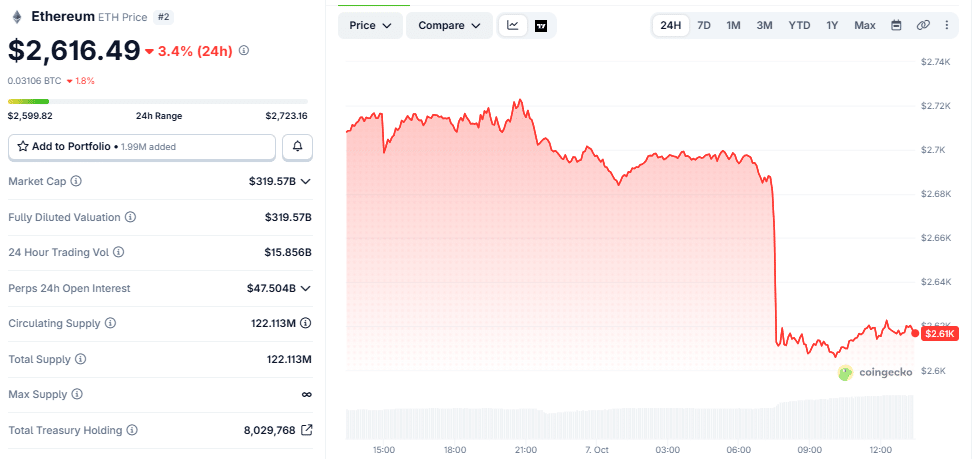
Ethereum’s market capitalization, the total value of all ETH in circulation, stands at $319.57 billion on CoinGecko. Spot trading volume over 24 hours rose to $15.856 billion, up from about $10.49 billion a day earlier, when ETH was holding near $2,700. Circulating supply is 122.113 million ETH, and Ethereum has no maximum supply cap.
Open interest in ETH perpetual futures stands at $47.504 billion. Perpetual futures are derivative contracts with no expiry date, and open interest measures the total value of contracts still open. A high reading means that even a modest price move can force a large number of leveraged positions to close.
$175 Million in ETH Liquidations, Almost All Longs
A liquidation happens when an exchange forcibly closes a leveraged position because the trader’s collateral can no longer cover losses. A “long” is a bet that the price will rise, and a “short” is a bet that it will fall.
Data from CoinGlass shows $174.93 million in ETH liquidations over 24 hours as of 07:57 UTC. Long positions made up $164.91 million, or about 94% of the total. Shorts accounted for only $10.03 million. ETH was the largest block on the CoinGlass liquidation heatmap, ahead of Bitcoin at $142.87 million.
Across the crypto market, CoinGlass recorded $549.42 million in liquidations over the same 24 hours, affecting 101,102 traders. Longs accounted for $479.63 million, or about 87%, and shorts for $69.80 million. ETH alone made up nearly a third of the total. The largest single liquidation order was a $26.64 million ETHUSDC position on Binance.
The timing data shows that most of the damage came overnight. Of the $451.09 million liquidated across the market in the past 12 hours, $424.54 million came from longs. Only $11.85 million was liquidated in the most recent four hours, which suggests the forced selling has slowed for now. Liquidation totals are reported by exchanges and may not capture every closed position.
The selloff was not limited to Ether. Bitcoin fell to about $84,000 in the same session as leveraged longs were cleared across major assets.
Glamsterdam Goes Live on Sepolia, Not Mainnet
Sepolia is a public Ethereum test network where developers try out protocol changes using test ether, which has no market value. According to the Ethereum Foundation’s testnet announcement, Glamsterdam was scheduled to activate on Sepolia at epoch 353,024, slot 11,296,768, at 13:53:36 UTC (7:23 PM IST) on October 6.
Ethereum community contributor Pooja Ranjan confirmed the activation the same day, saying the fork carries 18 core Ethereum Improvement Proposals (EIPs) and seven other EIPs. The Crypto Times reported the activation on Tuesday.
Glamsterdam combines the Amsterdam upgrade on Ethereum’s execution layer with the Gloas upgrade on its consensus layer. It follows the Fusaka upgrade, which activated on mainnet on December 3, 2025. Its two headline changes are:
- Enshrined proposer-builder separation (ePBS) under EIP-7732, which moves the split between block proposers and block builders into Ethereum’s core protocol.
- Block-level access lists (BALs) under EIP-7928, which record the accounts and storage a block touches so clients can read and validate transactions in parallel.
The full fork scope is tracked in the meta-proposal EIP-7773. Hours before the fork, consensus client Prysm released version 7.2.1 so that Sepolia validators would default to a 200 million gas limit instead of 60 million, as The Crypto Times reported.
None of these changes apply to Ethereum mainnet yet. The Ethereum Foundation lists activation dates for Hoodi, the validator-focused testnet, and for mainnet as still to be decided. The Glamsterdam roadmap page on ethereum.org shows mainnet targeted for the fourth quarter of 2026, with no confirmed date. The Sepolia activation and Wednesday’s price drop landed in the same 24-hour window, but market data does not show that the testnet fork caused the move.
ETF Outflows and Fed Minutes in Focus
Institutional demand had already cooled before Wednesday’s drop. U.S. spot Ethereum exchange-traded funds (ETFs), which hold actual ETH and trade on U.S. stock exchanges, recorded about $155 million in net outflows over four straight sessions to October 2, The Crypto Times reported, citing SoSoValue data. ETH held $2,700 through that streak and lost the level on Wednesday.
Macro risk is the next event on the calendar. The Federal Open Market Committee (FOMC), the Federal Reserve body that sets U.S. interest rates, will publish minutes of its September 15 to 16 meeting today at 2:00 PM ET (11:30 PM IST), according to the Federal Reserve calendar. At that meeting, the committee raised its target range by 25 basis points (0.25 percentage points) to 3.75% to 4.00%. The minutes do not change policy, but they show how officials weighed the decision. The next FOMC meeting runs October 27 and 28, with the rate decision due on October 28.
Ethereum Price Levels to Watch
On the downside, the first level is the $2,600 area, including Wednesday’s session low of $2,599.82. A sustained break below it would extend the move beyond the range tested in this session.
On the upside, ETH first needs to reclaim $2,700, about 3.2% above the current price, followed by the session high of $2,723.16. A daily close back above $2,700 would return ETH to the range it held on October 5 and 6. Traders are also likely to watch whether ETF flows stabilize and how markets read the Fed minutes.
Also Read: Bitcoin Price Today: BTC Falls to $84K as $546M Liquidations, ETF Outflows Hit Before Fed