Zcash (ZEC), the privacy-focused cryptocurrency that lets users hide transaction details through optional shielded transfers, traded at $1,366.37 on Tuesday, October 6, up 3.5% in 24 hours. The move came as Network Upgrade 7 (NU7) went live on the Zcash public test network two days ahead of its projected date, and as redemptions from Grayscale’s spot Zcash exchange-traded fund (ETF) slowed sharply after the fund’s first negative week.
ZEC moved between $1,281.40 and $1,372.80 over the past 24 hours, according to CoinGecko market data. The token carried a market capitalization of $23.11 billion, ranking No. 10 among all cryptocurrencies, with a fully diluted valuation (FDV), the value of all 21 million coins that will ever exist, of $23.12 billion.
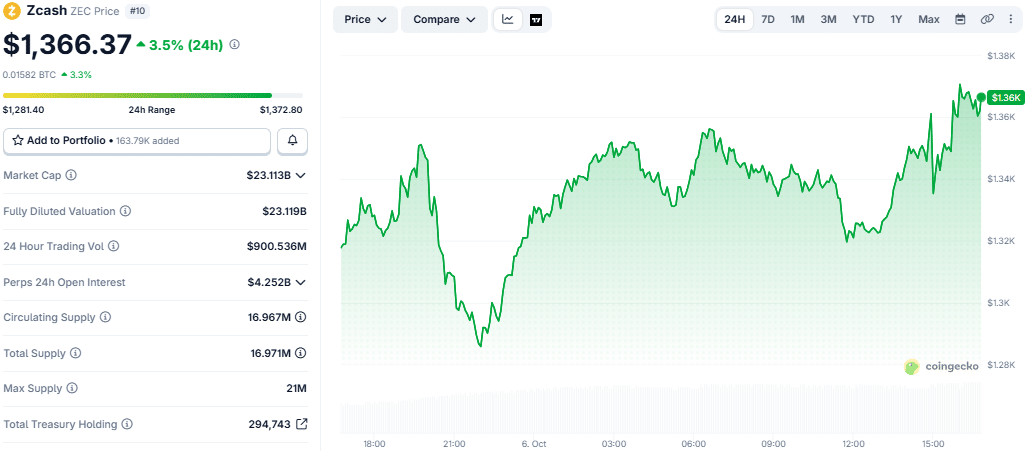
Spot trading volume over 24 hours was $900.54 million, and ZEC was priced at 0.01582 Bitcoin (BTC), up 3.3% against the largest cryptocurrency.
The Zcash price is still up about 193% over the past three months on CoinGecko’s chart, but it sits roughly 19.5% below its September 27 high near $1,697. The current session reads as consolidation after a sharp pullback, not as a fresh breakout.
NU7 Goes Live on Zcash Testnet Two Days Early
NU7 is the next scheduled hard fork of the Zcash blockchain, a protocol change that every full node must adopt. It activated on the public testnet at block 4,465,026 on October 4, according to the live NU7 dashboard run by the team behind Zakura, one of the two node programs that implement Zcash.
The Zcash Foundation, which maintains the other node program, Zebra, had said in its Zebra 7.0.0-rc.0 release notes that activation at that height was expected around October 6. Because activation is tied to a block height rather than a calendar date, faster block production brought it forward.
The rollout schedule was set in the NU7 timeline posted on the Zcash Community Forum by Zcash co-founder Sean Bowe. It places the mainnet go or no-go decision, together with the mainnet activation height, on October 20, and targets mainnet activation on November 5. The official Zcash account published the same calendar on X on September 21, with code completion set for September 30.
The headline change is speed. NU7 cuts the target time between blocks from 75 seconds to 25 seconds, three times faster than today. Faster blocks do not mean faster issuance: the Zcash Foundation said each block reward is divided by three, and the remaining halving intervals are lengthened, so the daily amount of newly issued ZEC stays the same, according to the Zebra release notes.
The upgrade also introduces the Network Sustainability Mechanism (NSM), which sends 60% of each block’s transaction fees into a reserve meant to fund future block rewards, leaving miners with 40%. NU7 also disables version 4 (v4) transactions, which suspends Sprout, the original Zcash shielded pool launched in 2016. Participants in the forum thread warned that funds left in Sprout after mainnet activation would effectively be stuck, so Sprout holders need to move coins before November 5.
In the same post, Bowe wrote that the upgrade should not significantly affect wallets, while full nodes, indexers, and block explorers may need to upgrade. Mainnet node operators have no action to take until the October 20 decision sets an activation height. The Crypto Times earlier reported that the NU7 mainnet upgrade targets November 5 with 25-second blocks.
Zcash ETF Outflows Slow After First Negative Week
ZCSH is the ticker of the Zcash ETF from Grayscale, formerly the Grayscale Zcash Trust, which holds ZEC directly and has traded on NYSE Arca since August 25, 2026. It recorded a net outflow of $3.57 million on October 5, according to SoSoValue settlement data republished by the ZCSH flow tracker. SoSoValue is a crypto market data provider that compiles daily ETF flows.
That print followed a net outflow of $93.56 million in the week ended October 2, the first negative week since the fund’s listing.
| Settlement date | ZCSH net flow (USD) |
| October 5 | -$3.57 million |
| October 2 | -$26.93 million |
| October 1 | -$28.26 million |
| September 30 | -$30.25 million |
| September 29 | $0 |
| September 28 | -$8.12 million |
Across the first three October sessions, ZCSH shed a combined $58.76 million, after a net inflow of $245.92 million in September, per the same dataset. Net assets, also called assets under management (AUM), stood at $781.96 million on the October 5 settlement, and cumulative net inflows remained positive at about $209 million. The Crypto Times had earlier reported that the fund planned a 3-for-1 share split after $233 million in inflows.
Zcash Policy Group Registers to Lobby in Washington
Pretty Good Policy for Zcash, a policy group focused on Zcash, registered to lobby in Washington effective October 1, with executive director Divij Pandya as its only named lobbyist, The Crypto Times reported in its coverage of the Zcash policy group’s lobbying registration. The filing covers the Digital Asset Market Clarity Act (CLARITY Act), H.R. 3633, a United States market structure bill for digital assets, along with two digital-asset tax bills.
The group is funded by a $750,000 award from Zcash Community Grants (ZCG), the committee that distributes development funding from the Zcash block reward. Founder Paul Brigner sits on that committee and recused himself from the discussion that approved the award, according to the same report.
Derivatives, Shielded Supply and Exchange Access
Perpetual futures open interest (OI), the total value of outstanding leveraged contracts that have no expiry date, stood at $4.252 billion on CoinGecko, equal to about 18.4% of ZEC’s market capitalization. A derivatives book of that size can extend a rally through short liquidations, and it can also speed up a decline when leveraged longs are forced out.
Supply data shows 16.967 million ZEC in circulation, about 80.8% of the 21 million maximum supply, with total supply at 16.971 million. About 29.08% of ZEC sits in shielded pools, according to the ZecZcash shielded supply tracker, which reduces the share of supply readily available on exchanges. Corporate and fund treasuries tracked by CoinGecko hold 294,743 ZEC, worth about $402.7 million at the current price.
Access to ZEC is widening slowly. The Crypto Times reported on October 2 that THORChain activated a Zcash pool, a step toward native cross-chain ZEC swaps, though native trading was still pending and liquidity was shallow.
One risk item remains open. Onchain investigator ZachXBT said alleged North Korean operators had begun shielding about 2,700 ZEC, roughly $3.8 million at the time, stolen in the Bitget exploit, The Crypto Times reported in its story on alleged North Korean hackers using the Ironwood pool. Such flows are not a protocol failure, but they keep privacy coins under regulatory scrutiny.
ZEC Price Analysis: Key Support and Resistance Levels
ZEC is holding the middle of its recent range, and the next directional move likely depends on whether buyers can clear the highs printed this week. The token closed the latest 24-hour window near the top of its $1,281.40 to $1,372.80 range on CoinGecko, recovering from an overnight dip that briefly took it under $1,300.
Support sits first at the 24-hour low of $1,281.40, about 6.2% below the current price, and then in the $1,270 to $1,300 zone that held during the October 3 to October 5 lows. Below that, $1,200 is the next round-number level, roughly 12.2% lower and the same mark co-founder Eli Ben-Sasson had targeted for late September.
Resistance starts at the 24-hour high of $1,372.80 and extends to about $1,410, the top of this week’s trading. Above that, the early-October high near $1,480 and the $1,600 area, roughly 17.1% above the current price, mark the levels where the September rally stalled. The September 27 peak near $1,697 is the final barrier, about 24.2% above where ZEC trades now.
Bullish case: A sustained daily close above $1,410 would put the $1,480 to $1,600 band back in play. A clean NU7 testnet run into the October 20 decision, together with a return to net inflows into ZCSH, would be the most direct catalysts for a retest of the September high.
Bearish case: A daily close below $1,270 would break the floor of this pullback and expose the $1,200 level. With $4.25 billion in perpetual futures open interest, a break of support could accelerate through forced selling of leveraged long positions.
Ben-Sasson’s end-of-year call of ZEC above $5,000, which he said on September 24 he still felt on track to meet, implies a further gain of about 266% from current levels. Both posts were labeled as not investment advice, and he did not publish a model behind the target. It is a personal forecast from a project co-founder, not a base case.
What to Watch Next for the Zcash Price
- October 20: Zcash developers decide whether NU7 proceeds to mainnet and set the activation height, per the NU7 timeline.
- Daily ZCSH flows: A return to net inflows would be the clearest sign of renewed institutional demand, based on the ZCSH flow tracker.
- October 27 and 28: The Federal Open Market Committee (FOMC), the Federal Reserve body that sets United States interest rates, holds its next scheduled meeting.
- November 5: Target date for NU7 mainnet activation, and the practical deadline for Sprout holders to move funds.
Nothing in the past 48 hours has broken the three-month uptrend, and nothing has confirmed the next leg higher. ZEC is digesting a 193% run, a first week of ETF outflows, and a testnet upgrade that still has to clear the October 20 review.
Disclaimer: This article is for informational purposes only and does not constitute investment advice. Cryptocurrency prices are highly volatile. ZCSH flow figures are vendor-settled data from SoSoValue, not a Grayscale release, and the $5,000 figure is a personal forecast.
Also Read: ETH Price Holds $2,700 as Ethereum Economic Zone Runs Atomic L1-to-L2 Mainnet Test