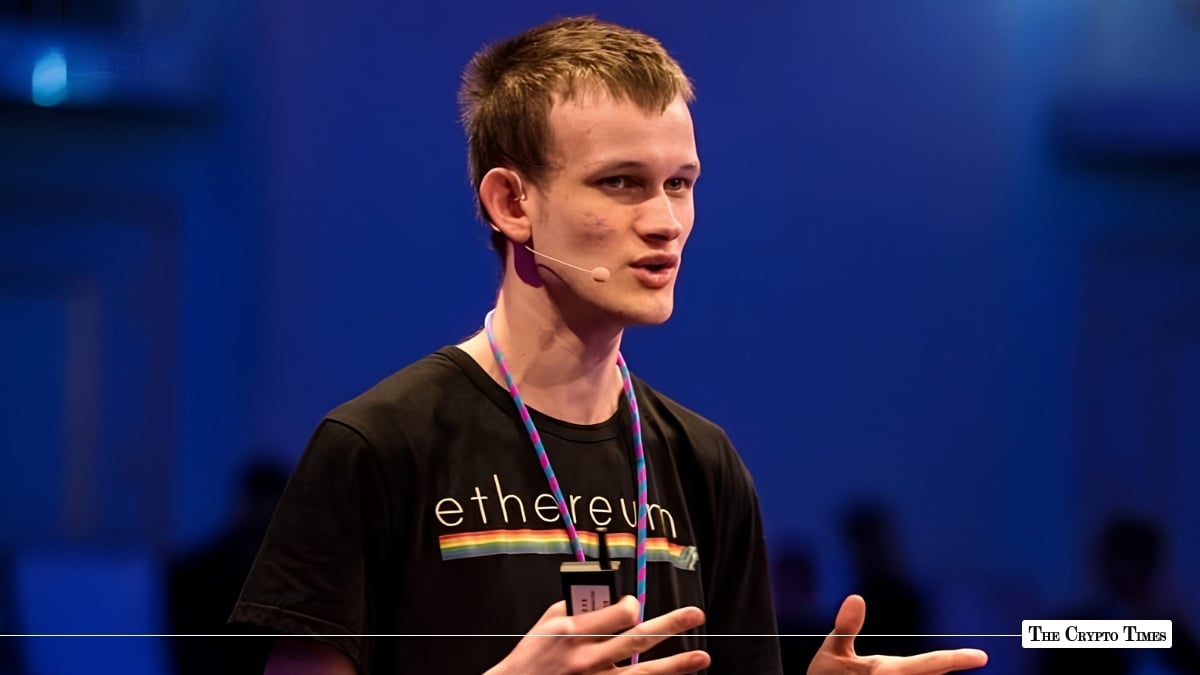
Ethereum Co-Founder Vitalik Buterin used a keynote in Singapore to sketch a detailed, deliberately balanced picture of how artificial intelligence is reshaping crypto; not just as a convenience, but as a force that cuts both ways across the industry’s security challenges.
Speaking at OKX’s “OKX NOW” 2026 Summit on October 6, during TOKEN2049 week, Buterin argued that AI could become a primary interface for interacting with blockchains, while warning that the shift would relocate some risks rather than eliminate them.
AI as the New User Interface
Buterin’s headline claim was that “AI will become the new user interface,” with complex on-chain operations increasingly executed through AI agents rather than conventional apps and web pages.
He illustrated the idea with a personal example. Buterin said he recently updated his Ethereum Name Service (ENS) record without using a conventional interface, instead having a local AI agent write a script to perform the operation. The task took roughly five minutes.
The example suggests a different model for blockchain interaction: users describe what they want to accomplish, while an AI agent handles the technical steps required to execute the operation. Buterin indicated that these kinds of interactions could become increasingly normal as AI capabilities improve.
Why That Could Make Crypto Safer
The more striking part of the argument concerned security. Buterin pointed to attacks targeting the interaction layer between users and blockchain systems, arguing that vulnerabilities can exist in the interfaces people rely on even when the underlying smart contracts themselves are not compromised.
He cited the roughly $1.4 billion Safe-related incident as an example of this type of risk. Rather than describing it as proof that smart contracts are inherently safer than interfaces, Buterin’s broader point was that the layer connecting users to on-chain systems can itself become a major target.
That is where an AI interface could potentially change the equation. If an AI agent constructs and submits transactions by interacting more directly with blockchain infrastructure, some risks associated with compromised websites, DNS attacks, or malicious frontend code could potentially be reduced. But that would not eliminate the security problem; it would shift part of it to the agent responsible for interpreting and executing the user’s instructions.
But AI Is Also a Weapon for Attackers
Buterin was explicit that the benefits are not one-sided. He noted that AI can already break out of sandboxes, attack websites, and discover software vulnerabilities; capabilities that can help defenders but can also be used by attackers. His argument was that increasingly capable AI will make stronger security both more difficult and more necessary.
In this model, AI raises the capabilities available to both sides of the security equation. Attackers can use AI to identify weaknesses faster, while defenders can use the same technology to find and fix vulnerabilities before they are exploited.
Giving AI agents the ability to act directly on-chain introduces another layer of risk. The agent itself must be secure, resistant to prompt injection and capable of correctly interpreting what a transaction or smart-contract interaction actually does.
An agent that misunderstands an instruction or is manipulated by malicious input could potentially execute an irreversible transaction involving real assets.
Why Buterin Isn’t a Doomer on AI Security
Crucially, Buterin rejected the idea that increasingly capable AI necessarily gives attackers a permanent advantage. His central example is formal verification, in which mathematical methods are used to establish that software satisfies specified properties. More capable AI, he argued, could help developers verify increasingly complex programs and test security properties at a scale that was previously difficult to achieve.
Buterin said AI is already being used within Ethereum-related security work to identify protocol vulnerabilities, implement cryptography and assist with formal verification. He also stressed the limits of that approach.
Formal verification can establish that software satisfies properties included in its specification, but it cannot protect against risks that developers failed to specify. And blockchain systems depend on far more than smart contracts, including servers, databases, networking infrastructure, and other components that can introduce their own vulnerabilities.
Buterin also cautioned against treating AI-generated security findings as automatically valid. He said the Ethereum Foundation uses AI agents for security testing but requires independent verification because AI can produce convincing findings that do not actually affect production systems.
That distinction is important: AI can accelerate security research, but its output still needs to be reproduced and independently checked before it is treated as a genuine vulnerability.
A Pattern in Buterin’s Recent Thinking
The address fits a consistent line Buterin has been developing through 2026. As The Crypto Times has reported, he has unveiled new tools aimed at secure AI and crypto access, warned that AI is reshaping the blockchain privacy debate, and pushed the idea of self-sovereign computing — users running their own local AI and software rather than relying entirely on centralized services.
His emphasis on a local AI agent in the ENS example fits that preference for keeping control and data on the user’s own machine. It also connects with his longer-standing thinking about what an ideal crypto wallet should look like.
What to Watch
Buterin’s OKX address is significant less for any single prediction than for the framework he offered for thinking about AI and crypto security.
The interface between users and blockchains could increasingly move from websites and applications to AI agents. That could make some frontend attacks harder, but it would create a new security layer around the models, permissions and software responsible for executing user instructions.
At the same time, AI could give defenders more powerful tools for finding vulnerabilities, testing code and improving software security, even as attackers gain access to many of the same capabilities.
The result is not necessarily a safer or less safe blockchain environment. It is a different security model in which both the capabilities and the attack surface expand. As Buterin put it, new interaction methods can resolve some existing problems while creating new security challenges of their own.
Also read: Ethereum Holds 53% of $349B Onchain Tokenized Asset and Stablecoin Market