Uniswap’s UNI token came under pressure on October 7, 2026, as a broader decline across the crypto market weighed on higher-beta digital assets. UNI was trading at about $8.04 as of 09:59 UTC, down 9.3% over the previous 24 hours, according to CoinGecko data.
At that snapshot, UNI had fallen more sharply than Bitcoin and Ethereum, declining 6.8% against BTC and 5.3% against ETH. The token traded in a 24-hour range of $8.01 to $8.93, putting the cited price close to the bottom of that range.
UNI’s market capitalization was about $5.03 billion, while 24-hour trading volume stood at roughly $724.6 million. Perpetual-futures open interest was approximately $1.25 billion, highlighting the amount of derivatives positioning around the token at the time.
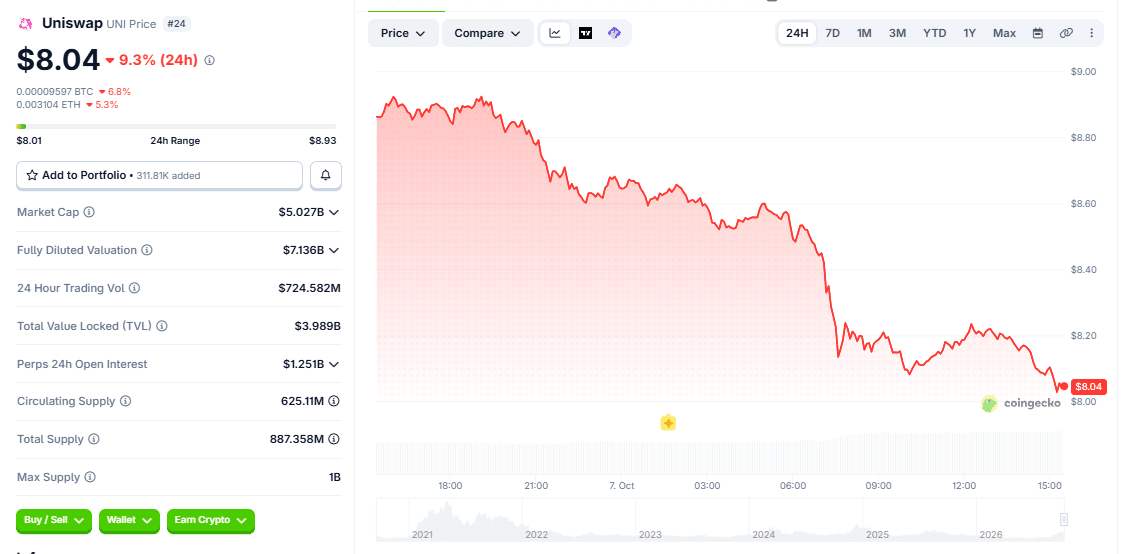
Those figures are timestamp-sensitive and can change rapidly during a volatile session.
Why UNI Is Down
The decline came as Bitcoin and Ethereum also moved lower and crypto liquidations increased across the market. CoinGlass data showed that crypto liquidations reached $606.91 million over a 24-hour period, including $540.03 million in long positions, as Bitcoin was trading around the $84,000 mark.
That broader backdrop provides context for UNI’s decline, but it does not establish that liquidations alone caused the token’s move.
Additionally, as the governance token of the largest decentralized exchange, UNI has historically amplified the market’s swings: it rallies more than the majors when sentiment is strong and falls more when it turns. On a day when traders were cutting risk and rotating out of DeFi, that beta worked against it. There was no single negative Uniswap-specific headline behind the move; it was macro positioning, not protocol news.
The UNIfication Effect
The price decline is occurring after a major change to Uniswap’s token economics. In December 2025, Uniswap governance approved the UNIfication proposal, which activated protocol fees and established a mechanism through which those fees can be used to burn UNI. The proposal also included a one-time burn of 100 million UNI from the treasury.
The 100-million-UNI burn was designed as a retroactive supply adjustment. Uniswap’s proposal described it as an estimate of the amount that might have been burned had protocol fees been active since the token’s launch. The ongoing mechanism works differently. Protocol fees accumulate in contracts and can be converted into UNI burns, linking protocol activity to supply reduction rather than paying UNI holders a direct revenue distribution.
Uniswap’s governance discussions show that the fee rollout has continued beyond Ethereum. A February 2026 governance proposal said fees had initially gone live on Ethereum and were being expanded to additional chains, with the burn system converting accumulated fees into UNI burns.
The mechanism gives UNI an indirect economic relationship with protocol activity through supply reduction, rather than making UNI a conventional revenue-sharing token.
UNI Supply and Uniswap’s On-Chain Footprint
Uniswap continues to maintain a substantial on-chain footprint despite the token’s short-term decline. DeFiLlama currently puts Uniswap’s combined total value locked (TVL) at roughly $3.988 billion. On the supply side, CoinGecko currently reports about 625.1 million UNI in circulation, 887.4 million in total supply and a 1 billion maximum supply.
The difference between circulating and total supply means UNI still has tokens outside the circulating supply, while the one-time 100-million-token burn has already reduced the overall supply relative to the original allocation. The supply reduction does not, by itself, guarantee higher prices. Its economic impact depends in part on future protocol activity, fee generation, the amount of UNI burned and broader market demand.
Derivatives positioning also remains significant. CoinGecko’s current data shows roughly $1.2 billion to $1.3 billion in UNI perpetual open interest, meaning leveraged positioning remains large relative to the token’s market capitalization. Open interest measures outstanding derivatives positions, however, and does not by itself show whether traders are positioned long or short.
What to Watch for UNI
The near-term questions are whether the broader market selloff stabilizes or deepens, whether UNI can hold the $8 level it is testing, and whether the value-accrual mechanics now live through UNIfication begin to matter to the price once macro conditions calm. For context on the wider market backdrop, see The Crypto Times’ coverage of how Bitcoin has been navigating its “Uptober” test.
Also Read: Ethereum Price Today: ETH Falls Below $2,620 as $175M Liquidations Hit After Glamsterdam