Key Highlights
- Ethereum’s Fusaka Upgrade Goes Live Improving Speed, Fees, and Layer-2 Capacity.
- Fusaka introduces PeerDAS, allowing faster transactions and up to eight times higher Layer-2 capacity.
- ETH market shows bullish signals as large holders increase positions ahead of Fusaka.
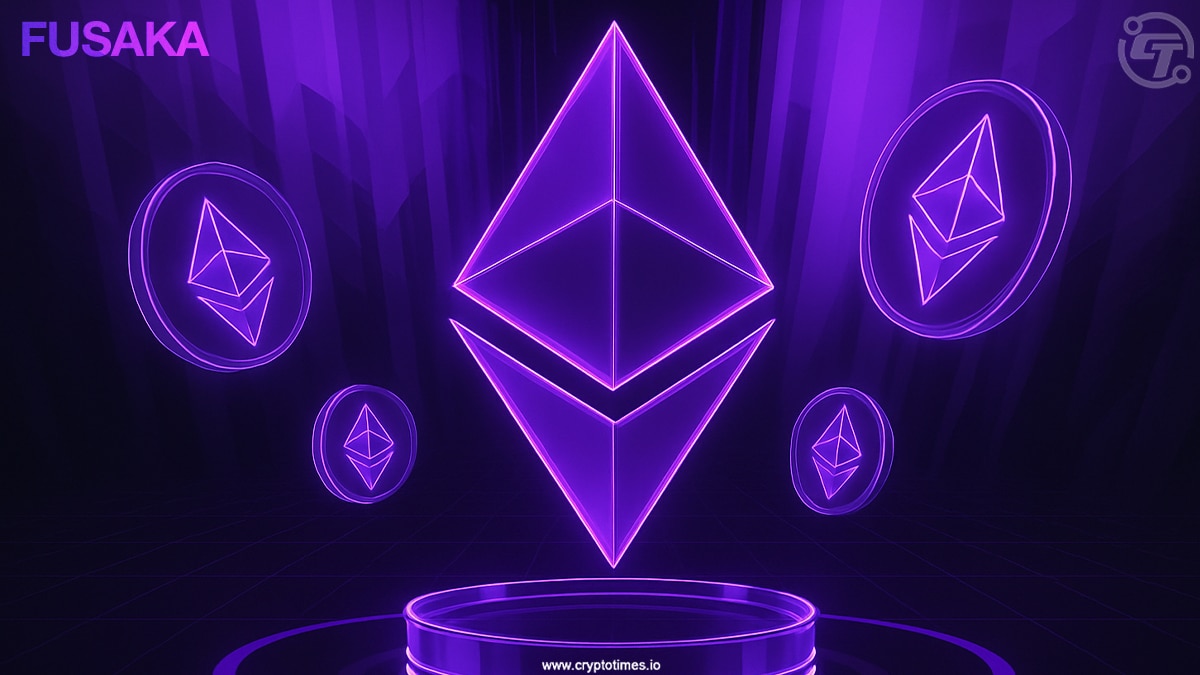
Ethereum has successfully activated its latest network upgrade, known as Fusaka, marking a major step forward for performance, scalability, and long-term usability.
The upgrade went live on the Ethereum mainnet at 9:49 p.m. UTC on Wednesday, during Epoch 411392, and brings with it one of the most important scaling features ever implemented on Ethereum: Peer Data Availability Sampling, or PeerDAS.
This marks Ethereum’s second major upgrade of the year, and although its benefits will unfold gradually, network developers say the long-term implications are significant.
A foundation for near-instant transactions
According to the Ethereum Foundation, Fusaka brings the network closer to a world where transactions feel almost instant. By using preconfirmations, transaction times are reduced from minutes to milliseconds, and lower fees create a new level of usability for the network.
PeerDAS allows Ethereum to dramatically increase the amount of data Layer-2 networks can process, boosting their capacity by up to eight times. Instead of requiring every node to download complete data blobs, Fusaka splits the information into smaller pieces that nodes can share and sample from each other.
This change helps the network process transactions more quickly, eases the load on bandwidth, and lowers fees for users who rely on rollups.
This update is especially important because Ethereum relies heavily on rollups to manage the large volume of activity across decentralized finance (DeFi) platforms, non-fungible tokens (NFTs), and other on-chain applications.
“This literally represents sharding”
One of the biggest technical milestones inside Fusaka is that PeerDAS finally delivers the first real form of sharding, a long-promised evolution in Ethereum’s roadmap.
Ethereum Co-Founder Vitalik Buterin highlighted the moment, stating: “PeerDAS in Fusaka is important because it literally represents sharding. Sharding has been a dream for Ethereum since 2015, and data availability sampling since 2017, and now we have it.”
Fusaka also introduces a system called Blob-Parameter-Only configuration, which allows Ethereum to increase blob capacity in future upgrades without a full hard fork. This means scaling enhancements can now happen more smoothly and more regularly.
Additional fee-structure updates ensure blob fees can’t collapse during periods of high gas demand, helping maintain stability as more activity moves on-chain.
Layer-2 networks already preparing
Rollup teams have been quietly adjusting their infrastructure ahead of the upgrade. Blockscout, a major explorer for Ethereum-based chains, observed a visible shift in how Layer-2s are posting data. They said the network is showing: “Signs of preparation for higher data throughput across the L2 networks we index with the most visible shift in posting patterns.”
Rollups have reportedly begun increasing the frequency of state-root submissions and optimizing their block intervals — changes that suggest smoother sequencing and more predictable transaction batching from here on.
Blockscout added that the trend is “incremental rather than disruptive, but it is noticeable,” describing the upgrade as a crucial alignment between Ethereum’s base layer and the massive activity already occurring above it.
Analysts see a catalyst for ETH price momentum
Market observers are closely watching Ethereum, seeing Fusaka as a possible trigger for renewed gains in the price of Ethereum (ETH). Crypto trader MerlijnTrader recently noted that Ethereum’s previous upgrade, Pectra, led to a 58% price surge, and believes Fusaka has the potential to drive even stronger upside since its improvements are more foundational.
Over the last few weeks, Ethereum has already displayed notable recovery. ETH has risen more than 13% since December 1 and remains up over 17% for the month. Traders have noticed a bullish divergence between Ethereum’s price and the Relative Strength Index (RSI), the same pattern that came before the network’s sharp seven-day rally during the Pectra upgrade in May 2023.
At the same time, large investors seem to be positioning ahead of the upgrade. The number of wallets holding at least $1 million in ETH has increased from 13,322 to 13,945, adding more than $623 million in concentrated holdings — a move that has historically signaled strong institutional confidence.
A strengthened base before the next major step
Ethereum has been the most widely used decentralized blockchain for years, but success has come with challenges, congestion, high fees, and rising demands on nodes. Fusaka helps Ethereum handle its biggest challenges by lowering bandwidth needs and letting the network process more data safely.
Developers see it as strengthening the foundation before adding more layers. A representative from Sygnum Bank told the Cryptotimes, “Fusaka introduces several improvements that will influence how value flows through Ethereum’s base layer, and the most direct beneficiary is Layer 1 block space. When the network becomes more efficient in handling execution or processing larger volumes of data, the effects will likely lead to a gradual increase in fee burn and validator rewards.”
Users may not notice the change right away, but everything that comes after depends on Fusaka being in place.
The Ethereum community is already looking ahead to Glamsterdam, a major upgrade planned for next year. Without Fusaka, that kind of growth would not be possible.
Ethereum’s Fusaka upgrade has started improving the network. DeFi activity, NFT minting, and Layer-2 transfers are running more smoothly. The changes are small at first, but they lay the groundwork for wider adoption.
Also Read: Ethereum Launches Private ZK Secret Santa on Blockchain