
Ethereum (ETH), the second-largest cryptocurrency by market capitalization, traded at $2,716.23 on Monday, October 5, up 0.6% over the past 24 hours. The price held steady even as U.S. spot Ether exchange-traded funds (ETFs) recorded a fourth consecutive session of net outflows in their latest reported data, and as new research showed that ETH trading books on major exchanges remain thinner than Bitcoin’s.
Ethereum Price Today: ETH Trades in a Narrow Range
According to CoinGecko’s Ethereum price data, ETH moved between $2,692.54 and $2,736.97 over the past 24 hours, a range of about $44. Its market capitalization, which is the token price multiplied by the number of coins in circulation, stood at $331.68 billion.
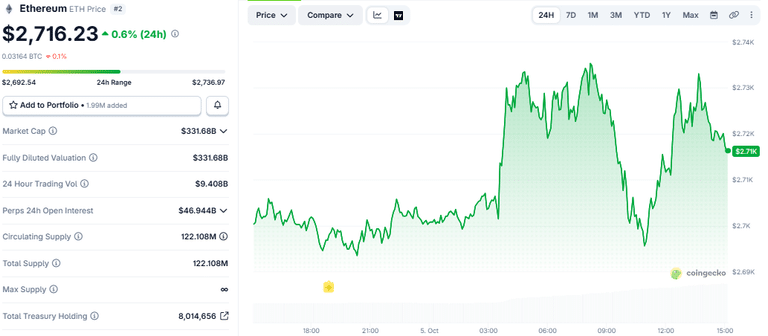
Fully diluted valuation (FDV), which values a token’s total supply at the current price, was also $331.68 billion. The two figures are the same because Ethereum has no fixed maximum supply, and its entire supply of about 122.108 million ETH is already in circulation.
Trading volume over the past 24 hours reached about $9.41 billion. Measured against Bitcoin, ETH traded at 0.03164 BTC, down 0.1% on the day, which means Ethereum slightly lagged Bitcoin over the same period.
In the derivatives market, CoinGecko data showed about $46.94 billion in open interest on ETH perpetual futures. Perpetual futures are contracts that let traders bet on price moves without an expiry date, and open interest is the total value of those contracts that remain open. CoinGecko also lists total treasury holdings of 8,014,656 ETH held by companies and other entities that keep Ether on their balance sheets.
Spot Ether ETF Outflows Extend to Four Straight Sessions
A spot Ether ETF is a fund that holds actual ETH and trades on U.S. stock exchanges, giving investors price exposure without buying the token directly. Data from SoSoValue’s U.S. spot Ethereum ETF dashboard show net outflows in each of the last four completed trading sessions:
- September 29: ~$2.81 million
- September 30: ~$59.58 million
- October 1: ~$55.37 million
- October 2: ~$37.36 million
That adds up to roughly $155.12 million in net outflows across the four sessions. On 2 October, BlackRock’s iShares Ethereum Trust (ETHA) saw about $20.10 million in net outflows, while the Fidelity Ethereum Fund (FETH) recorded about $17.25 million. Together, the two funds accounted for nearly all of that day’s withdrawals.
Despite the streak, SoSoValue figures show the U.S. spot Ether ETFs still hold about $13.80 billion in cumulative net inflows since launch, with total net assets of about $17.46 billion. Flow data for Monday’s session had not been published at the time of writing.
ETH Liquidity Remains Thinner Than Bitcoin’s
Order-book depth measures how much buying and selling interest sits close to the current market price. Deeper books can absorb larger trades with smaller price moves.
CoinGecko’s 2026 Crypto Liquidity on CEXes report measured median daily order-book depth on eight major centralized exchanges (CEXs), which are trading platforms run by a company, from early July to early September. Within about 0.15% of the mid-price, which is the midpoint between the best buy and sell offers, ETH depth was about $13 million to $14 million. That equals roughly 35% to 45% of Bitcoin’s depth in the same band, compared with at least 60% a year earlier.
Bitcoin’s median depth in the study was about $29 million on the bid (buy) side and $37 million on the ask (sell) side. Most exchanges still showed more than $1 million of ETH depth on each side, so smaller trades are easily absorbed. However, a thinner book means a large order of the same dollar size can move ETH’s price further than it would move Bitcoin’s.
For a wider view of the levels traders are watching this month, see The Crypto Times’ Ethereum price prediction for October 2026.
Upcoming Ethereum and Market Events This Week
Glamsterdam on Sepolia (October 6): The Ethereum Foundation’s Protocol team has scheduled the Glamsterdam network upgrade to activate on the Sepolia testnet at 13:53:36 UTC (7:23 PM IST) on October 6, at epoch 353,024. A testnet is a practice network where developers trial changes using tokens with no real value before they reach the main Ethereum network.
Glamsterdam introduces enshrined proposer-builder separation (ePBS), which builds the split between the parties that assemble blocks and the validators that propose them directly into the protocol. It also adds block-level access lists, a record of what each block touches that allows parts of transaction processing to run in parallel. Dates for the Hoodi testnet and mainnet activation have not yet been decided. The Crypto Times earlier reported the Glamsterdam Sepolia activation schedule in detail.
FOMC minutes (October 7): The U.S. Federal Reserve is scheduled to release the minutes of its 15 and 16 September Federal Open Market Committee (FOMC) meeting on October 7, at 2:00 PM Eastern Time (11:30 PM IST). The FOMC is the Fed committee that sets U.S. interest rates, and its minutes give a detailed account of policymakers’ discussions. Other key dates are covered in The Crypto Times’ crypto week ahead roundup.
Ethereum Market Update: Where ETH Stands
Ethereum is trading near $2,716, within a 24-hour range of $2,692 to $2,737, after U.S. spot Ether ETFs saw about $155 million leave over four sessions. Exchange data show ETH order books carrying less depth relative to Bitcoin than a year ago, while the Glamsterdam testnet activation and the FOMC minutes are the next scheduled events on the calendar.
Also Read: Bitcoin’s Hold Near $86,000 Builds Tension as It Fails to Clear Resistance