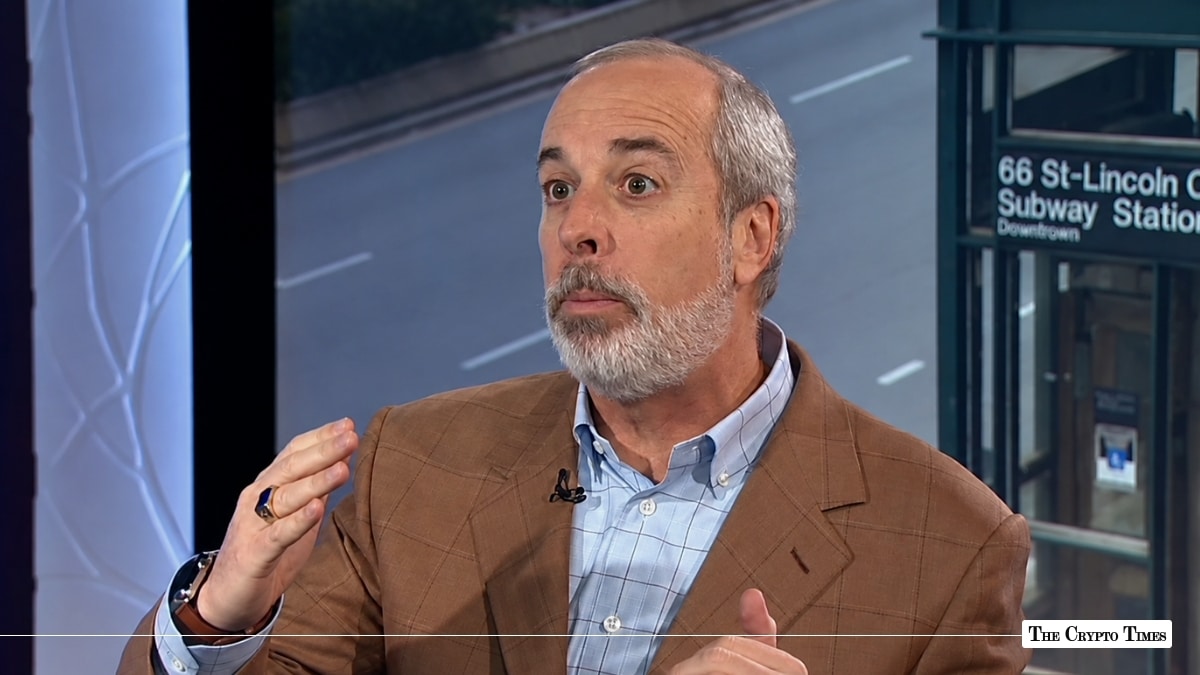
Ric Edelman, a longtime Bitcoin advocate in traditional finance, says that buying Bitcoin now resembles buying Amazon in 1999, and that a worldwide 1% portfolio allocation would support a price of $500,000 by 2030. He also said that figure may prove too low and too late.
Edelman, founder of Edelman Financial Engines and the Digital Assets Council of Financial Professionals, spoke on Bitcoin Magazine’s September 17 BMTV program as Bitcoin traded near $77,200 (as of 4:30 AM UTC), about 1.4% higher on the day—as per CoinGecko data.
“Back in 1999, people were arguing over whether to invest in Amazon,” Edelman said. “Nobody has that argument — everybody owns it, and Bitcoin will have the same trajectory in the future.”
The comparison is an adoption argument, not a claim that bitcoin and Amazon are the same asset. Edelman framed BTC as moving from a contested idea toward a default holding, while the price path he described depends on how much capital diversified investors actually assign to it.
The 1% allocation math behind $500,000
Edelman’s price target rests on one assumption. “If everybody in the world allocates 1% of assets to bitcoin, that translates to a $500,000 price — it’s really that simple,” he said in the interview.
He added that investors “don’t have to go to a website and look at that arithmetic,” and that he sees “nothing… that’s going to interfere” with the forecast — “in fact, just the opposite.”
In the same interview, he called $500,000 by 2030 “kind of low compared to many others,” then said the call may be wrong “on two counts: one, it’ll be more than $500,000, and second, it’ll probably be before 2030.”
That is a supply-and-demand sketch, not a guarantee. It assumes a broad 1% slice of global portfolios actually arrives, that enough liquid coins are available to absorb the demand, and that sellers do not offset the bid. A higher average allocation would imply a higher implied price; a lower or slower allocation would not.
Other public 2030 maps sit in a similar six-figure band. Coinbase chief executive Brian Armstrong has separately called $400,000 by 2030 a reasonable long-term level, after earlier floating a $1 million case.
Strategy Inc.—the largest Bitcoin treasury company with over 845K BTC in holdings—Executive Chairman Michael Saylor has argued Bitcoin is still a sliver of global wealth and could rise if that share moves from about 0.1% toward 1% to 10%. Those views use different models. None of them is a settled valuation.
From 2013 stage jeers to a 2% client target
Edelman has argued for bitcoin inside advisory portfolios for more than a decade. He recalled being “booed off many a stage in 2013, 2014” when he urged financial-services colleagues to pay attention. He said most traditional finance now at least treats the asset as “here to stay.”
On the same broadcast he said Edelman Financial Engines has set a 2% Bitcoin target for willing client portfolios, and that 16 years of data, in his view, show a small sleeve can improve risk-adjusted results when it is rebalanced. He described volatility as a portfolio-management problem rather than a reason for a zero weight: rebalancing, he said, forces selling strength and buying weakness.
That 2% house target is larger than many bank starting ranges and smaller than Edelman’s own past public ranges for aggressive crypto exposure. Bank of America has told wealth advisers they may recommend about 1% to 4% in bitcoin ETFs, depending on suitability. The gap shows how uneven practice still is: one large RIA talking about 2%, a bank corridor of 1–4%, and a global 1% thought experiment used only to illustrate a $500,000 price.
Edelman also discussed regulation. He said the failed Clarity Act vote was a setback, blamed parts of the industry fight over the bill, and argued the SEC can still write rules without Congress. Those comments are political judgments, not price inputs.
Though Bitcoin remains far below its October high and far below $500,000. Edelman’s case is that ownership broadens the way Amazon ownership did after 1999, and that even a 1% global sleeve would reprice a fixed-supply asset. The interview does not prove that allocation will happen on that timetable. It states the arithmetic he is using, and his view that the 2030, $500,000 marker may be conservative if the sleeve is larger than 1%.
This article is a report of public comments. It is not investment advice.
Also read: Michael Saylor’s Strategy (MSTR) Outpasses Berkshire Hathaway in Volume