Key Highlights
- Saylor said Bitcoin represents only about 0.1% of global wealth today and could grow to between 1% and 10% as institutional adoption expands.
- He introduced a 10-dimensional model showing how global capital can be redirected into Bitcoin through different products, rules, and systems.
- Saylor said Bitcoin could reach $700,000 to $7 million per coin if $10–20 trillion flows into Bitcoin-backed financial systems.
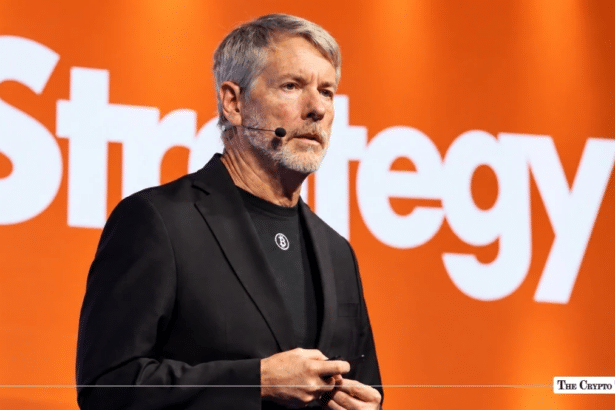
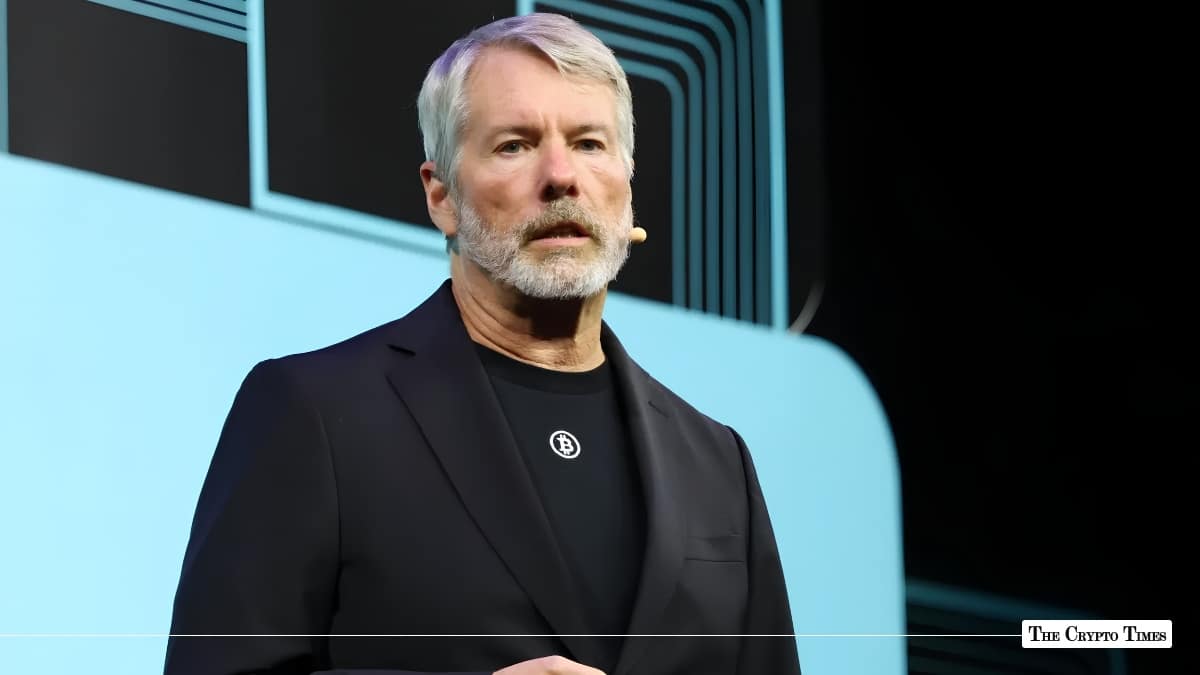
Michael Saylor, executive chairman of Strategy, the world’s largest corporate holder of Bitcoin, explained his idea of “Bitcoin Capitalism” during a keynote speech at BTC Prague 2026 in Prague.
In an X post on Monday, Saylor shared his speech, where he said Bitcoin is currently worth about $1 trillion, while total global wealth is around $1,000 trillion. That means Bitcoin is only about 0.1% of all money and assets in the world. He argued that this share could increase to between 1% and 10% over time as more institutions adopt Bitcoin.
“We need to actually convert from 0.1% to 1% and to 2% and to 3% and to 5% and to 10%, “ he said.
He explained that wealth advisors control about $156 trillion, and banks control about $200 trillion, which means these groups hold a large share of global wealth. If they cannot access Bitcoin, that money stays outside the system. He further said Bitcoin’s dominance in the crypto market is now around 68% to 70%, indicating it remains the strongest digital asset.
Building Bitcoin capitalism beyond holding BTC
Salyor explained that Bitcoin capitalism is not just about holding Bitcoin, but about building a full system around it. This system includes digital credit, digital money, and digital yield products.
He said digital credit has already grown into an $11–12 billion market in just one year. He also said Bitcoin-backed financial tools are starting to grow, where investors can earn returns or use Bitcoin-based assets in a more flexible way.
The 10-dimensional model of capital
Saylor introduced a “10-dimensional model” to explain how money moves in the world. He said capital is not one simple thing. It is split into different forms like real estate, stocks, bonds, commodities, cash, and digital tokens. Each of these needs different financial products to connect them to Bitcoin.
He said people use money for different reasons, such as saving, growing wealth, earning income, using it as security, or making payments. Bitcoin fits well for saving and growing value, but other uses need new financial designs built around it.
He also talked about how people store their money. Some use self-custody, meaning they hold their own Bitcoin. Others use banks, exchanges, or financial companies. Each option has different rules and risks. He said custody rules matter because they decide how safe or flexible the money is.
According to him, different countries have different laws. In fact, there are over 600,000 legal and tax systems around the world. This makes global money movement very complicated.
Risks, rules, and institutional barriers
During his speech, Saylor also discussed risk, listing market, currency, credit, regulatory, technical, and custody risks as key factors that shape investment design. He said different investors, including retail users, corporations, pension funds, and banks, all have different access levels and restrictions, which affect how Bitcoin products can reach them.
He pointed out why many institutions still cannot directly hold Bitcoin due to regulations, especially insurance companies and retirement systems. He said solving this requires either policy changes or new compliant products like Bitcoin-backed credit, yield instruments, and structured financial tools.
He said the future of Bitcoin depends on building bridges between traditional finance and Bitcoin systems. This means creating new products that banks, pension funds, and insurance companies can legally use.
Bitcoin market cap recovers to $1.33 trillion
Saylor’s comments come as Bitcoin’s market cap increases to $1.33 trillion. The asset is currently trading around $66,825, up 4.93% today as the overall market recovers after weeks of downtrend pressure.
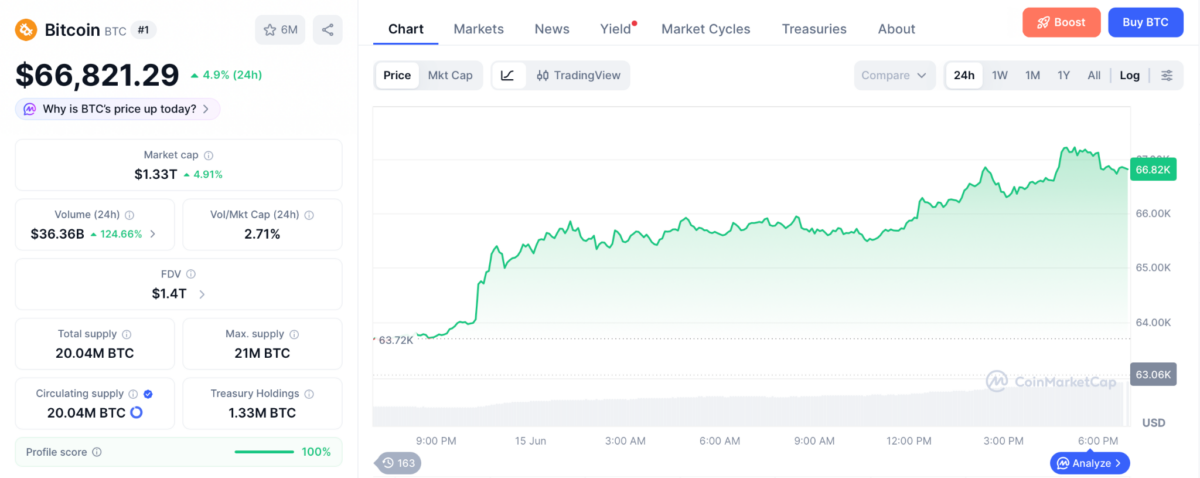
Bitcoin has also recorded 124% increase in trading activity within just 24 hours, pushing its volume to around $36,36 billion.
At the same time, Spot BTC ETF recorded its first inflow in weeks. According to data from SosoValue, the investment fund saw about $85 million in inflows on June 12. $57.69 from this amount came from BlackRock, followed by Fidelity, which brought in around $18 million. This is the latest inflow in over a month. In fact, the ETF has not recorded any inflow since May 27.
Looking further ahead, Saylor said that if between $10 trillion and $20 trillion eventually flows into Bitcoin-backed financial systems, Bitcoin’s price could rise from roughly $70,000 to between $700,000 and $7 million over the long term.
Also Read: $4.7M Purchase: Strive Adds More Bitcoin as Treasury Strategy Grows