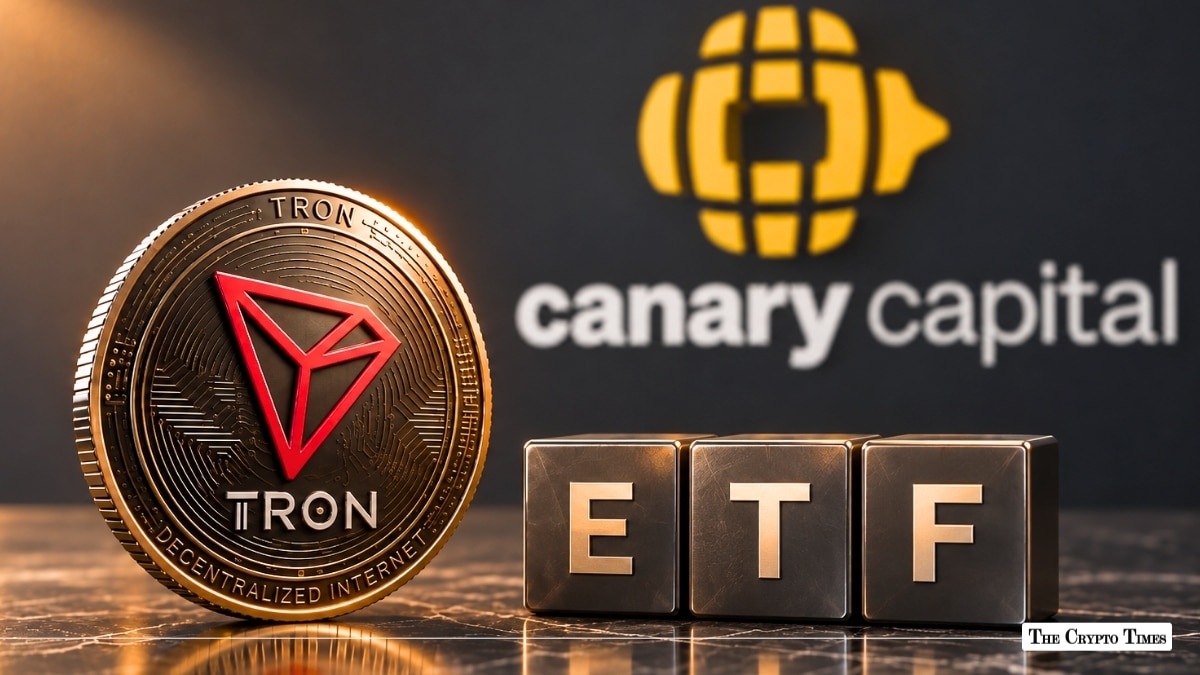
The Canary Staked TRX ETF, an exchange-traded fund tied to TRX, the native token of the TRON blockchain, is expected to begin trading on Cboe BZX Exchange (Cboe BZX) on September 9, 2026, under the ticker TRXS.
The product is sponsored by Canary Capital Group LLC, a Delaware-based asset manager that has filed a series of altcoin exchange-traded fund (ETF) applications with the U.S. Securities and Exchange Commission (SEC) over the past 18 months.
Bloomberg Intelligence ETF analyst Henry Jim first flagged the expected listing date on September 7 through his X handle, referencing Canary Capital’s August 19 pre-effective prospectus amendment.
TRON Founder Justin Sun posted multiple messages on X on September 8 referencing the debut, naming the venue and ticker and following up with additional commentary later the same day. Sun referred to the venue as the “Chicago Exchange,” a colloquial reference to Cboe BZX Exchange’s base city; the exchange’s formal name is Cboe BZX Exchange, Inc.
As of the latest publicly available S-1/A amendment reviewed for this report, the prospectus was still marked “subject to completion,” and shares were described as expected to list “subject to notice of issuance.”
What the Prospectus Discloses
The August 19, 2026 pre-effective amendment to Form S-1 describes the trust as a commodity-based exchange-traded product, not a corporate stock listing. Its primary investment objective is to provide exposure to the price of TRX held by the trust, less the expenses of the trust’s operations and other liabilities. Its secondary objective is to earn additional TRX through participation in a staking program administered by the sponsor, in which rewards are earned through validation of transactions in the TRON network’s proof-of-stake (PoS) process.
Under normal conditions, the sponsor expects to stake at least 90% of the trust’s TRX through staking providers. Aggregate staking fees are disclosed as capped at 20% of staking rewards, leaving 80% with the trust. The annual sponsor fee is set at 1.10% of TRX holdings, accrued daily and payable monthly in TRX or cash. The sponsor has agreed to cover ordinary operating expenses up to $200,000 per fiscal year, with extraordinary expenses borne by the trust.
BitGo Bank & Trust, N.A. is named as TRX custodian. U.S. Bank, N.A. serves as cash custodian. U.S. Bancorp Fund Services, LLC is listed as administrator and transfer agent. Creation and redemption are designed in baskets of 10,000 shares and may be settled in cash or TRX. An affiliate of the sponsor has indicated an intent to purchase 10,000 seed shares at $25 each, in kind in TRX.
Staking on TRON requires freezing tokens, and the prospectus notes a 14-day unfreeze period. That lockup is an operational feature of the network and is separate from the ability of TRXS shares to trade during exchange hours. The filing also states that the trust is not registered under the Investment Company Act of 1940 and does not seek to manage or hedge declines in the TRX price.
Canary Capital first filed for a staked TRX product in April 2025. The SEC later acknowledged the related Cboe BZX listing rule filing in May 2025 and opened it to public comment. Acknowledgment of a 19b-4 notice is procedurally distinct from an effectiveness order for the S-1 registration statement.
Distinguishing TRXS From Tron Inc.
TRXS, if it lists, would be shares in a trust that holds TRX. It would not be a stock listing, and the trust is not affiliated with the corporate entity Tron Inc.
Tron Inc. (Nasdaq: TRON) is a separate U.S. operating company. It was previously SRM Entertainment and changed its Nasdaq ticker to TRON on July 17, 2025, after adopting a TRX treasury strategy. Buying Tron Inc. stock is an equity investment in the company itself, including its treasury policy, financing decisions, governance, and other business risks.
Recent company disclosures have reported additional TRX purchases and total holdings above 712 million TRX. Those figures are company-reported treasury balances, not ETF assets.
Buying TRXS would not confer an ownership interest in Tron Inc., the TRON DAO (Decentralized Autonomous Organization), or the TRON protocol itself. Equity prices can diverge from token prices because of share supply, earnings, dilution, and control. ETF prices can diverge from token prices because of creation and redemption frictions, fees, staking liquidity, and any premium or discount to NAV.
Analyst View: What a Listing Measures
A listing date answers a market-structure question: whether TRX exposure can sit inside a U.S. brokerage account. It does not, by itself, measure demand.
The first test after any debut is creations, redemptions, and assets under management (AUM), not the opening print. If authorized participants (APs), the broker-dealers that create and redeem ETF baskets, do not create shares against underlying TRX, the product remains a ticker with limited economic effect on the token. If creations persist, the trust becomes a marginal buyer of TRX and a participant in TRON staking. Those are separate outcomes and should be tracked separately.
Staking changes the product’s risk profile relative to a plain spot wrapper. Rewards can increase the amount of TRX represented by each share over time, after fees. The same design introduces an unbonding delay, reliance on staking providers, and a fee split on rewards.
The prospectus does not describe a slashing mechanism for TRON staking, but frozen tokens cannot be transferred during the unfreeze window. That is a liquidity constraint inside the trust, even if the shares themselves remain freely tradable during exchange hours.
Fees also cut both ways. A 1.10% sponsor fee plus up to 20% of staking rewards is a disclosed cost stack. Whether net staking income exceeds that drag depends on network yields, the share of assets actually staked at any given time, and how often the trust must keep TRX unstaked to meet redemptions. Those variables will only be visible after the fund publishes holdings and performance data.
Market Context
At the time of writing on September 8 at 10:59 UTC, TRX was changing hands near $0.3345, with a market capitalization of about $31.75 billion and 24-hour trading volume close to $328 million, according to data from CoinGecko. Price reaction in TRX around a listing announcement is not itself evidence of sustained inflows. Token markets often price headlines before fund mechanics go live.
The more informative later comparison is TRXS net creations against contemporaneous TRX market volume, and against Tron Inc.’s ongoing corporate treasury purchases, which already remove tokens from circulation through a different channel.
Listing remains subject to regulatory effectiveness and exchange notice until trading actually begins.
Also Read: Hashdex Adds HYPE to Crypto ETF, Expanding Holdings to 9 Assets