
Key Highlights
- Lido will reduce EarnETH’s annual AUM fee from 1% to 0.2% under the new structure.
- The performance fee will increase from 10% to 15% of strategy returns.
- Future fee adjustments can reach a maximum of 0.5% AUM and 20% performance.
Lido is changing how fees are charged on its EarnETH Vault, shifting a larger portion of the cost from assets under management to returns generated by the strategy.
According to a post from Lido on Thursday, EarnETH’s existing fee structure consists of a 1% annual AUM fee and a 10% performance fee. The new structure will initially reduce the AUM charge to 0.2% while raising the performance fee to 15%.
Lido said the fees can later be adjusted, with the structure capped at 0.5% AUM and 20% performance.
EarnETH moves to a more performance-linked fee model
The immediate change is an 80% reduction in the AUM fee, from 1% to 0.2%.
The performance fee, meanwhile, increases by five percentage points, from 10% to 15%.
This means the effect on individual depositors will depend partly on the vault’s performance. The lower AUM charge reduces the recurring fee on deposited assets, while the higher performance fee takes a larger share of returns generated by the strategy.
The two fees therefore affect users differently depending on how EarnETH performs.
EarnETH holds nearly $200 million in TVL
The fee change comes while EarnETH has close to $200 million in total value locked.
Lido’s EarnETH interface showed approximately $198.3 million in TVL on August 27, with a reported 3.5% APY over the previous 14 days.
The interface also displayed a vault APY of around 3.47% and a staking APY of approximately 2.19%.
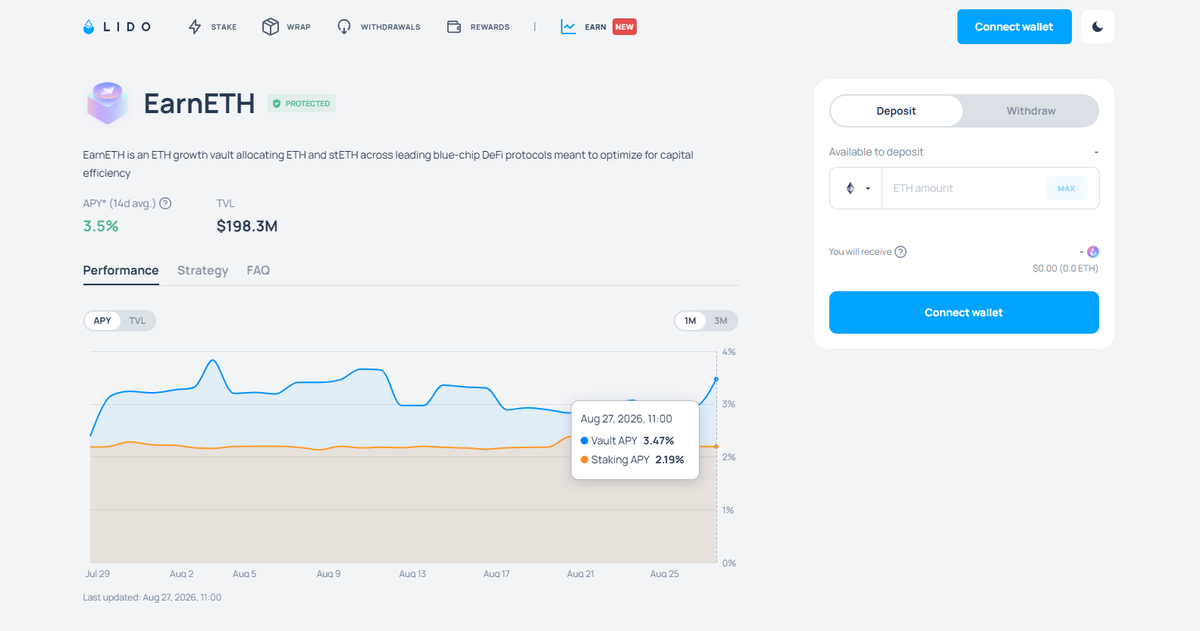
These rates are based on recent performance and can change. They should not be interpreted as guaranteed returns.
EarnETH uses ETH and staked ETH in DeFi strategies to generate returns in addition to the underlying staking yield.
Higher returns would mean a larger performance fee
The impact of the new structure becomes clearer when looking at different levels of returns.
If the vault generates a 5% return before fees, a 15% performance fee would equal 0.75 percentage points of the return.
Under the previous 10% performance fee, the same return would result in a 0.5 percentage-point performance charge.
The 0.2% AUM fee would then apply separately. Lido said the applicable fees will be shown directly on the EarnETH interface.
That makes the fee level an important consideration when assessing the vault’s displayed APY, since the headline return and the amount received by depositors can differ after fees.
Lido also said it will announce future changes to the fee structure.
Mixed reaction as broader market rallies
The announcement drew some pointed commentary on X. One reply argued LDO was sitting out the current crypto rally entirely, framing the update as tone-deaf against that backdrop. Other replies were more mixed, some dismissive, one supportive of the shift toward performance-based fees.
The broader market has in fact been running hot. Bitcoin has traded near $79,000 this week, and analysts have attributed the late-August rebound above $80,000 to spot ETF inflows and short covering rather than a retail-driven rush.
The total crypto market cap sat around $2.76 trillion on August 27, up 0.8% in 24 hours, with Ethereum among the day’s gainers.
Lido at a glance
Beyond EarnETH, Lido remains the largest liquid-staking protocol by a wide margin. The protocol currently holds $23.8 billion in total value locked, up 36.1% over the past 30 days, and ranks #1 by TVL among liquid-staking protocols tracked by DefiLlama, accounting for 46.7% of that category’s $50.9 billion total.
Lido generated $37.81 million in fees over the past 30 days, of which $2.35 million counted as protocol revenue, a split that underscores why fee-model tweaks like EarnETH’s carry weight for the DAO’s broader economics.
On the staking side, Lido’s share of all staked ETH has been gradually eroding from past highs as competitors chip away at its lead, though it still commands the largest single share of the liquid-staking market.
Change comes amid other Lido developments
The EarnETH update follows several changes across Lido’s Ethereum staking ecosystem.
On August 13, Ethereum treasury company SharpLink moved roughly $200 million in ETH into Lido’s liquid-staking ecosystem and received wstETH, with Anchorage Digital providing custody.
Lido also introduced Curated Module v2 in July, adding features including validator consolidation and ETH-backed operator bonds.
Those developments are separate from the EarnETH fee change but provide context for Lido’s ongoing activity across Ethereum staking infrastructure.
What the new model means for users
The revised structure does not represent a straightforward fee reduction.
Instead, EarnETH will charge less based on the amount deposited while taking a larger share of the returns generated by the vault.
For users, the relative cost will therefore depend on both the size of their position and the performance generated during the period.
The starting structure is 0.2% AUM plus a 15% performance fee, compared with the previous 1% AUM plus 10% performance fee. Future adjustments within Lido’s stated limits could change that balance further.
Also Read: Strategy (MSTR) Posts First Red Session After Five-Day Surge as Bitcoin Rally Pauses