Key Highlights
- Starknet announced Shadow Accounts on October 13, introducing a privacy feature that separates application activity from users’ main wallet addresses.
- Each application can provide a persistent pseudonymous identity, allowing users to maintain positions and interact over time without publicly linking those activities to their primary wallets.
- Potential applications include private liquidity provision, lending, borrowing, staking, recurring purchases, derivatives trading, prediction markets, and NFT marketplaces.
Starknet, a decentralized Layer 2 scaling network, has introduced Shadow Accounts, a STRK20 feature designed to give decentralized applications persistent pseudonymous addresses for users. The feature allows applications to offer a public-to-private switch without publicly linking users’ activity to their main wallets.
In an X post on October 13, Starknet stated that, on-chain, a wallet address serves as a user’s identity. Using the same public address across applications enables others to connect positions, trades, strategies, and activity. Shadow accounts provide each application with its own persistent, pseudonymous identity. This allows users to maintain positions and interact over time without a public on-chain link to their main wallet.
From the user’s perspective, once an application integrates the feature, the process involves connecting a wallet, switching from public to private mode, depositing into a vault, maintaining positions through the Shadow Account, and withdrawing back to a shielded balance.
The mechanism is not limited to vaults. Potential applications include liquidity provision, lending, borrowing, staking and trading, as well as prediction markets and NFT marketplaces. These are possible use cases rather than evidence that every category is already integrated.
Developer integration of Starknet
Developers can add the privacy feature to existing applications without rebuilding them. Integration occurs through the Starknet Wallet API using the shadow_account_invoke function. The wallet handles private state, proof generation, and transaction submission. Applications do not require access to users’ viewing keys and can maintain persistent positions without publicly linking users to their main wallets.
The feature is available via the Starknet Wallet API v0.10.4, Starknet.js v10.8.0, and compatible privacy-enabled wallets. Documentation for the integration flow is provided at strk20.starknet.io.
The first integration is scheduled to launch the day after the announcement, with additional integrations expected to follow. Planned use cases include providing liquidity on Ekubo Protocol, taking positions on SuperVega, bringing USDC from EVM to a private balance via Chance, and adding collateral or borrowing on Opus Money.
Broader network context
StarkWare, an Israeli software and cryptography company, previously published a post-quantum roadmap for Starknet. The firm stated that the Ethereum layer-2 network is positioned for a straightforward migration because its architecture never relied on the cryptography that quantum computers place at risk.
The proof system uses STARK proofs, which rely on collision-resistant hash functions rather than elliptic-curve arithmetic. Native account abstraction allows a contract to change its authentication method without a protocol-level breaking change.
StarkWare indicated that a quantum-resistant wallet has already been demonstrated by S2morrow using a Falcon-512 account in Cairo, with OpenZeppelin developing a post-quantum account contract. The roadmap is organized into three phases, with the first two under StarkWare’s control and carrying time estimates. The third phase depends on Ethereum.
On October 8, Starknet stated on its official X account that it is actively considering becoming a layer-1 network. The announcement said this would enable Starknet to become the first fully quantum-resistant network, with 2027 as the target. The statement followed discussion within the ecosystem about preparing for potential advances in quantum computing and artificial intelligence that could affect existing cryptographic assumptions.
Starknet’s Shadow Accounts announcement focuses on providing a privacy option for applications interacting with public DeFi protocols while keeping the connection to a user’s main wallet confidential. The feature operates within the existing Starknet environment and uses the network’s STRK20 standard.
Starknet price momentum today
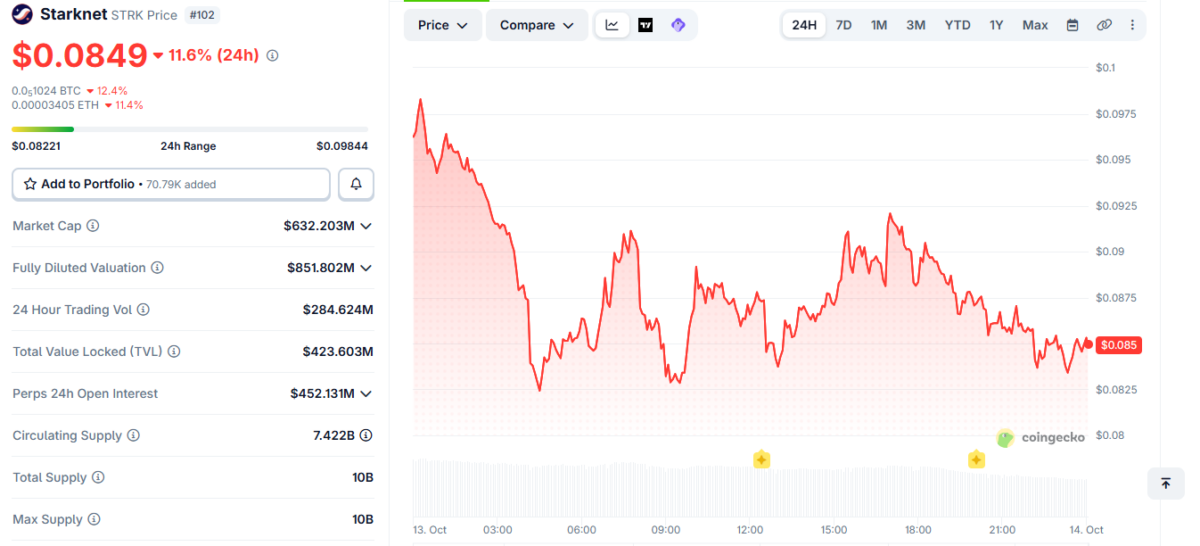
After the announcement, Starknet STRK traded at $0.0849 on Tuesday (at 18:30 UTC), down 11.6 percent over the previous 24 hours. The token’s 24-hour range spanned $0.08221 to $0.09844. Market capitalization stood at $632.203 million, with fully diluted valuation at $851.802 million.
Twenty-four-hour trading volume reached $284.624 million. Total value locked was reported at $423.603 million. Circulating supply stood at 7.422 billion tokens out of a total and maximum supply of 10 billion. Starknet’s all-time high remains $4.41, while its all-time low is $0.02221.
Also Read: India’s Haryana Police Probe Alleged LPNT Crypto Investment Fraud