Key Highlights
- Mysten Labs co-founder and chief cryptographer Kostas Chalkias announced Sui’s first native quantum-safe transaction on Devnet on October 13.
- A SuiVision transaction record shows successful execution at checkpoint 264,197.
- Sui Devnet v1.82.0 adds support for ML-DSA-65, a digital-signature scheme designed to resist attacks from quantum computers.
Mysten Labs co-founder and chief cryptographer Kostas Chalkias announced Sui’s first native quantum-safe transaction on Devnet in an October 13 post on X.
Chalkias linked to a SuiVision transaction record showing successful execution at checkpoint 264,197.
The transaction comes as Sui adds ML-DSA-65 support to its development network, enabling developers to test a digital-signature scheme designed to resist attacks from quantum computers.
SuiVision record shows successful Devnet transaction
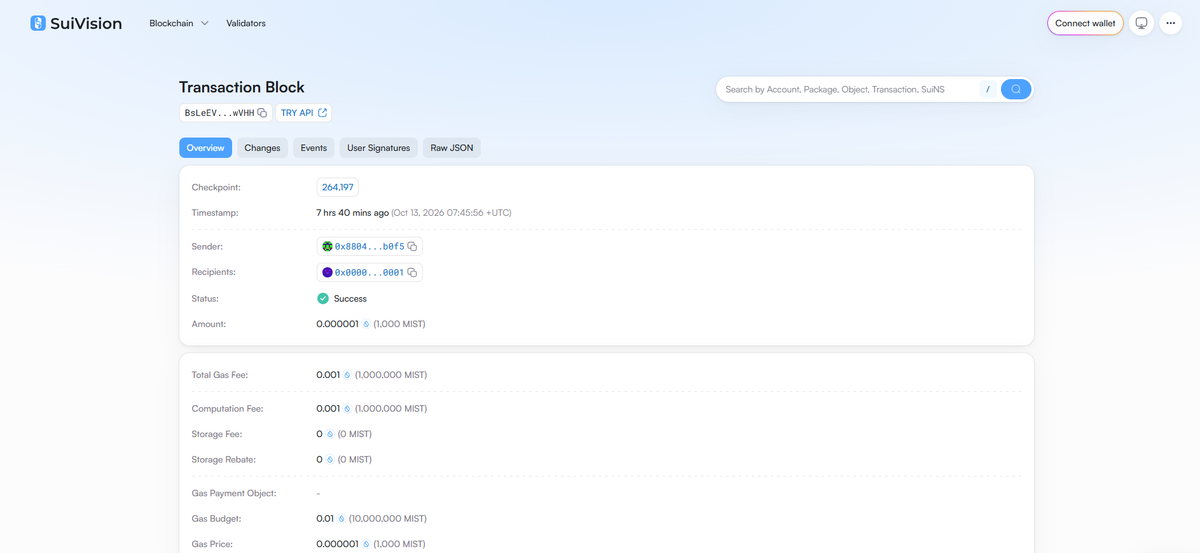
SuiVision record of a successful transaction at checkpoint 264,197 on Oct 13 | Source: SuiVision
The SuiVision record shows that the transaction was successfully completed on Sui Devnet at checkpoint 264,197 on October 13, 2026, at 07:45:56 UTC.
The transaction transferred 1,000 MIST, equivalent to 0.000001 SUI, from the listed sender address to 0x0000…0001. The record lists a gas fee of 0.001 SUI.
The record confirms successful execution on Devnet but does not independently identify the signature scheme used.
Devnet v1.82.0 adds ML-DSA-65 support
The technical changes appear in Sui Devnet v1.82.0, a pre-release in the Mysten Labs Sui repository.
According to the release notes, the update adds SignatureScheme::MLDSA65 = 7. ML-DSA-65 signatures and multisignature members can be submitted through the ExecuteTransaction API and verified through the VerifySignature API.
The release also adds MlDsa65Signature and MlDsa65PublicKey types to GraphQL and updates the Rust SDK to support the scheme.
These changes let developers test ML-DSA-65 in transaction workflows. The release does not establish that the feature is available for general use on Sui mainnet.
What Is ML-DSA-65?
ML-DSA-65 is a post-quantum digital-signature scheme standardized by the U.S. National Institute of Standards and Technology (NIST) under FIPS 204. It belongs to the Module-Lattice-Based Digital Signature Algorithm family.
Digital signatures verify that a transaction was authorized by someone controlling the relevant private key. Many blockchain networks rely on conventional public-key cryptography that could become vulnerable if sufficiently powerful quantum computers are developed.
ML-DSA-65 uses a different mathematical construction designed to resist attacks from classical and quantum computers. Its addition gives Sui developers an alternative signing method to test, but it does not eliminate every potential security risk.
The Devnet release notes do not provide production performance benchmarks or compare the scheme’s signature sizes and verification costs with existing methods.
Sui targets mainnet authentication in Q1 2027
Sui’s roadmap targets native ML-DSA-65 accounts on Testnet by the end of 2026, followed by native account authentication on mainnet in Q1 2027.
The timeline remains subject to testing and security reviews. The October 13 announcement marks a development step, not confirmation that quantum-safe authentication is available across Sui mainnet.
Sui previously reported 40.6M TPS in Basecamp test
The announcement follows another Sui development.
On October 10, Sui Hits 40.6M TPS in Basecamp Test as CertiK Reviews Results and reported that a Basecamp demonstration recorded 40.6 million transactions per second (TPS) using more than 10,000 Sui tunnels. The test involved off-chain activity that settled to Sui mainnet.
According to the report, CertiK was independently reviewing the performance data. The reported figure relates to the specific Basecamp test setup and should not be treated as Sui’s normal onchain transaction throughput.
The Basecamp demonstration concerned transaction-processing capacity, while the latest announcement focuses on post-quantum signature support.
Bitcoin reported a different quantum-safe approach
Bitcoin saw a separate development on August 27, where Bitcoin’s First Quantum-Safe Transaction was Live on Mainnet, a transaction using a quantum-safe spending method was mined through MARA Slipstream.
The report described a hash-based signature-grinding method intended to provide a quantum-safe spending path without changing Bitcoin’s base protocol or requiring a soft fork.
Sui is testing native ML-DSA-65 support on Devnet, whereas the Bitcoin report covered a specific mainnet transaction using a hash-based method. Neither development establishes a network-wide migration to post-quantum security.
Also Read: Tether Invests in EFY Finance to Expand Stablecoin Infrastructure in Latin America