Strategy Inc. stock closed lower on Wednesday for the first time in a week, snapping a five-session winning streak that had added more than a third to the share price.
The pullback was modest by the stock’s own volatile standards, but it arrived after one of the sharpest short-term rallies of 2026 and against a backdrop of a changing corporate playbook.
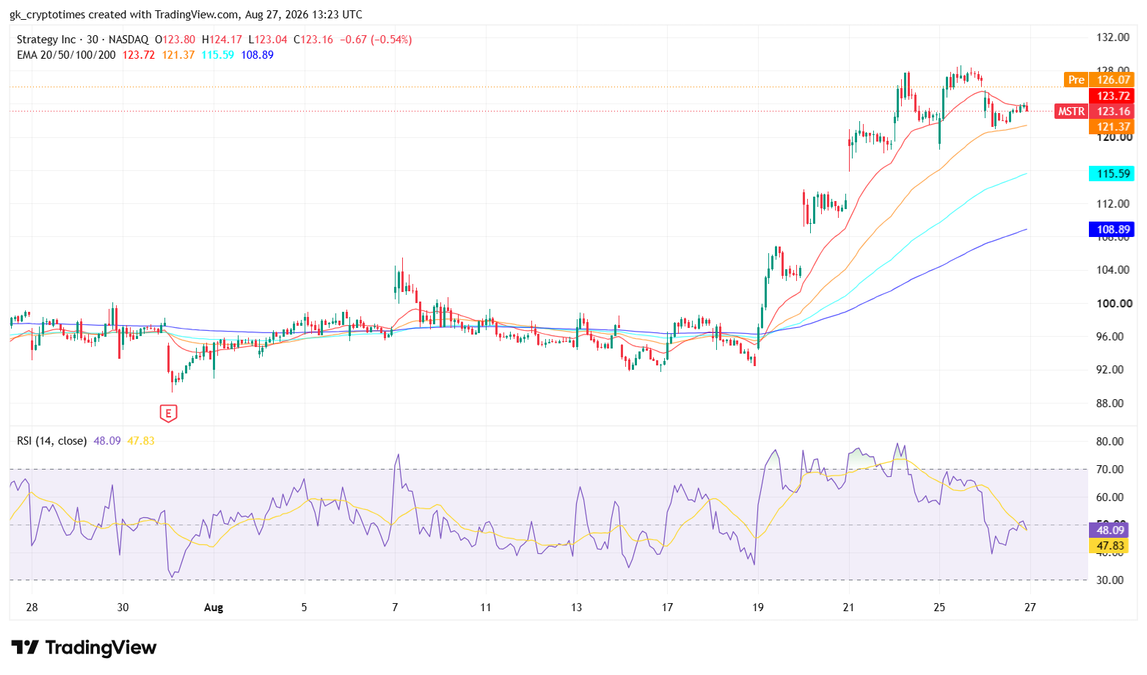
Market data from TradingView shows MSTR finished Wednesday at $123.19, down 2.8%, after trading between $120.87 and $125.54. Volume fell to about 17 million shares, well below the 31 million to 49 million shares that changed hands on each of the preceding green days.
Five Green Days That Recast the Tape
The rally in MSTR began on August 19, when Strategy jumped 12.68% to $104.25. It then added 7.81% on August 20, 6.10% on August 21, 2.83% on August 24 and 3.42% on August 25, closing that session at $126.83—as recorded data by Investing.com. Measured from the August 18 close of $92.52, the five-session advance was roughly 37%.
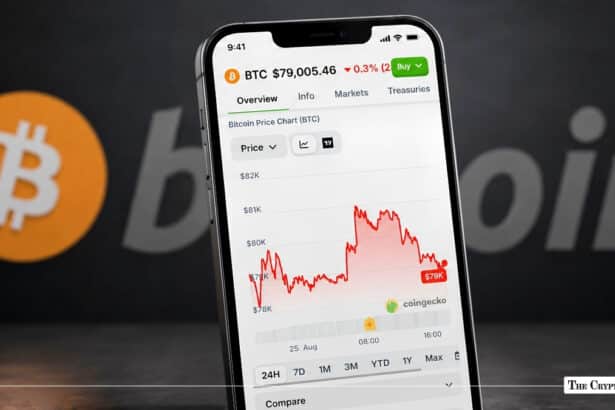
That burst of buying coincided with a sharp rebound in Bitcoin, which climbed from the mid-$60,000s toward the high $70,000s and briefly tested levels near $80,000—as per CoinGecko data.
Strategy’s shares have long functioned as a leveraged proxy for Bitcoin because the company holds a hoard of 840,447 coins. When Bitcoin rises quickly, MSTR often rises faster; when Bitcoin pauses, the stock typically gives back some of those gains first.
The volume pattern told the same story. The largest prints came on the biggest up days, a sign that both momentum traders and longer-term holders were participating. By Wednesday the participation had thinned, consistent with a market that had already priced in a large part of the Bitcoin rebound.
A Red Day That Looked Like Digestion, Not Collapse
As shown in the TradingView chart, Wednesday’s decline was orderly. The stock opened near the prior close, failed to hold the previous day’s highs, and settled a few dollars lower without a late-session collapse. That profile is closer to digestion after an extended run than to a sudden loss of confidence.
MSTR remains far below its 52-week high near $365 and is still down sharply on a one-year view. The recent bounce recovered only a slice of the damage inflicted earlier in 2026, when both Bitcoin and the stock’s premium to net asset value compressed. A single red day after five greens does not reverse that longer-term picture, but it does reset short-term expectations.
Notably, Strategy has also been issuing shares through its at-the-market program. Fresh supply can cap upside even when Bitcoin is rising, especially if the company is not immediately recycling the proceeds into more coins. On August 24, 2026, the company announced it had sold 18,261,118 MSTR shares under its ATM program between August 17 and August 23, raising about $2.01 billion in net proceeds without buying any Bitcoin.
Wednesday’s lighter volume suggested some of that supply was absorbed without panic, yet it also showed buyers were less aggressive once the easy part of the rebound was over.
Bitcoin Holdings Meet a New Balance-Sheet Playbook
The bigger story sits on the balance sheet. Strategy still holds roughly 840,447 Bitcoin, acquired at an average cost near $75,385. At recent prices (BTC trading near $79,200 as of 1:40 PM UTC—per CoinGecko data) the stack is worth approximately $66.56 billion and reporting an unrealized profit of $3.24 billion. This leaves the common equity trading close to one times Bitcoin net asset value after earlier premium collapse.
What has changed is the operating model. For years the company raised capital and bought Bitcoin in a self-reinforcing cycle. In 2026 that flywheel has slowed. Strategy has sold Bitcoin in several small batches, built a large dollar reserve to service preferred-stock obligations, and used ATM proceeds to strengthen cash and repurchase preferred shares rather than to add coins.
The company’s management has framed the shift as “digital asset bank” discipline: hold Bitcoin as a reserve asset, keep enough dollars to cover dividends and interest, and wait for better conditions before expanding the stack.
Critics like Peter Schiff call it a retreat from the original thesis. Meanwhile supporters argue it reduces the risk of a forced-sale spiral if Bitcoin stays range-bound. Either way, the stock is no longer priced as a pure leveraged Bitcoin ETF with an expanding premium. It is priced more like a levered holder whose multiple has compressed toward parity, as previously reported by The Crypto Times.
That structural change helps explain why a five-day surge could end so quickly. When the market believes every dollar of new capital will become more Bitcoin, rallies tend to overshoot. When the market believes new capital may sit in cash or retire preferred stock, rallies fade faster.
Valuation, Risks, and the Next Test
Various analysts on X think that the stock’s fate remains tightly tied to Bitcoin. A push back above $80,000 would likely rekindle interest in MSTR; a slide toward the mid-$70,000s would test Wednesday’s lows. Dilution remains a live risk as long as the ATM stays open. Preferred dividends create a standing cash need that the old accumulation model did not have to meet at this scale.
On the other side of the ledger, the company still controls about 4% of Bitcoin’s eventual 21 million supply. Analysts note that if Bitcoin resumes a durable uptrend, even a stock trading near 1 times NAV can deliver amplified returns because of the embedded leverage in the capital structure. The five green days showed that leverage still works in both directions when the underlying asset moves hard.
For now, Wednesday’s red close looks like a pause after an outsized bounce rather than a verdict on the new strategy. The coming sessions will show whether buyers treat $120 as support or whether the stock needs to digest the entire August spike before the next attempt higher. Strategy’s shares have rarely moved in a straight line. The last week was no exception—only the direction changed.
Also read: Bithumb Wins First Court Ruling Over 620,000 Bitcoin Payout Blunder