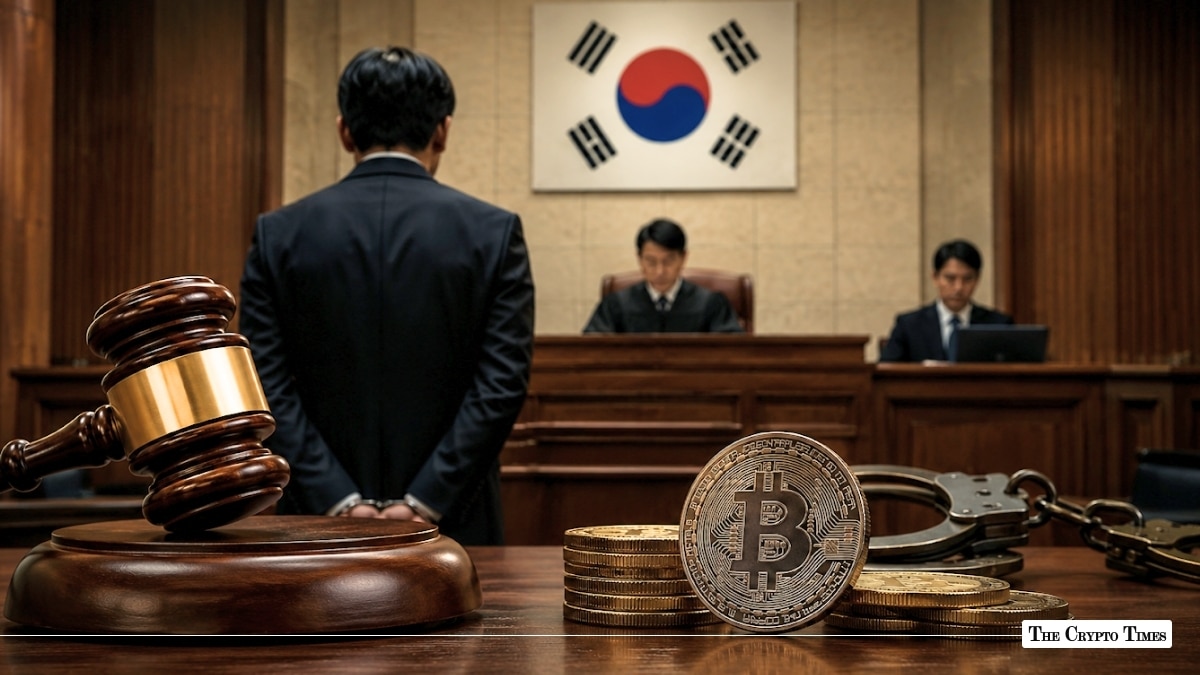
The CEO of South Korean crypto deposit platform Delio, Jeong Sang-ho, has been sentenced to 15 years in prison in the first trial of a case stemming from the company’s 2023 withdrawal freeze.
According to a report by Chosun Daily, the Seoul Southern District Court’s 11th Criminal Division, presided over by Judge Jang Chan, handed down the sentence on August 13 under the Act on Aggravated Punishment of Specific Economic Crimes (Fraud). The court found Jeong guilty of fraud involving about 70 billion won ($50 million) in virtual assets belonging to 1,078 victims.
The ruling comes more than three years after Delio abruptly suspended deposits and withdrawals in June 2023, leaving thousands of customers unable to access their crypto. The court also ordered Jeong to be detained immediately, citing a risk that he could flee.
Court alleges Delio deceived investors
The court said Jeong had promoted Delio as a “crypto bank,” advertising annual returns of around 10% on deposits of assets including Bitcoin and Ethereum. Prosecutors alleged that Delio’s financial position had deteriorated while Jeong continued to attract customer funds by claiming the company’s stability and profitability.
The court claimed Jeong concealed losses caused by deficits, operating losses, and hacking incidents while falsely telling customers that Delio generated profits through strategies including arbitrage trading and crypto-backed lending.
The court described the crime as serious, citing the scale of the losses and the financial damage suffered by victims. It also criticized Jeong for repeatedly shifting responsibility to other companies and failing to accept responsibility during the proceedings.
250B Won claim cut to 70B Won
The prosecution initially accused Jeong of misappropriating around 250 billion won in virtual assets from roughly 2,800 victims between August 2021 and June 2023. However, the court did not accept the full amount.
The prosecution ultimately presented an alternative charge involving about 70 billion won from 1,078 victims after Jeong challenged the legality of evidence obtained during a search and seizure. The court agreed that part of the prosecution’s evidence was inadmissible. It found that investigators had failed to properly notify the relevant seizure list when searching the database held by Delio’s server company.
As a result, the court ruled that electronic database information and secondary evidence obtained through the procedure lacked evidentiary value. Despite rejecting evidence connected to the larger allegation, the court still held Jeong criminally responsible for the 70 billion won loss covered by the alternative charge.
The 2023 backstory
Delio operated as a virtual asset deposit service, attracting customers with crypto by promising interest payments. The business collapsed into crisis on June 14, 2023, when Delio suddenly halted deposits and withdrawals. The freeze followed a difficult period in South Korea’s crypto lending sector, with Delio and related firms facing major losses and liquidity problems.
Earlier investigations also found that Jeong had used false records in other transactions. According to the court account, he misappropriated about 1 billion won in investment funds from an investment partnership by submitting false records relating to 2 billion won in crypto-backed loans.
He was also found to have submitted an accounting-firm audit report that overstated Delio’s crypto holdings by about 47.6 billion won, helping the company complete its virtual asset business registration.
Crypto lending risks
The Delio collapse became one of South Korea’s most closely watched crypto-fraud cases, particularly because the company had operated as a regulated virtual asset service provider. The platform had marketed itself as a way for customers to earn yield on crypto holdings, but the sudden withdrawal suspension exposed the risks of businesses promising high returns while relying on complex arrangements to manage customer assets.
The case also unfolded alongside the collapse of Haru Invest, a related South Korean crypto investment company that halted operations around the same period. Delio and Haru later became subjects of separate bankruptcy and criminal proceedings.
Prosecutors had sought a 20-year prison sentence for Jeong at the April closing arguments, alleging that he had misappropriated about 250 billion won from nearly 2,800 investors. The court’s 15-year sentence therefore falls below the prosecution’s request, while still representing a substantial prison term in the first-instance ruling.
What happens next
The August 13 ruling is a first-instance judgment and can be appealed. For Delio customers, however, the criminal case is only part of the broader fallout from the 2023 collapse. The company’s financial failure and the recovery of customer assets have remained separate issues from Jeong’s criminal liability.
The ruling is likely to draw further attention to how crypto deposit and yield services manage customer assets, disclose losses and advertise returns—particularly as South Korea continues strengthening oversight of its digital-asset sector.
The Crypto Times was unable to identify a verified, active public contact channel for Jeong Sang-ho before publication. The public accounts identified for him have been inactive since 2023.
Also Read: Bybit Sues North Korea Over $1.5B Hack, Secures Court-Ordered Asset Freeze