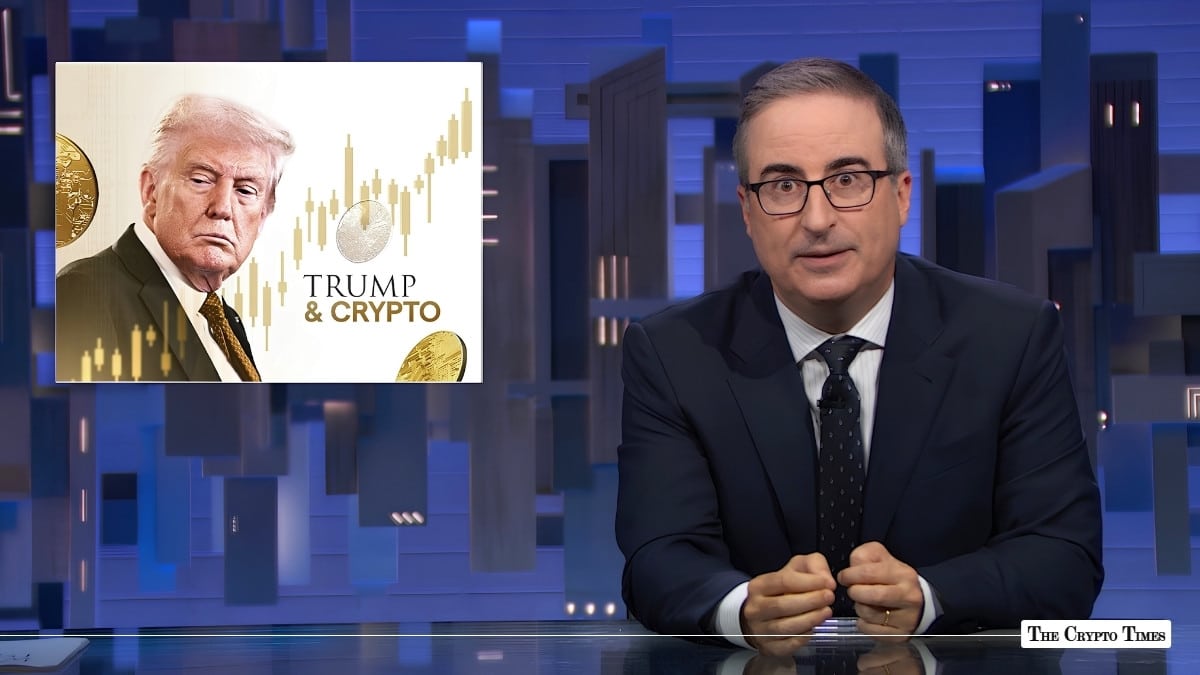
Comedian and Last Week Tonight host John Oliver used his latest episode to sharply criticize U.S. President Donald Trump’s expanding cryptocurrency business interests, arguing that they create serious conflicts of interest and undermine public trust.
In the latest episode, Oliver described Trump as the country’s “first crypto president,” saying the president’s embrace of digital assets came after the crypto industry poured significant money into supporting his political comeback. He stated that the Trump family’s crypto ventures have become its largest business interest and said they make the president appear “flagrantly corrupt and compromised.”
Memecoin fallout and access dinners
Oliver devoted a significant portion of the episode to Trump’s official memecoin, describing memecoins as internet jokes turned into digital assets whose value depends entirely on market demand.
He argued that such tokens often resemble “pump-and-dump schemes,” where prices surge before collapsing as insiders sell near the peak. Trump announced his memecoin just days before his second inauguration, followed shortly by a token linked to First Lady Melania Trump.
According to Oliver, the Trump token briefly reached a market value of around $50 billion before falling roughly 92% from its peak by December. Despite the decline, he said Trump received an estimated $636 million payout while “nearly a million people who bought into the coin lost money.”
Oliver also criticized Trump’s decision to host an exclusive dinner for the token’s top 220 holders, saying it effectively offered access to the White House in exchange for investment in one of the president’s crypto ventures. The announcement boosted the token’s value by about 30%, although Oliver noted there is no evidence Trump or insiders sold tokens during the price increase.
“It clearly doesn’t look good for a president to be involved in something like that,” he said.
World Liberty Financial and capital outflows
Oliver also highlighted World Liberty Financial, the crypto company launched by Trump alongside his sons shortly before the 2024 presidential election. He said the company has since become the Trump family’s most valuable business.
The episode questioned whether investors may have used the platform to gain influence with the administration. Oliver pointed to crypto entrepreneur Justin Sun, who invested $75 million in World Liberty Financial governance tokens and another $37.7 million in Trump-linked memecoins while facing an enforcement action from the U.S. Securities and Exchange Commission (SEC).
The SEC later paused its case before settling. Oliver noted that both Sun and regulators have denied any quid pro quo arrangement.
He also referenced reports that an investment firm linked to the United Arab Emirates invested heavily in World Liberty Financial around the same time the UAE sought access to advanced U.S. semiconductor technology that had previously faced restrictions. While stressing there is “no evidence that one deal was explicitly offered in return for the other,” Oliver said the timing was “extraordinary.”
Crypto policy influence
Beyond the business ventures, Oliver argued that Trump’s crypto policies have benefited the industry.
He noted that former SEC Chair Gary Gensler, whose enforcement approach was widely criticized by the crypto sector, left office on Trump’s first day back in the White House. His successor, Paul Atkins, has overseen a more crypto-friendly regulatory approach, with Oliver claiming roughly 60% of crypto-related enforcement cases have since been eased.
Oliver also criticized Trump’s support for the proposed CLARITY Act, arguing that shifting much of crypto oversight away from the SEC to the Commodity Futures Trading Commission(CFTC) could weaken investor protections and make future regulatory changes more difficult.
Oliver concluded that Trump’s deep involvement in cryptocurrency businesses, combined with policy decisions affecting the industry, makes the president appear “flagrantly corrupt and compromised.”
His comments add to the growing political debate over whether elected officials should be permitted to maintain major financial interests in crypto businesses while shaping digital asset regulation. The issue is expected to remain in focus as lawmakers continue debating U.S. crypto legislation and oversight of the rapidly expanding industry.
Also Read: NFL Pushes CFTC for Sports Contract Bans as Crypto Industry Backs the Rules