



Canton Network has emerged as the leading blockchain by protocol revenue in mid-2026, generating approximately $55.38 million over the past 30 days according to DefiLlama data.
This places it well ahead of Tron at roughly $25.86 million, Robinhood Chain near $3 million, and Ethereum at about $1.57 million in the same period. Daily figures often exceed $1.7 million, underscoring sustained activity far removed from typical retail DeFi patterns.
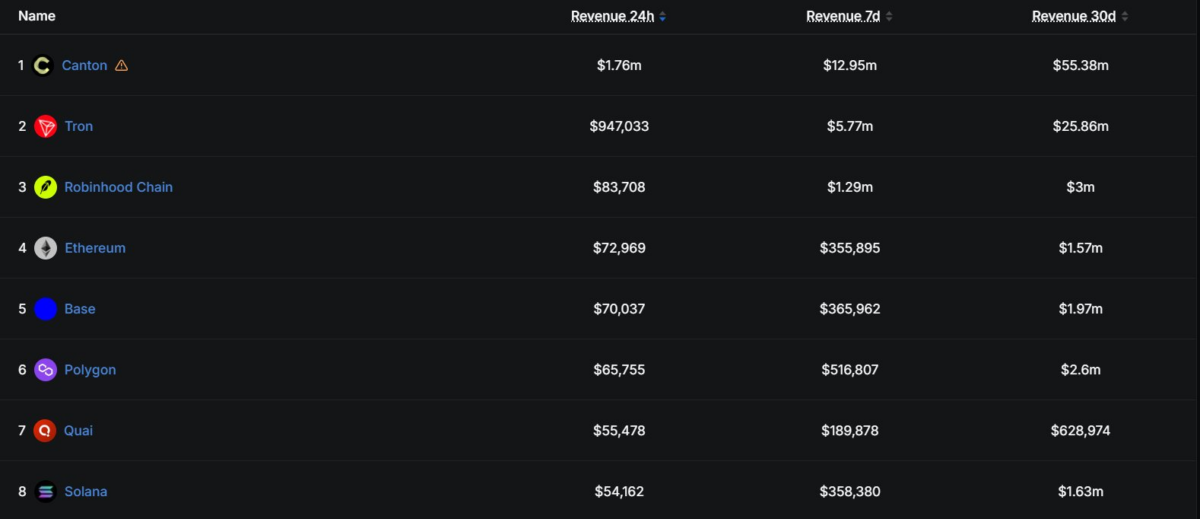
The network’s performance stands out because its total value locked in DeFi remains modest, hovering around $200,000. Instead of relying on decentralized exchanges or speculative trading, Canton draws revenue from high-volume institutional workflows.
Reports describe monthly transaction volumes approaching $9 trillion, with Broadridge’s Distributed Ledger Repo platform alone processing on the order of $8 trillion monthly in repurchase agreements. Additional momentum comes from tokenized real-world assets valued in the hundreds of billions and planned production activity involving DTCC tokenized U.S. Treasuries.
This is not the first time Canton has topped blockchain revenue rankings. Throughout 2026 the network has repeatedly claimed the No. 1 position on DefiLlama, recording 30-day figures of $65.5 million in April, more than $60 million in June, and similar leading totals in intervening periods, underscoring a consistent pattern of institutional-driven fee generation rather than a one-off surge.
Institutional Design and Privacy Features Drive Adoption
Built on the ground for regulated financial markets, Canton emphasizes privacy by default, compliance controls, and permissioned participation elements that public blockchains have historically struggled to deliver at scale. This architecture has attracted banks, clearinghouses, and asset managers seeking efficient settlement of securities, repos, and digital assets without exposing sensitive data on fully transparent ledgers.
Major participants include institutions linked to recent capital raises. Digital Asset, the primary developer behind the network, closed a $355 million funding round in June 2026 led by a16z crypto, with participation from BNP Paribas, Citadel Securities, HSBC, Tradeweb, and others.
Earlier strategic investments and Super Validator roles involving firms such as Visa further signal institutional confidence. These flows translate directly into network usage: every message submitted to the Global Synchronizer consumes traffic, which is metered and paid for in a manner that generates measurable fees.
Unlike gas markets that fluctuate with retail congestion, Canton prices traffic primarily in USD terms based on data volume and recipient factors. Users or application providers settle these costs by burning Canton Coin (CC) at the prevailing on-chain conversion rate. The result is a steady stream of fee burns that DefiLlama records as chain and holders revenue—mirroring the treatment of burned fees on networks like Tron.
Burn-Mint Equilibrium Aligns Incentives with Real Utility
Canton’s tokenomics reinforce this activity-driven model through a burn-and-mint equilibrium. Fees paid for traffic are permanently removed from circulation, creating demand tied to actual network consumption.
Simultaneously, new CC is minted and allocated according to contribution: a substantial portion (recently around 62 percent) flows to featured applications based on the traffic they generate, with additional shares directed to validators and Super Validators. Application providers can earn rewards that, under certain designs, approach or exceed the traffic costs they sponsor, capped on a per-transaction basis.
This structure aims to reward participants who drive genuine settlement and tokenization activity rather than pure speculation. After a January 2026 adjustment in issuance, monthly minting has moved closer to the volume of fees burned, supporting the network’s stated goal of balancing supply with usage.
While some observers highlight the scale of ongoing reward emissions relative to burns and the permissioned aspects of participation, the fee generation itself reflects concrete institutional demand.
Canton’s rise in the rankings illustrates a shift in blockchain economics: value accrual increasingly follows regulated, high-notional financial infrastructure rather than purely open retail experimentation.
As more tokenized assets and settlement workflows move on-chain, the network’s revenue leadership may serve as an early indicator of how institutional adoption can reshape public metrics.
Also read: Why is NEAR Token Price Down Today? $4.54M in Longs Liquidated





