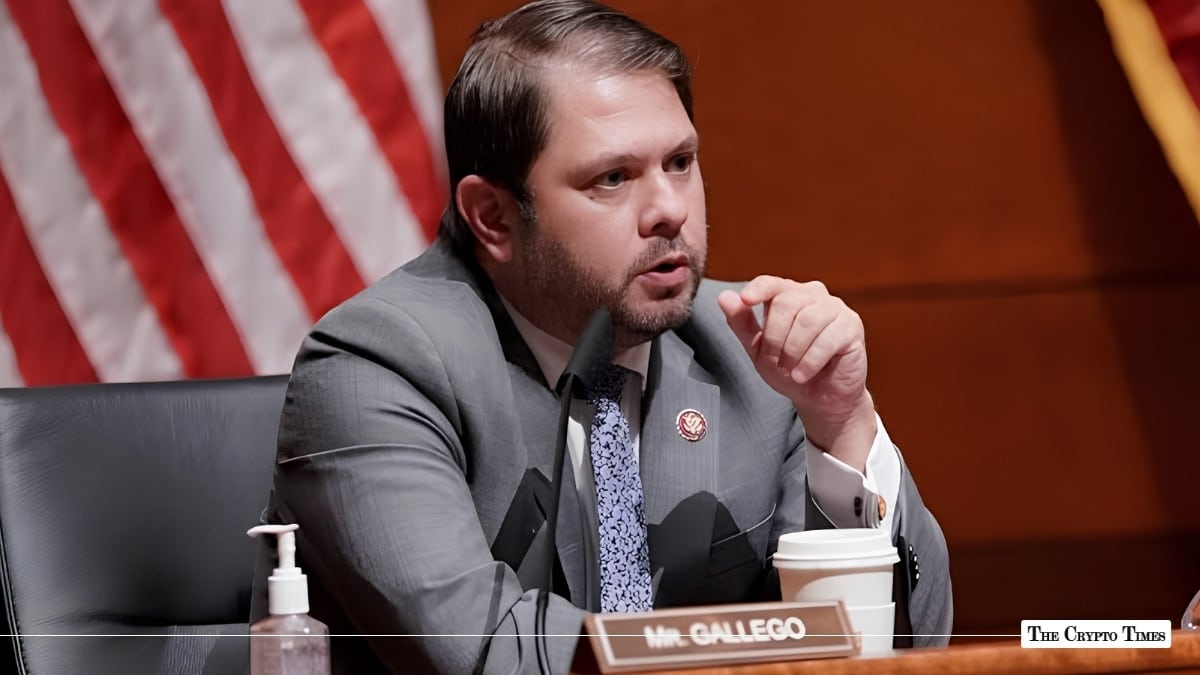
The ethics fight over crypto’s landmark market-structure bill has turned openly hostile. Senator Ruben Gallego (D-AZ), one of only two Democrats to vote the CLARITY Act out of committee, and the industry’s most essential swing vote, publicly torched the White House-approved ethics language Republicans unveiled this week.
Gallego told Politico it was so inadequate he could not treat it as a genuine attempt at compromise. “Whatever piece of shit they sent back to us, that was not a serious effort,” Gallego said in an interview on Thursday. He argued that after months of bipartisan negotiation, Republicans had taken that work and returned something not “remotely close” to what had been discussed.
Hours later came the second blow. Senate Majority Leader John Thune (R-SD), asked whether the chamber could clear both the crypto bill and separate college sports legislation before the August recess, said plainly: “I don’t think we’ll be able to get them done.” He added that he would like to at least get CLARITY started, and see where the votes land.
What Republicans actually proposed
The language that triggered the blowup arrived Wednesday, when Senate Republicans released an updated draft of the Digital Asset Market CLARITY Act. For the first time, it included explicit limits on how a sitting president may profit from crypto: the president, vice president, members of Congress, federal judges, and other covered officials would be barred from issuing or sponsoring digital assets for compensation while in office.
On paper, that is a substantial concession from a White House that had spent weeks resisting anything resembling a personal restriction. Senator Cynthia Lummis (R-WY), the bill’s lead sponsor, framed it as historic, saying in a statement that President Trump was backing “the most robust ethics rules ever imposed on the office of the presidency” and choosing a higher standard than the law required of him.
Democrats did not see it that way, because of a single clause.
The real fight is not what the rules say. It’s who enforces them.
The provision would give the Department of Justice exclusive authority to enforce the new ethics restrictions. That is the impasse, and it is where months of negotiation collapsed. Gallego and other Democrats had pushed for state attorneys general to have enforcement power alongside federal prosecutors; the final text left them out entirely.
The logic of the Democratic objection is straightforward, and it has little to do with crypto. An ethics rule policed solely by the DOJ is an ethics rule policed by an agency whose leadership serves at the president’s pleasure, the same president the provision is designed to constrain. Senator Angela Alsobrooks (D-MD), the only other Democrat who backed the bill in committee and who also opposes the new draft, made the point bluntly to reporters at the Capitol this week: “Look at this Department of Justice.”
That skepticism has a documented basis. The DOJ under Acting Attorney General Todd Blanche disbanded its National Cryptocurrency Enforcement Team and instructed prosecutors to step back from crypto cases, a retreat Senator Dick Durbin pressed Blanche on directly at his confirmation hearing this month, tying it to the president’s own crypto income. Asking that department to be the sole enforcer against presidential crypto profiteering is, for Democrats, the definition of a hollow guarantee. It is the same enforcement roadblock that surfaced earlier in the week, now confirmed as the specific point on which the talks broke.
The counteroffer: Gallego, Tillis, and unnamed Republicans
Despite the language, Gallego is not walking away. He told Politico he is now working with Senator Thom Tillis (R-NC) “and other Republicans that are not being named right now” to draft a counterproposal to send back to negotiators. “We are still in this fight,” he said. “We are going to send back language.”
Tillis, who has been leading the Republican side of the bipartisan ethics track, offered a notably more diplomatic read of the same text, calling the White House-approved language good, while acknowledging its limits. “We’ve got to get to 60 votes,” he told reporters. “The baseline, I think, falls short of what some of the Democrats want.” He said negotiators need one more conversation with the White House to test whether a few additional changes he considers reasonable would be acceptable to the president.
That is the needle everyone is trying to thread: language strong enough to attract seven Democratic votes without triggering a presidential veto. The parallel track run by Lummis and Senator Bernie Moreno (R-OH) produced a deal the White House would sign; it just could not clear the Senate. The Tillis-Gallego track is now attempting the reverse, start from what Democrats need, and see if Trump will tolerate it.
The math and the clock
The arithmetic has not changed, and it is unforgiving. Passage requires 60 votes. Republicans hold 53 seats, and Senators Josh Hawley and Rand Paul are expected to vote no on substantive grounds, meaning the bill likely needs eight or more Democrats. It currently has two conditional supporters, Gallego and Alsobrooks, and both now oppose the text as written.
Thune’s comments confirm what the whiplash of the past week already suggested. Prediction markets have swung violently, from a record low near 24% in mid-July to about 45% when the updated text dropped, before sliding again as the ethics deadlock hardened. With the recess bearing down, “getting Clarity started,” beginning floor debate without finishing it, may be the realistic ceiling for July, pushing final passage into September at the earliest and into a fall dominated by midterm politics.
Why it matters
Strip away the profanity and this is a fight about a single question crypto legislation was never supposed to turn on: who watches the watchmen. Republicans have moved further on presidential ethics than most expected, banning a sitting president from issuing tokens for profit, a genuine first. Democrats have responded that a rule enforceable only by the president’s own Justice Department is not a rule at all.
Both positions are defensible, which is precisely why the deadlock is so durable. And the cost of that durability is mounting: an industry that has waited years for federal market-structure rules is watching the most viable vehicle it has stall over enforcement jurisdiction, while the GENIUS Act’s own rulemaking deadline passes unmet and other jurisdictions legislate around it. Gallego says he is still in the fight. Whether there is enough calendar left for that fight to matter this year is now Thune’s call, and, by his own account, not one he is confident about.
Also Read: Senate Majority Leader Says CLARITY Act Unlikely Before August