The fight over crypto’s marquee market-structure bill has turned inward and personal. In a scoop from Axios, progressive advocacy groups have opened a new front in the battle over the CLARITY Act, not against Republicans or the crypto industry, but against one of their own party’s most important negotiators.
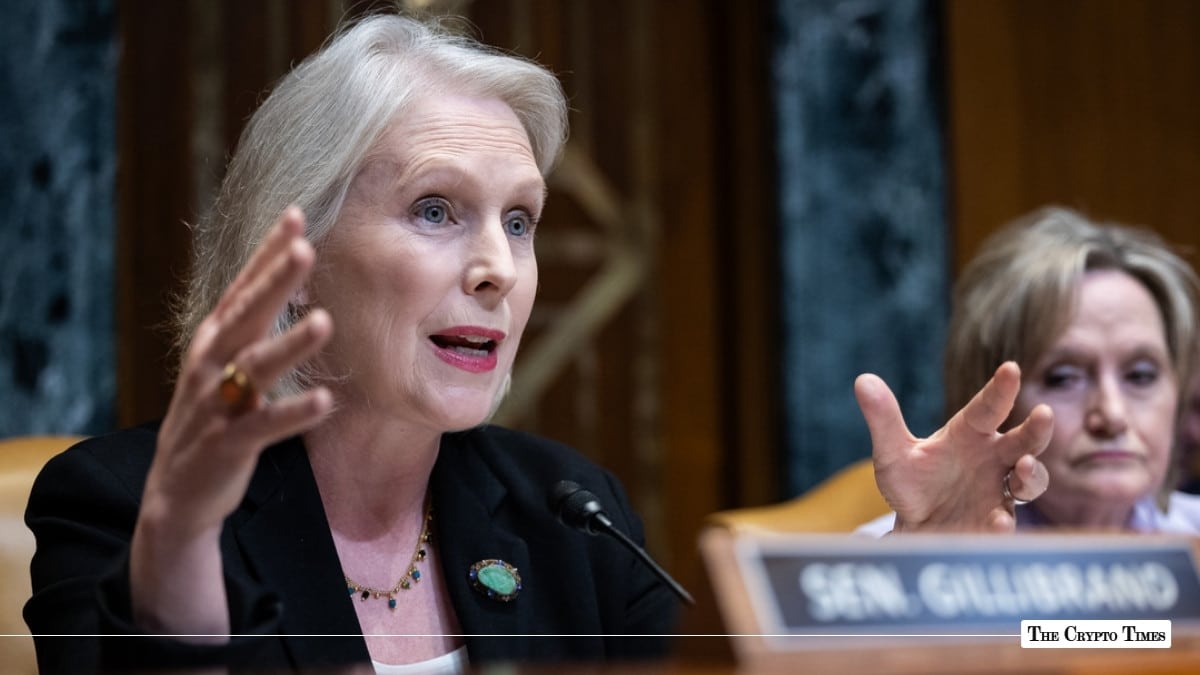
Indivisible, Demand Progress, and the Revolving Door Project sent a blistering letter to every Democratic Senate office on Tuesday evening targeting Senator Kirsten Gillibrand (D-NY), who has been trying to broker a compromise on the bill’s unresolved ethics provisions. The attack is a warning shot: progressives are signaling they will make support for the legislation politically painful, even at the cost of an intraparty brawl over one of crypto’s top priorities.
The Charge: Can’t Attack Trump While Doing Similar Things
The groups’ argument is as much about political credibility as policy. Gillibrand, who also chairs the Democratic Senatorial Campaign Committee, is “a prime example of a Democratic leader whose conduct undermines efforts to hold the Trump administration accountable for their rampant corruption,” the letter read. “Fair or not, criticisms of the Trump administration’s overwhelming corruption fall flat when voters perceive the critics to be engaged in substantively similar behavior.”
The reference is to reporting that Gillibrand’s 22-year-old son runs a crypto-backed derivatives startup, American Perpetuals Exchange, whose investors reportedly include Ripple co-founder Chris Larsen. The progressives’ point is that a Democrat with family exposure to the industry cannot credibly demand ethics guardrails aimed at the president’s own crypto empire — that the messenger undercuts the message.
The irony is sharp, because Gillibrand has been one of the more vocal Democrats on exactly this issue. She has called for Congress to bar all elected officials and their spouses from issuing or sponsoring their own digital assets. “Public officials and their spouses should not be issuing memecoins,” she said in a June statement, calling it a commonsense standard that should draw bipartisan support. That she is now being attacked from her left for insufficient purity, while simultaneously negotiating the very guardrails progressives want, captures how tangled the ethics fight has become.
Trump’s Crypto Windfall Context
The attack does not exist in a vacuum. It draws its force from the disclosures that have reframed the entire CLARITY debate. President Trump’s crypto ventures have generated an estimated windfall in the hundreds of millions of dollars — Axios cites roughly $600 million, while Trump’s own financial disclosure pointed to figures as high as $1.4 billion across his crypto businesses, most of it from the $TRUMP memecoin and World Liberty Financial. Senator Elizabeth Warren has seized on those numbers to demand that any bill bar the president, vice president, officials and their families from profiting off crypto, calling anything less “a flagrant giveaway.”
That is the standard progressives want written into the bill. Their frustration with Gillibrand is that a compromise brokered by a conflicted messenger, in their view, risks watering it down.
Tillis Leads Bipartisan Talks, White House Pushes “Historic” Deal
Beneath the political theater, actual drafting continues on two parallel tracks. According to Axios and reporting from Eleanor Terrett, bipartisan talks on the ethics language are underway with Senator Thom Tillis (R-NC) leading the Republican side.
A separate White House track involves Senators Cynthia Lummis (R-WY) and Bernie Moreno (R-OH) working directly with the administration on compromise language. In the latest development, a White House official urged Senate Democrats to accept President Trump’s ethics compromise. The official described it as the “most comprehensive and wide-ranging ethics provision in history,” reached after discussions with Lummis and Moreno.
Trump has approved the proposal, and draft ethics language is now circulating internally among Senate Republicans.However, Democrats, including Gillibrand, Ruben Gallego, Angela Alsobrooks, and Elizabeth Warren, have not yet seen the full text and are insisting on strong rules that prevent senior officials and their families from profiting in the digital asset space.A new enforcement roadblock has also emerged. Senator Angela Alsobrooks (D-MD), one of only two Democrats who voted to advance the bill out of the Senate Banking Committee, publicly rejected the White House’s proposal to give the Department of Justice sole authority to enforce the ethics provisions. She called it “an unserious offer” and said she would not support the bill if that remained the only enforcement mechanism.
Negotiators are also discussing DeFi provisions, but ethics remains the primary hurdle. A spokesperson for Senator Lummis said last week’s conversation with the White House “went well” and that “the ethics text set to release in the coming days will reflect that productive conversation.”
The Money in the Room: Fairshake’s $125 Million
Looming over all of it is the crypto industry’s political firepower. Fairshake, the sector’s flagship super PAC, is sitting on roughly $125 million ahead of the midterms; a war chest that gives both parties an incentive to cut a deal and gives progressives a reason to dig in. Republicans are eager to deploy that money to defend their Senate majority, but the clock is ticking on both the legislation and the dollars: the closer the fight drifts to the election, the less room there is to spend effectively.
It is a revealing dynamic. The same industry money that makes passage attractive to lawmakers is precisely what makes progressives frame the bill as a corruption risk — the war chest is both the carrot and the target.
Why It Matters
The math remains unforgiving. The bill needs 60 votes, requiring at least seven Democrats to join Republicans. It cleared the Senate Banking Committee in May with support from just two Democrats (Gallego and Alsobrooks), and every additional vote must navigate an increasingly charged political environment. With roughly two weeks left before the August recess, widely viewed as the last realistic window for 2026 passage, the ethics fight has become both a policy dispute and an intraparty identity battle.
Progressive pressure is designed to make supporting a compromise politically costly, while the White House and Republican negotiators are trying to deliver language broad enough to win signatures and enough Democratic votes.
Whether the Tillis-led bipartisan track and the White House-Lummis-Moreno track can produce ethics language that satisfies enough Democrats, without collapsing under progressive fire or enforcement objections, will determine if the CLARITY Act moves forward this summer.
Also Read: CLARITY Act Talks Hit Fresh Roadblock Over Ethics Enforcement