
Key Highlights
- Binance and Bybit saw nearly $2.3 billion in stablecoin outflows over the past 30 days.
- Bitcoin is struggling around the $60,000 level as fresh market liquidity remains weak.
- Falling stablecoin reserves suggest reduced short-term buying demand and more cautious investor positioning.
Binance and Bybit, two of the world’s largest crypto exchanges, have seen nearly $2.3 billion in stablecoins leave their platforms in just 30 days as Bitcoin (BTC) continues to struggle around the $60,000 level. The outflow is a result of the drop in crypto market liquidity, with investors pulling funds from the two exchanges while the funds needed to support a strong Bitcoin rally remain limited.
According to CryptoQuant data cited by crypto analyst Darkfost, Binance recorded about $1.55 billion in stablecoin outflows during the period. Bybit saw another $786 million leave its reserves. Together, the two exchanges lost nearly $2.3 billion in stablecoins.
Why stablecoins matter for crypto liquidity
Stablecoins play an important role in the crypto market because they often act as ready-to-use trading money. Traders can keep assets such as USDT and USDC on exchanges before using them to buy Bitcoin or other cryptocurrencies. This means that when stablecoin reserves rise, it can suggest that more money is waiting to enter the market.
However, the opposite is happening now. Stablecoin reserves have been falling across major exchanges since the beginning of the year, with outflows continuing to outweigh inflows. As more stablecoins leave trading platforms, less money is sitting on exchanges ready to be used for new crypto purchases.
Bitcoin remains stuck around the $60,000 level
That trend comes at a challenging time for Bitcoin. According to Darkfost, it has now spent nearly 165 days testing the $60,000 region, more than five months.
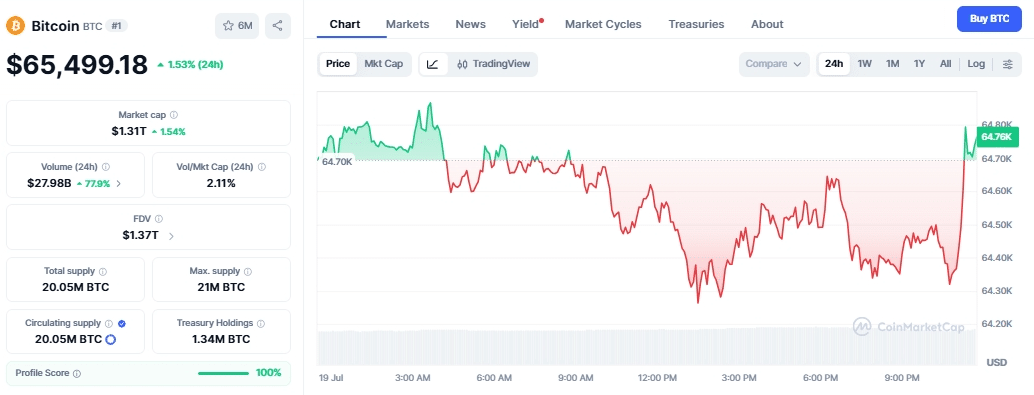
Bitcoin is currently trading at $65,499, up about 1.48% over the past 24 hours. However, its price remains down 44% over the past year and about 50% below its peak of $126,000, which it reached in October 2025.
The token did manage to break above $80,000 in May, but that move failed to hold. The rally also failed to bring back the strong upward momentum that many traders were looking for.
The problem is that Bitcoin needs buyers and fresh money to make a lasting move higher. When there is less capital available on exchanges, it becomes harder for buyers to create enough pressure to push the market out of a long trading range.
“Fresh demand is struggling to materialize,” Darkfost said.
Bitcoin needs new capital to break higher
It is important to note that stablecoin withdrawals do not automatically mean that investors are selling all their crypto holdings. Some may be moving their funds to private wallets for long-term storage. Others may be putting their money into different investments or simply reducing their exposure to the crypto market.
However, the continued decline still shows that fewer investors are keeping stablecoins ready for immediate crypto trades.
This is why stablecoin flows are often observed by traders. When large amounts of stablecoins move onto exchanges, it can show that investors are preparing to buy. When large amounts leave, it can point to weaker short-term demand and more cautious market positioning.
The combined outflow from two exchanges therefore gives a clear picture of the current challenge facing Bitcoin. The market is not only waiting for a price catalyst. It also needs fresh capital.
Until stablecoin reserves begin to recover, Bitcoin may continue to struggle to break decisively from its long consolidation range. For now, the money that could help fuel a stronger move higher is steadily leaving two of the crypto market’s biggest exchanges.
Also Read: IREN Stock Jumps 17% After Landing $2.8B AI Cloud Contracts