To the surprise of the whole crypto industry, Robinhood’s newly launched blockchain has become ground zero for a meme coin explosion. What was pitched as a platform for tokenized real-world assets (RWAs) and regulated financial products has instead seen its decentralized exchange (DEX) activity hijacked by retail-driven memes.
As of mid-July 2026, Robinhood-themed and Robinhood Chain-native tokens are flooding the top spots on Dexscreener, challenging Solana’s long-standing dominance in meme coin discovery and trading.
This shift highlights how quickly narrative and community momentum can override corporate intent in crypto. With Robinhood’s massive retail user base—tens of millions strong—pouring into on-chain activity, the platform’s blockchain has seen DEX volumes surge from modest six figures to hundreds of millions of dollars in under two weeks. The result? A wave of cat-, dog-, and folklore-themed tokens capturing trader attention and capital at unprecedented speed.
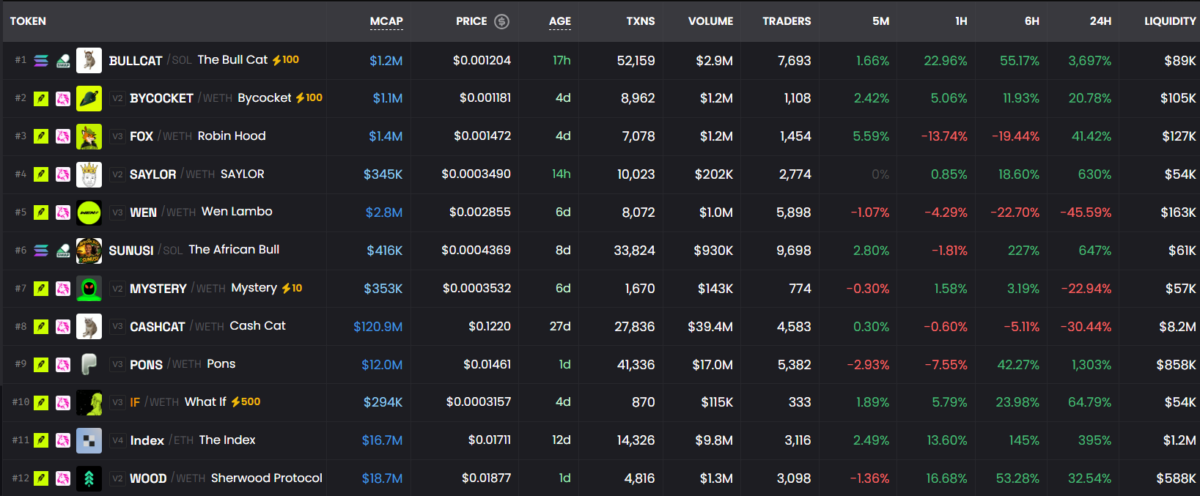
The current trending meme coins chart on Dexscreener shows 10 out of 12 meme coins being on Robinhood chain while only 2 remains of Solana.
The Explosive Launch of Robinhood Chain and the Meme Surge
Robinhood Chain went live on its public mainnet around July 1, 2026. Built with an eye toward tokenized stocks, lending, custody, and developer tools—leveraging technology compatible with ecosystems like Arbitrum—the chain aimed to bring regulated, real-world assets on-chain in a seamless way.
While early expectations focused on institutional-grade activity and bridging traditional finance with crypto, memecoins emerged as the dominant use case on the chain. Its DEX trading volume on the chain skyrocketed from roughly $200,000 shortly after launch to over $500 million within nine days.
Much of this activity came from speculative meme trading rather than RWAs, which accounted for only a fraction of the total value locked or transacted (around $12-13 million in one estimate).
Traders quickly migrated, drawn by low fees, fast execution, and the novelty of a major brokerage’s dedicated chain. Launchpads and trading bots tailored to the ecosystem, such as NOXA.fun, amplified the frenzy. Social media buzz, particularly on X, turned Robinhood Chain into a hot narrative.
By early July, Robinhood-themed tokens began appearing prominently in Dexscreener’s trending sections and new pairs lists. Names evoking the brokerage’s branding—Hoodrat, Dog In Hood, Robinhood Dog variants, and others—populated high-volume and high-trending spots alongside more established meme ecosystems.
This wasn’t just noise; multiple tokens saw explosive 6-hour or 24-hour gains, with traders rotating capital rapidly. The overall Robinhood Chain meme category reached market caps exceeding $200 million at peaks, underscoring the scale of retail participation.
The phenomenon echoes past cycles where retail platforms or familiar brands catalyze meme adoption—think Dogecoin’s early boosts or Solana’s meme summer. Here, Robinhood’s existing app users, already comfortable with fractional shares and easy crypto access, found a natural on-ramp to on-chain speculation.
$CASHCAT Emerges as the Flagship and Official Mascot
At the center of the storm sits $CASHCAT, a cat-themed token whose name directly references Robinhood’s original working title (“CashCat”) from its early days before the rebrand. The token’s rise has been meteoric: it reportedly turned modest investments into seven-figure gains for early buyers and climbed to market caps around $150-200 million at its peak, with 24-hour volumes frequently in the tens of millions.
Community momentum received a major catalyst when Robinhood CEO Vlad Tenev followed the project’s X account and publicly noted that while the chain was built for RWAs, “it works great for memes too.” This subtle endorsement supercharged activity, pushing daily volumes on the chain to spikes exceeding $500-560 million on key days.
Further solidifying its status, Robinhood later confirmed $CASHCAT as the company’s official mascot in public statements and took steps to distance itself from rival memecoins (such as deleting old LinkedIn associations with competing projects). This corporate nod transformed a grassroots meme into something with semi-official branding legitimacy, fueling even more FOMO and copycat launches.
On the broader Dexscreener platform, Robinhood/HOOD/CASHCAT-themed pairs have occupied multiple top-30 or trending slots at times, mixing with Solana and Ethereum tokens but carving out a distinct, high-visibility niche.
This isn’t isolated hype. CoinGecko tracks a dedicated “Robinhood Chain Meme” category with significant aggregate market cap and volume, while social sentiment trackers show sustained discussion around the meta’s staying power.
Robinhood Chain TVL and Volume Surge Since Launch
Since its mainnet launch on July 1, 2026, Robinhood Chain has experienced remarkable growth in Total Value Locked (TVL). According to DeFiLlama, the chain’s TVL now stands at approximately $178.89 million, reflecting an 11.87% increase in the last 24 hours and substantial gains over the past two weeks.
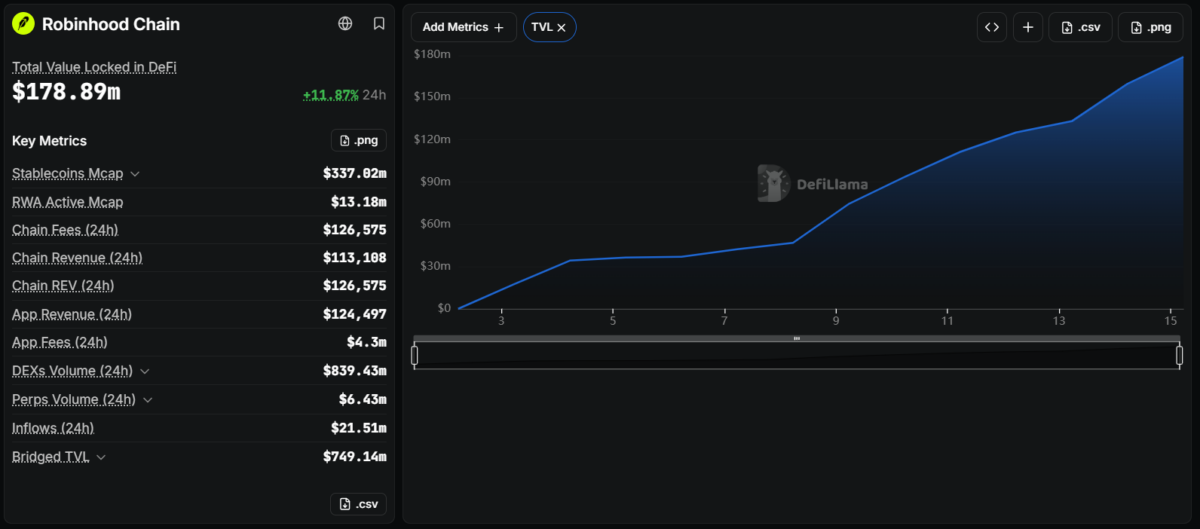
This rapid expansion has been driven largely by lending protocols like Morpho Blue, which holds over $105 million, alongside contributions from DEXs such as Uniswap. The chain has also attracted significant stablecoin inflows, with a market cap reaching $337.15 million (up 36.62% in 7 days), underscoring strong user interest in its tokenized RWAs and financial infrastructure.
Trading activity on Robinhood Chain has been even more explosive. 24-hour DEX volume recently hit around $687–839 million, with 7-day volume totaling $4.677 billion—a weekly surge exceeding 5,500%. Cumulative DEX volume since launch surpasses $5.5 billion, placing the chain among top performers despite its short history. This momentum is fueled by low fees, integration with Robinhood’s ecosystem, and hype around memecoins and perpetuals, demonstrating its quick emergence as a vibrant hub for on-chain trading.
Market Implications, Retail Appeal, and Inherent Risks
The Robinhood meme takeover carries broader implications for how retail investors interact with crypto. Robinhood, as a go-to stock and crypto trading platform, has long been a gateway for everyday traders—its app simplified access during previous bull runs.
By providing a native on-chain environment, the company inadvertently (or perhaps strategically) created a playground where its user base could experiment with high-risk, high-reward memes without leaving the familiar brand orbit.
This blurs lines between traditional brokerage services and decentralized speculation. While RWAs remain a long-term goal, the immediate liquidity and attention have gone to memes, proving once again that community-driven narratives often move faster and capture more capital than structured financial products in the short term.
Also read: Cathie Wood’s ARK Invest Buys 220K More Circle Shares as CRCL Selloff Deepens